

On this page
Reptiles were the first vertebrates to conquer dry land fully, leaving the water behind. To do this, they evolved a set of features that set them apart from amphibians, focusing on retaining water and reproducing in dry environments.
What are the features of reptiles?
The defining features of reptiles, as outlined in the NCERT Class 11 Biology syllabus, revolve around their creeping or crawling locomotion. Their bodies are covered by dry, cornified skin made of epidermal scales or scutes, which act as a waterproof barrier. They do not have external ear openings, relying instead on a tympanum to sense sound. Reptiles are poikilotherms, meaning they are cold-blooded and rely on the sun and their environment to regulate their body temperature. Finally, they are oviparous, laying shelled eggs after internal fertilisation.
Why do reptiles have dry scales?
Reptile skin is built from keratin, a tough protein that forms a watertight layer. Unlike amphibians, which must keep their skin moist to absorb oxygen, a reptile's scales lock water inside its body. This occlusive barrier prevents dehydration and protects them from rough terrain, allowing lizards and snakes to thrive in hot, dry deserts. Because this rigid layer does not grow with the animal, most reptiles must periodically shed their old skin in a process called molting.
How did leathery eggs change reproduction?
The amniotic egg was the biological breakthrough that allowed reptiles to lay eggs away from water. Rather than laying jelly-like eggs in a pond, reptiles produce eggs with a tough, leathery shell on land. Inside this shell, fluid-filled membranes—including the amnion, chorion and allantois—protect the embryo and manage its waste and oxygen.
Recent evidence suggests the path to this egg was gradual. A 2023 study by Baoyu Jiang and Michael Benton in *Nature Ecology & Evolution* challenged the traditional view by showing that the first amniotes may have practiced extended embryo retention. Instead of laying a hard-shelled egg immediately, early mothers kept the developing embryo inside their bodies to protect it, suggesting that the original safe environment for the embryo was the mother's body itself, not the eggshell.
The crocodile exception: how many heart chambers?
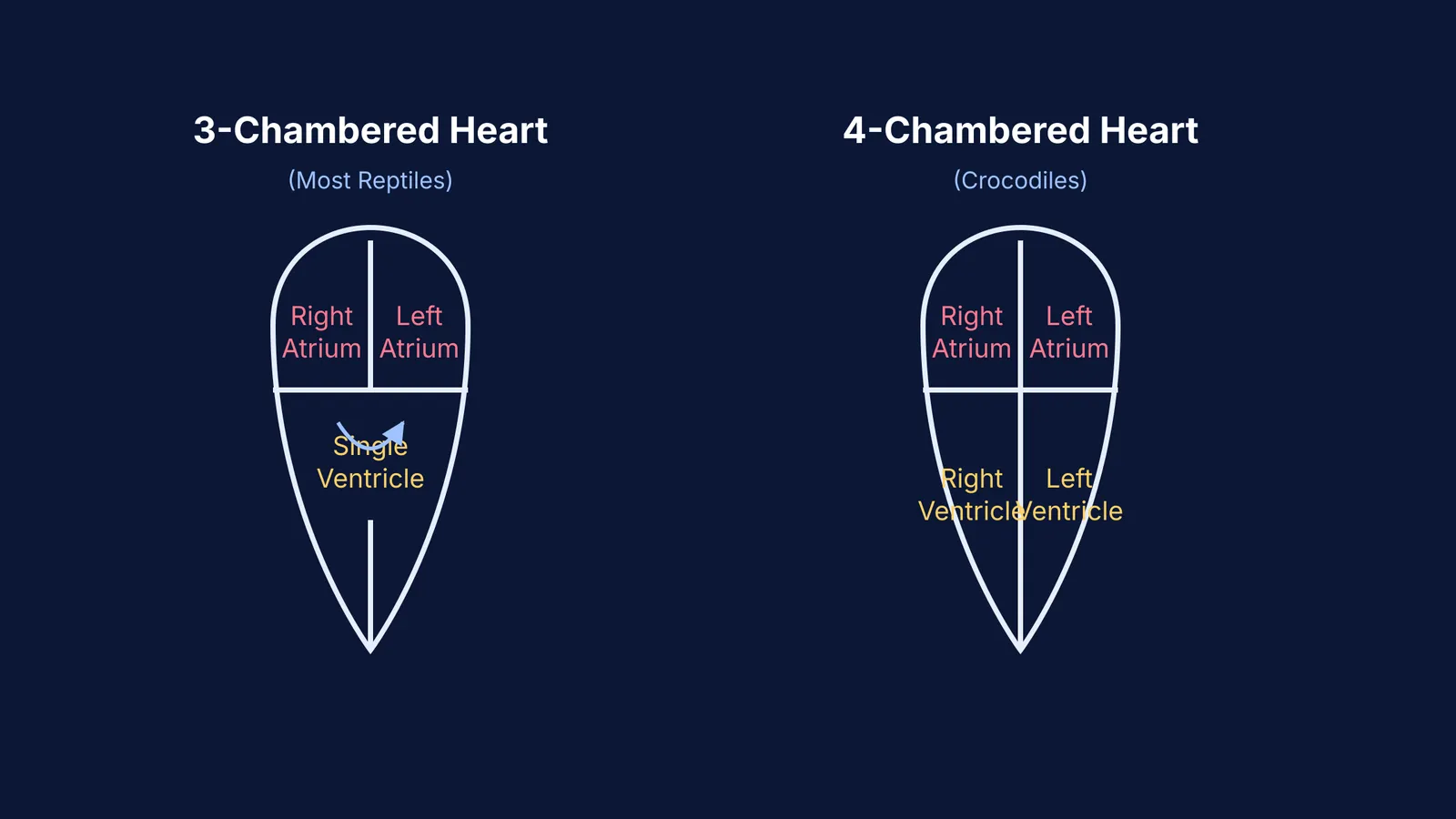
While most reptiles have a three-chambered heart, crocodiles are the exception. In a typical reptile heart, there are two atria and one partially divided ventricle where oxygenated and deoxygenated blood mix.
Crocodilians, however, have a fully separated four-chambered heart (two atria and two ventricles), much like birds and mammals. According to a 2009 study in *Nature*, this separation is driven by the *Tbx5* gene, which restricts its expression to build the wall between the two ventricles. Despite this advanced plumbing, crocodiles are still classified as reptiles because they remain cold-blooded and lay eggs.
NEET Revision Checklist: Class Reptilia
When revising the Animal Kingdom chapter, use this quick checklist to remember the core features:
Skin: Dry, cornified, with epidermal scales or scutes.
Heart: 3-chambered (two atria, one partially divided ventricle). Exception: Crocodile (4 chambers).
Temperature: Poikilotherms (cold-blooded).
Ear: No external opening; tympanum represents the ear.
Reproduction: Internal fertilisation, oviparous, direct development.
When you are reviewing animal classification for NEET, remembering exceptions like the crocodile's heart is a common hurdle. The Fermi Concept Library has every concept in biology, each with its own lesson and its place in the map. For complex concepts, you can also use the Fermi Simulation Lab to explore interactive simulations for the ideas that are easier to see than to read.
While learning about the reptilian circulatory system, you might also want to review the formed elements of blood that flow through it, or see how metabolic waste differs in ammonotelic, ureotelic and uricotelic animals. If you are looking at early classifications, read about viruses, viroids and lichens and why they are biological misfits.


