On this page
Multiply a positive vector by a matrix with all-positive entries again and again, and its direction settles on one fixed line. That line exists, is unique and has all-positive components. That is the Perron–Frobenius theorem, and it sits under Markov chains and PageRank.
What does the Perron–Frobenius theorem say about positive matrices?
Take a square matrix A whose entries are all strictly positive. Perron's theorem, as set out on the Wikipedia page for the Perron–Frobenius theorem, gives four guarantees:
There is a positive real eigenvalue r, called the Perron root.
Every other eigenvalue λ, real or complex, satisfies |λ| < r.
r is a simple root of the characteristic polynomial, so its direction is unique.
There is an eigenvector for r whose components are all positive.
Oskar Perron published the result for positive matrices in 1907 in Mathematische Annalen, volume 64. The same Wikipedia page records that results for non-negative matrices were first obtained by Frobenius in 1912.
Positivity matters. The matrix with rows (0, 1) and (1, 0) has eigenvalues 1 and −1, a tie in size. A 90° rotation matrix has no real eigenvalues at all.
How do you find the Perron root of a 2×2 matrix?
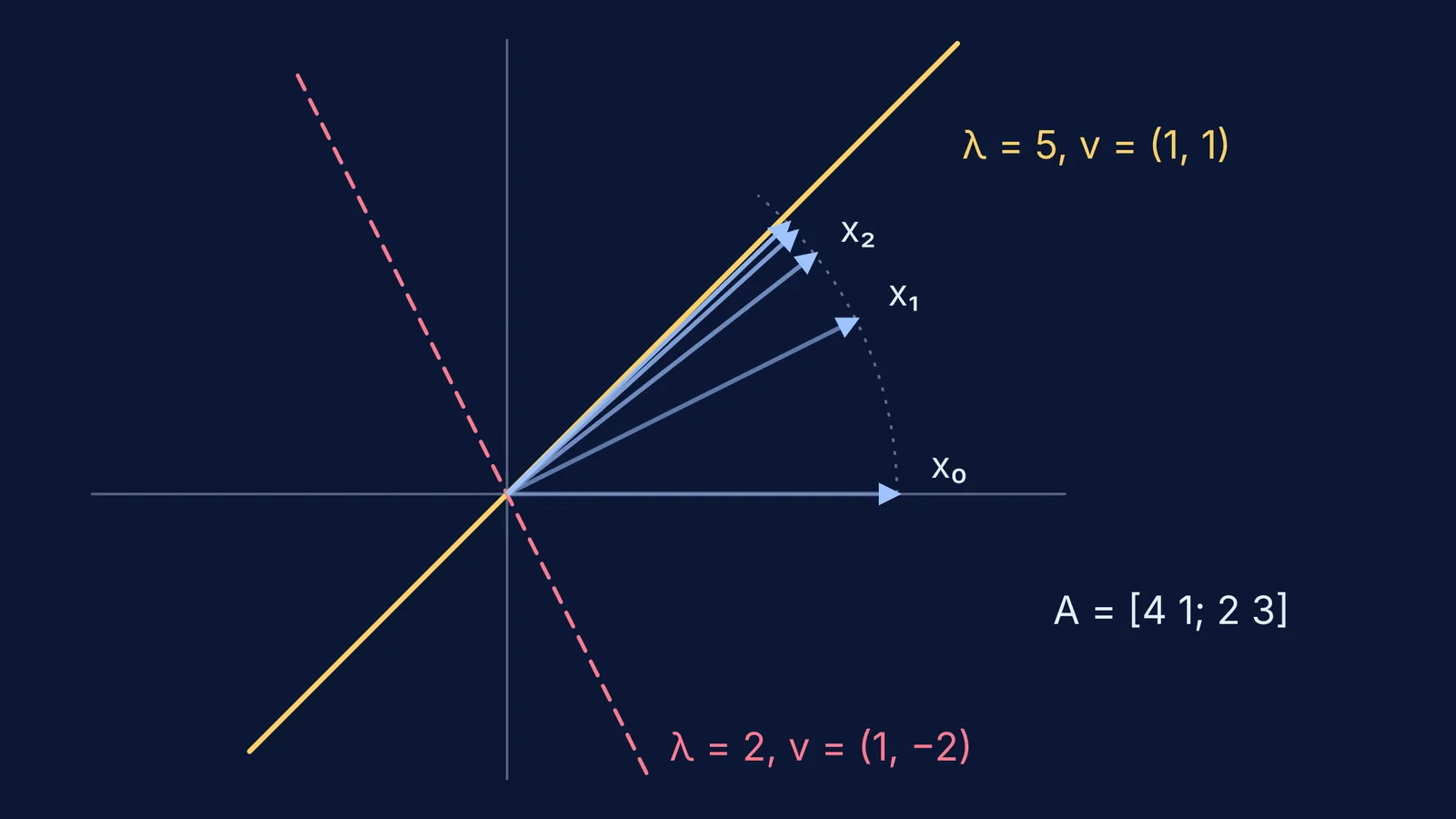
Let A have rows (4, 1) and (2, 3). Its trace is 7 and its determinant is 4·3 − 1·2 = 10, so the characteristic equation is λ² − 7λ + 10 = 0, with roots λ = 5 and λ = 2.
For λ = 5: (4 − 5)x + y = 0 gives y = x, so v = (1, 1). Every component is positive.
For λ = 2: 2x + y = 0 gives (1, −2). The signs are mixed.
As predicted: the Perron root 5 beats |2|, and only its eigenvector is all-positive. For the method step by step, see how to find the eigenvalues of a 2x2 matrix.
Why does power iteration converge to the Perron eigenvector?
Start from x₀ = (1, 0) and keep multiplying by A: (4, 2), (18, 14), (86, 78), (422, 406). The ratio of second to first component runs 0.5, 0.78, 0.91, 0.96, closing in on 1, the direction of (1, 1).
To see why, split the start along the eigenvectors: x₀ = (2/3)(1, 1) + (1/3)(1, −2). Then
Aᵏx₀ = (2/3)·5ᵏ·(1, 1) + (1/3)·2ᵏ·(1, −2).
The second part shrinks relative to the first by a factor of 2/5 each step: the gap between the ratio and 1 goes 0.5, 0.22, 0.093, 0.038. This matches the general rule on the Wikipedia page for power iteration: convergence is geometric with ratio |λ₂/λ₁|, and slow when a second eigenvalue is close in size to the first.
Perron–Frobenius supplies what the method needs: |λ₂| < r keeps the ratio below 1, and because the left eigenvector for r is also positive, any non-negative, non-zero start has a share of the Perron direction to grow. For why powers of a matrix behave this way, see finding large powers of a matrix by diagonalisation.
How does the theorem apply to Markov chains?
The Perron–Frobenius page lists the ergodicity of Markov chains among its important applications. Take a toy weather model: a dry day is followed by a dry day with probability 0.9, a rainy day by rain with probability 0.5. The transition matrix P has rows (0.9, 0.1) and (0.5, 0.5), all positive.
Each row sums to 1, so the Perron root is 1 and the other eigenvalue is trace − 1 = 0.4. The long-run distribution solves πP = π: 0.1·π(dry) = 0.5·π(rain), so π = (5/6, 1/6). Five days in six are dry in the long run, whatever today is, and the gap to that answer shrinks by a factor of 0.4 each day.
Where does PageRank come in?
Sergey Brin and Lawrence Page described PageRank in The anatomy of a large-scale hypertextual Web search engine, published in 1998 in Computer Networks and ISDN Systems. A surfer mostly follows a random link and sometimes jumps to a random page. The Wikipedia page on PageRank notes that the damping factor, the chance of following a link, is generally set around 0.85.
The random jump makes every entry of the modified link matrix positive, so Perron's theorem applies: one ranking vector, a positive score for every page. The same page calls PageRank values the entries of the dominant eigenvector, computed with the power method.
How to practise this idea
Take rows (5, 2) and (1, 4). Use the row sums to bound the Perron root.
Find both eigenvalues and check that only the larger one has a positive eigenvector.
Run three steps of power iteration from (1, 0) and check the gap shrinks by roughly |λ₂/λ₁| each step.
For symmetric matrices, where eigenvectors are orthogonal, read our walkthrough of the spectral theorem for symmetric matrices.
If eigenvalues still feel shaky, the Fermi Concept Library covers every concept in mathematics, each with its own lesson. For more practice, the Fermi Problem Library has worked problems with a step-by-step solver that explains the reasoning rather than printing an answer.