On this page
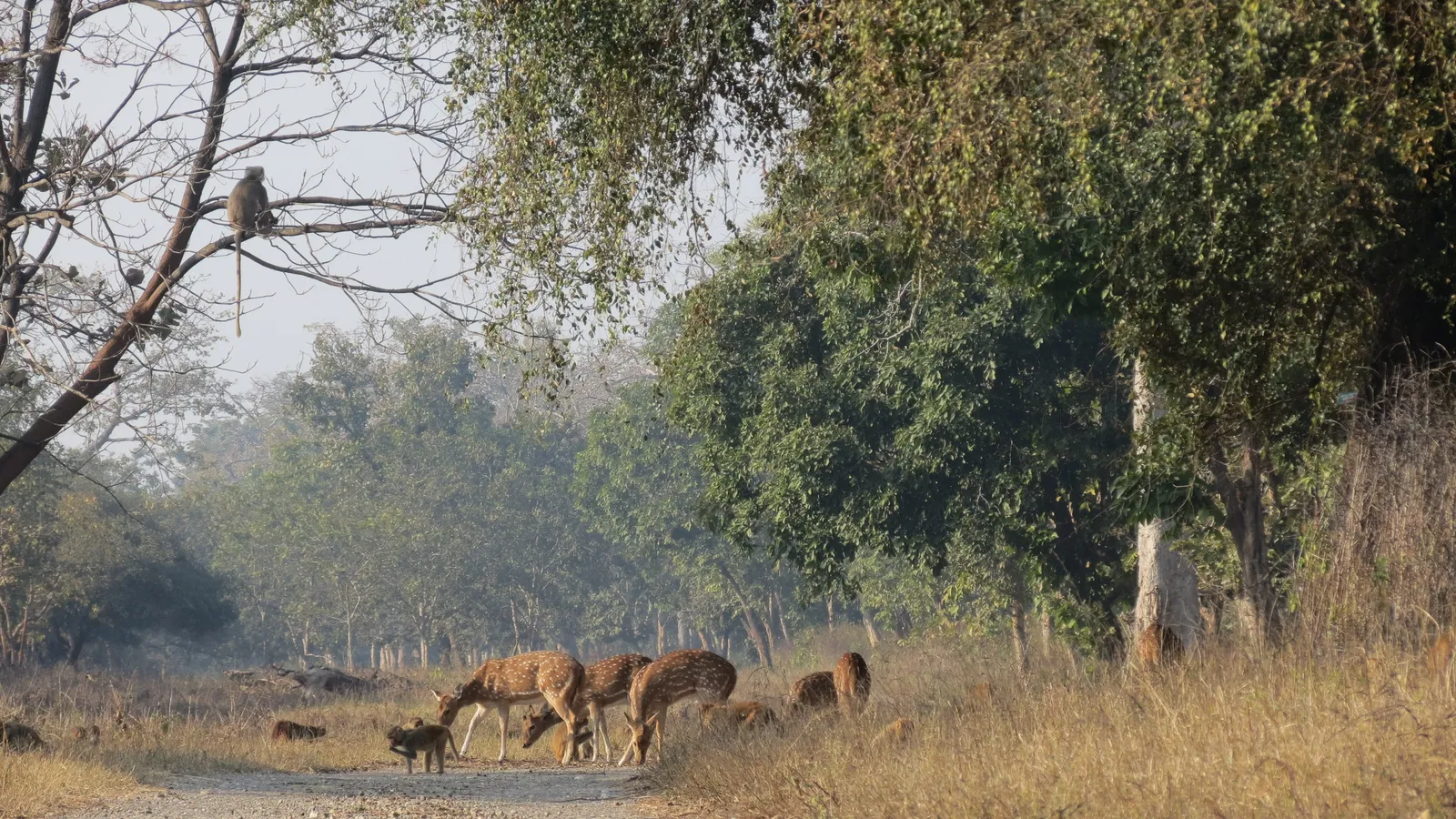
In Indian forests such as Kanha and Mudumalai, it is a familiar scene: grey langurs feeding high in a tree and a herd of chital (spotted deer) grazing right below. It looks like coincidence. Field studies say it is not. The deer come for food the monkeys drop, and both animals listen for each other's warnings.
Why do deer follow langurs in the forest?
The best-known study followed one langur troop in Kanha Tiger Reserve, Madhya Pradesh. Paul Newton found that the deer's close approaches were not chance encounters: 70.1% of chital herds seen within 200 m of the troop came within 25 m of it (Newton, Ethology, 1989).
The pull is food. Langurs are messy eaters. Newton's troop dropped a mean of 4.0 kg of fresh vegetation a day, and chital picked up this fallen food in 38.2% of their meetings with the monkeys (Newton 1989). The deer gleaned from 19 tree species, most often sal.
A survey by Wildlife Institute of India researchers in Mudumalai Tiger Reserve found the same habit in the Western Ghats (Ramesh and colleagues, Zoo's Print, 2012). In 48 of 74 recorded langur-chital associations, chital fed on food the langurs had dropped. Of the fallen items they ate, 73.1% were leaves, 17.3% fruit and 9.6% flowers. Chital live entirely on the ground, so a monkey feeding overhead is a free meal.
How do langurs and chital warn each other about tigers?
The second benefit is safety, and it works because the two animals sense the world differently.
Eyes up high. A langur in the canopy can see across grass and trails.
Nose on the ground. Chital are described as having a strong sense of smell that complements the langur's lookout (Wikipedia's chital entry).
Ears for both. Each species reacts to the other's alarm.
Newton recorded that chital and langurs responded to each other's alarm behaviour, and that chital were alerted by langur alarms more often than the reverse (Newton 1989).
Biologists call this eavesdropping. A review in Biological Reviews found that eavesdropping on other species' alarm calls has been shown experimentally in about 70 vertebrate species, and that it can give animals "more eyes looking for danger" (Magrath and colleagues, Biological Reviews, 2015).
Chital alarm calls are reliable enough that researchers are now listening too. In Nepal's Terai, a team tested a network of 10 sensors, run for 3 months, that detected chital alarm calls and built a heatmap of predator risk. High-risk alerts can go to forest rangers, who can then warn nearby villagers (Kershenbaum and colleagues, Remote Sensing in Ecology and Conservation, 2026).
Is the langur-chital relationship mutualism or commensalism?
Here the textbook picture gets more interesting. Newton concluded that chital-langur associations are "asymmetrical mutualisms": the deer clearly gain, but the benefit to langurs, if any, "was probably slight" (Newton 1989). Langurs may gain from chital alarms, but they also compete with the deer for food, and Newton saw antagonism in 5.8% of associations, mostly langurs towards chital.
The Mudumalai team saw langurs threaten deer to get back dropped food on five occasions, and judged the association "more likely to be a case of commensalism, or at least of asymmetrical mutualism" than pure mutualism (Ramesh et al. 2012).
How do you classify an interaction in a biology exam?
Use the sign method from organisms and populations in Class 12. Mark each partner + (gains), - (loses) or 0 (unaffected):
Mutualism: + and +
Commensalism: + and 0
Predation or parasitism: + and -
Competition: - and -
Amensalism: 0 and -
Worked example, langur and chital:
Chital: dropped food and early warnings. Mark +.
Langurs: some help from chital alarms, but lost food and energy spent chasing deer. Mark a small + or 0.
Decide: + and + with one side gaining far more is asymmetrical mutualism; if the langur gain is near zero, it is commensalism.
Write it with evidence: "Chital gain fallen food and respond to langur alarm calls; langurs gain little, so field studies describe the link as asymmetrical mutualism or commensalism."
Compare it with a more equal partnership, how cleaner fish and big fish help each other on a reef, and with the tiger's side of the story, why predators are important in nature.
If the five signs keep blurring together, the Fermi Concept Library gives each biology concept its own lesson and its place in the map. Fermi's AI tutor works through problems alongside you and checks your understanding as it goes, so you learn the method rather than one memorised answer.
Next time you see deer under a tree full of monkeys, look up. The langurs may well be why the deer are there.