

On this page
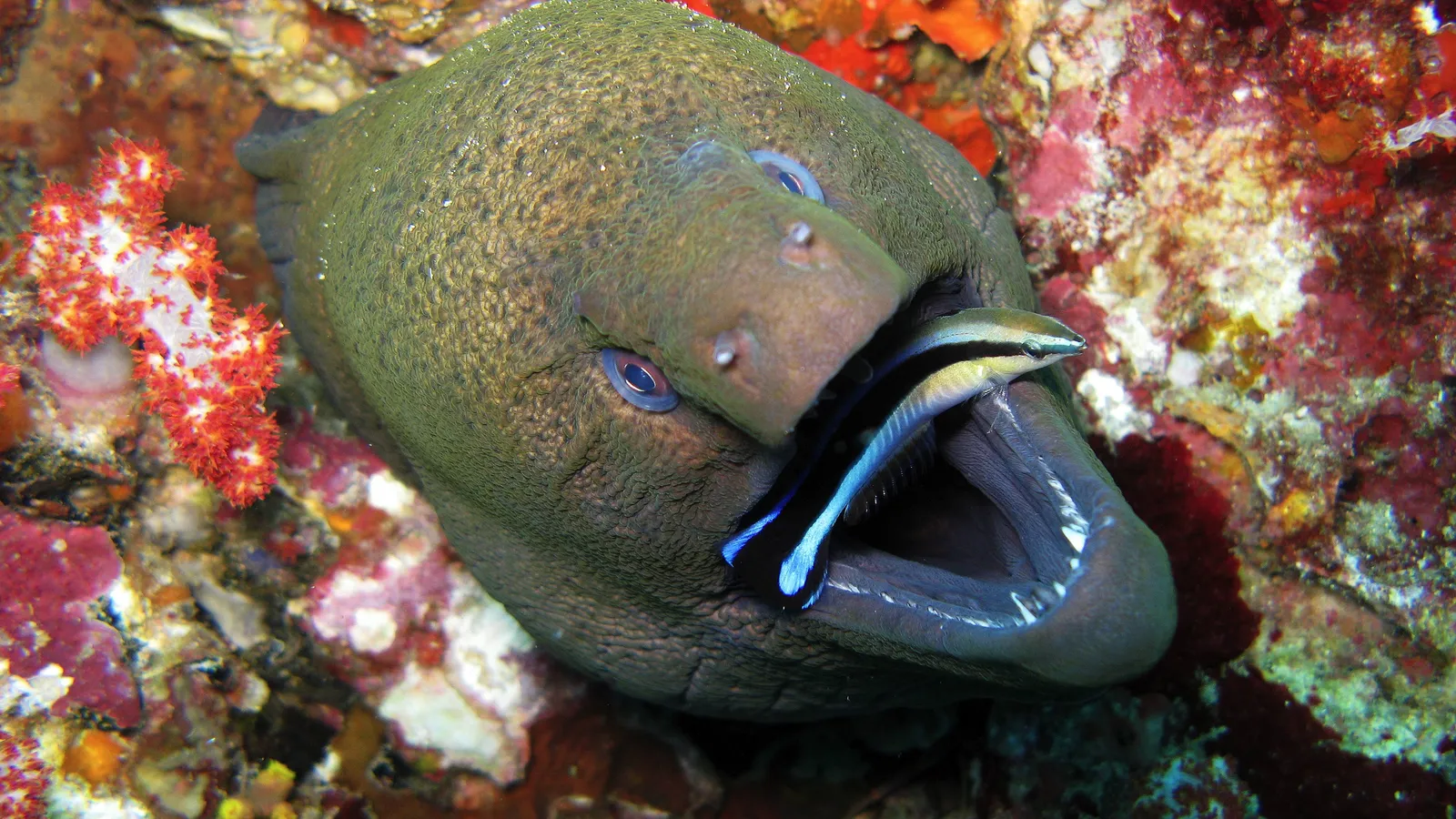
Picture a giant moray eel on a coral reef with its mouth wide open. A small striped fish swims in between its teeth, and swims out unharmed. That fish is the bluestreak cleaner wrasse, Labroides dimidiatus. It is not one of NCERT's named examples, but it fits NCERT's definition of mutualism exactly, which makes it a strong example for a Class 12 answer.
How do cleaner fish and big fish help each other?
NCERT's Class 12 Biology chapter Organisms and Populations defines mutualism as an interaction that "confers benefits on both the interacting species" (NCERT Biology, Chapter 11). Cleaning fits that definition on both sides:
The cleaner gets a meal: ectoparasites such as gnathiid isopods, small crustaceans that live on fish.
The client gets those parasites removed.
Does the cleaning really make a difference? Alexandra Grutter tested this with a client fish called Hemigymnus melapterus. Her 1999 study in Nature found that cleaners reduced parasite numbers, producing a 4.5-fold difference within 12 hours (Grutter 1999, Nature).
A 2011 paper, citing earlier fieldwork, reports that one cleaner eats an average of 1,218 parasites a day and inspects an average of 2,297 clients a day (Waldie et al. 2011, PLoS ONE). Some individual clients are cleaned up to 144 times a day, and cleaners often stay at fixed spots called cleaning stations, where clients come to them.
Why don't big fish eat the cleaner fish?
One explanation is that a cleaner is worth more to clients alive than as one mouthful. The evidence comes from removing them. In an experiment that ran for 8.5 years, researchers removed cleaner wrasse from some small patch reefs and compared them with reefs that kept their cleaners (Waldie et al. 2011, PLoS ONE):
Resident fish were 37% less abundant and 23% less species-rich per reef without cleaners.
Visiting fish were 23% less abundant and 33% less species-rich.
Visiting herbivores (surgeonfishes) were 66% less abundant.
So cleaners matter well beyond the fish they happen to clean.
Why do cheating cleaner fish get punished?
The twist: cleaners would rather not eat only parasites. When Grutter and Redouan Bshary offered cleaners food on plates, they ate more client mucus and monogenean flatworms than gnathiid isopods, even though gnathiids are the most abundant parasites (Grutter and Bshary 2003, Proc. R. Soc. B). Biting off mucus is cheating: the cleaner gains and the client pays.
Clients have three ways to push back:
Punish or leave. Field observations suggest clients chase cheating cleaners or swim away from them. In a lab test, eating the preferred prawn made the food plate chase the cleaner or move away; after six learning trials, cleaners shifted towards the fish flakes they liked less (Bshary and Grutter 2005, Biology Letters).
Watch. Bystander clients spent more time next to cleaners they had seen cooperating than next to unknown cleaners.
Reward a good reputation. Trained cleaners learned to feed more cooperatively when bystanders could watch (Bshary and Grutter 2006, Nature).
Cleaners even police each other. In lab tests with model clients, a male cleaner punished his female partner when she cheated, which made her more cooperative and gave him more food (Raihani, Grutter and Bshary 2010, Science).
NCERT makes the same point about plants and their animal partners: a mutually beneficial system "should also be safeguarded against 'cheaters'" (NCERT Biology, Chapter 11). Compare it with the fig and wasp mutualism, and with the prisoner's dilemma and Tit for Tat, where cooperation lasts only when cheating costs something.
Is it mutualism, commensalism or parasitism?
The reef gives you a trap. NCERT lists the clown fish living among sea anemone tentacles as commensalism, because "the anemone does not appear to derive any benefit" (NCERT Biology, Chapter 11). Use this three-question test on any pair:
Does species A gain (+)?
Does species B gain (+), lose (-) or stay unaffected (0)?
Read the signs: +/+ is mutualism, +/0 is commensalism, +/- is parasitism or predation.
Worked through for the reef:
Cleaner wrasse and client fish: +/+, so mutualism.
Clown fish and sea anemone: +/0 as NCERT describes it, so commensalism.
Gnathiid isopod and client fish: +/-, so parasitism. The isopod is an ectoparasite, like the ectoparasitic copepods NCERT mentions on marine fish.
A cleaner biting off mucus: +/- in that moment, which is why clients punish it.
A model three-mark answer you can adapt:
"Cleaner wrasse and large reef fish show mutualism. The cleaner feeds on ectoparasites on the client's body and so gets food; the client is freed of parasites. Both benefit (+/+). Clients chase off cleaners that bite their mucus instead, which keeps the relationship beneficial to both."
For more pairs to sort, see these commensalism examples from NCERT.
If these interactions still blur together, the Fermi Concept Library gives every concept in biology its own lesson and its place in the map. To practise, the Fermi Problem Library has worked problems with a step-by-step solver that explains the reasoning rather than printing an answer.
Next time you see a reef photo, find the small striped fish near a big mouth, and ask the three questions.


