On this page
Nakayama's lemma is the tool commutative algebra reaches for whenever it needs to pass from "true modulo an ideal" to "true on the nose". You meet it early in a course on rings and modules, and it keeps coming back.
What does Nakayama's lemma say?
Let R be a commutative ring, I an ideal and M an R-module. In the form given by the Stacks Project, Lemma 10.20.1: if M is finitely generated, IM = M and I lies in the Jacobson radical of R, then M = 0.
The Jacobson radical is the intersection of all maximal ideals. A local ring has one maximal ideal 𝔪, so there the lemma reads: if 𝔪M = M and M is finitely generated, then M = 0.
The name honours Tadasi Nakayama, whose note A Remark on Finitely Generated Modules appeared in the Nagoya Mathematical Journal in 1951; it generalises a theorem of Goro Azumaya. The Wikipedia article on the lemma notes that Wolfgang Krull found the special case for ideals first, and that Nakayama was said to dislike the name.
How does the determinant trick prove it?
Start with one generator. If M = Rx and IM = M, then x = ax for some a in I, so (1 − a)x = 0. Every element of 1 + (Jacobson radical) is a unit (Stacks Project, Lemma 10.19.1), so x = 0.
With generators y₁, …, yₙ the same move becomes linear algebra:
Since IM = M, write yᵢ = Σⱼ aᵢⱼyⱼ with every aᵢⱼ in I.
In matrix form, (1 − A)y = 0, where A = (aᵢⱼ).
Multiply by the adjugate of 1 − A. As adj(B)·B = det(B)·1, you get det(1 − A)·yⱼ = 0 for every j.
Expand: d = det(1 − A) is 1 plus an element of I, since every other term contains an entry of A.
So dM = 0, and d is a unit, so M = 0.
This is the Stacks Project proof; Wikipedia says the determinant argument was popularised by Atiyah and Macdonald's 1969 textbook. Steps 1 to 4 never used the radical, so they prove more: some r ≡ 1 (mod I) satisfies rM = 0.
What does it say about generators over a local ring?
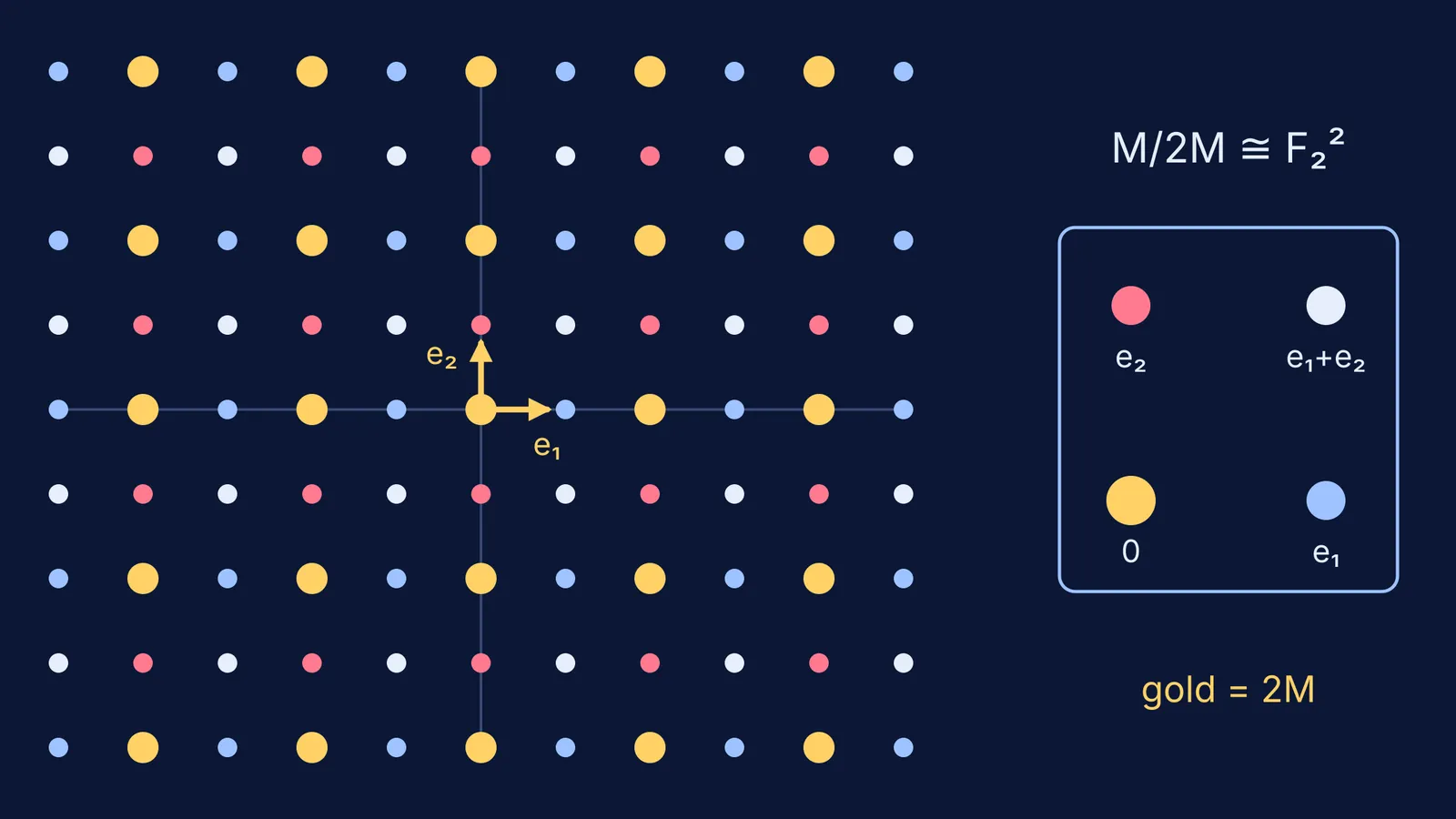
Let (R, 𝔪) be local with residue field k = R/𝔪 and M finitely generated. Then M/𝔪M is a finite-dimensional k-vector space, and, as the Wikipedia article puts it, a basis of M/𝔪M lifts to a minimal set of generators of M. In practice:
Elements x₁, …, xₙ generate M if and only if their images span M/𝔪M.
Every minimal generating set of M has exactly dim M/𝔪M elements.
Why: let N be the submodule the xᵢ generate. If their images span, M = N + 𝔪M, so 𝔪(M/N) = M/N, and Nakayama gives M = N. A spanning set is minimal exactly when it is a basis.
The pattern is "solve over the field, then lift", the same instinct as Hensel's lemma, lifting x² ≡ 2 from mod 7 to mod 343.
Worked example: when do two vectors generate ℤ₍ₚ₎²?
The ring ℤ₍ₚ₎ is the set of fractions a/b with b not divisible by p. Its only maximal ideal is pℤ₍ₚ₎ and its residue field is 𝔽ₚ; if measuring numbers by divisibility by p is new, see what p-adic numbers are. Take M = ℤ₍ₚ₎², so M/pM ≅ 𝔽ₚ² and minimal generating sets have two elements.
Test u = (1, 2) and v = (3, 1).
The determinant with rows u and v is 1·1 − 2·3 = −5.
For p = 7: −5 is not 0 mod 7, so the images form a basis of 𝔽₇². By Nakayama, u and v generate ℤ₍₇₎².
For p = 5: −5 is 0 mod 5, and v ≡ 3u (mod 5). The images span only a line, so u and v do not generate ℤ₍₅₎².
Check step 2 by hand: (1, 0) = −(1/5)u + (2/5)v and (0, 1) = (3/5)u − (1/5)v. Denominator 5 is allowed in ℤ₍₇₎ and forbidden in ℤ₍₅₎.
Why does M have to be finitely generated?
Take ℚ as a ℤ₍ₚ₎-module. Every rational q equals p·(q/p), so pℚ = ℚ, and pℤ₍ₚ₎ is the Jacobson radical. Yet ℚ is not 0, because ℚ is not finitely generated over ℤ₍ₚ₎.
To see that, take finitely many fractions and let pᴺ be the largest power of p in their denominators. Everything they generate lies in (1/pᴺ)ℤ₍ₚ₎, which misses 1/pᴺ⁺¹. In the proof, step 1 breaks: infinitely many generators give no square matrix and no determinant.
Self-test: redo the example with u = (2, 1) and v = (1, 3), and find the one prime p where they fail to generate. If the adjugate step or localisation feels shaky, the Fermi Concept Library has a lesson for every concept in mathematics, each with its place in the map.