On this page
You learned early that 1,000 is bigger than 1. p-adic numbers turn that around: pick a prime p, and call a number small when a large power of p divides it. With p = 5, 1,000 = 5³ × 8 is small, and 1 is not small at all. This one change of ruler builds a whole new number system, and you can follow it with Class 11 algebra and some modular arithmetic.
What are p-adic numbers?
The MathWorld entry on p-adic numbers gives the recipe. Write any nonzero rational x as p^a × r/s, where neither r nor s is divisible by p. The p-adic absolute value is |x|_p = p^(−a), and |0|_p = 0.
Three examples with p = 5:
|1000|_5 = 5^(−3) = 1/125, because 1000 = 5³ × 8.
|7|_5 = 1, because 5 does not divide 7.
|2/25|_5 = 25, because dividing by 25 makes a number 5-adically large.
The distance between x and y is |x − y|_p, so two whole numbers are close when they agree in their last several base-p digits. Filling in the gaps of the rationals under this distance, as the reals do under the usual one (see our post on Cauchy sequences and the ε–N idea), gives the field Q_p of p-adic numbers. MathWorld says Kurt Hensel probably introduced them in 1897, and the Wikipedia article on p-adic numbers gives the same year.
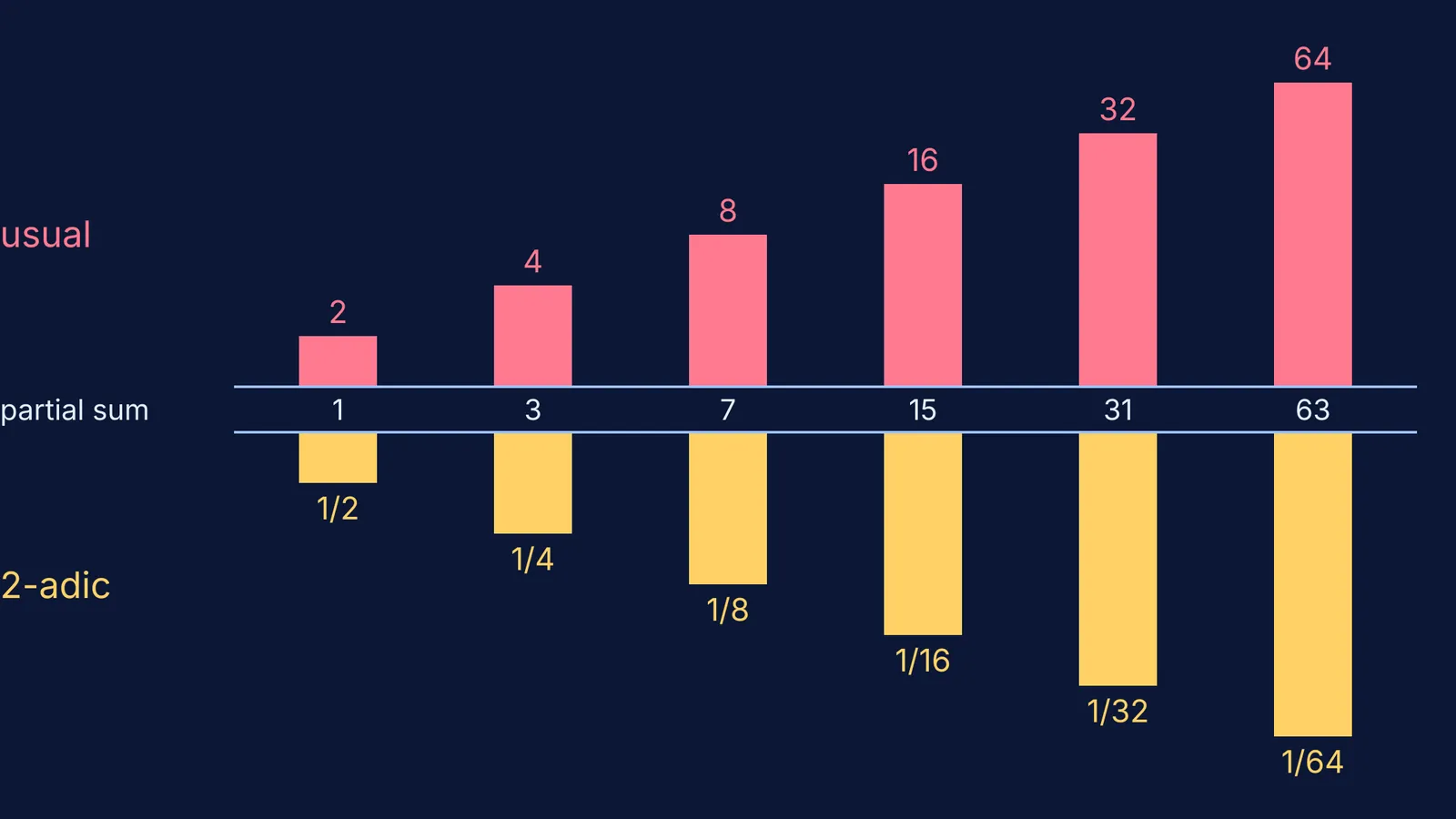
Why does 1 + 2 + 4 + 8 + … equal −1 in the 2-adics?
In the usual sense the partial sums 1, 3, 7, 15, 31 run off to infinity. Now measure with p = 2. After n terms the partial sum is 2^n − 1, so its gap from −1 is exactly 2^n, whose 2-adic size is 1/2^n. The gap halves at every step, so the series converges to −1. The Wikipedia article on this series states the same result: as a series of 2-adic numbers it converges to −1.
In binary, −1 is …1111, ones forever: add 1 and every column carries, leaving 0. Compare Grandi's series 1 − 1 + 1 − 1 + …, where averaging gives 1/2. There the method of summing changes; here the ruler does.
How do you write −1 and 1/3 in base 5?
A 5-adic number is a string of base-5 digits that may go on forever to the left. The method: choose the last digit so the remainder is divisible by 5, subtract it, divide by 5, and repeat.
For −1:
The last digit d needs d ≡ −1 (mod 5), so d = 4. Then (−1 − 4)/5 = −1.
You are back at −1, so every digit is 4.
So −1 = …4444 in base 5. Check: 4 + 4×5 + 4×25 + … is a geometric series with ratio 5, and |5|_5 = 1/5 is less than 1, so the sum is 4/(1 − 5) = −1.
For 1/3:
Need 3d ≡ 1 (mod 5), so d = 2. Then (1/3 − 2)/5 = −1/3.
Need 3d ≡ −1 ≡ 4 (mod 5), so d = 3. Then (−1/3 − 3)/5 = −2/3.
Need 3d ≡ −2 ≡ 3 (mod 5), so d = 1. Then (−2/3 − 1)/5 = −1/3.
You are back at −1/3, so the digits 3, 1 repeat for ever.
So 1/3 = …1313132 in base 5. Check five digits: 13132 in base 5 is 1042, and 3 × 1042 = 3126 = 5⁵ + 1, an error of 5-adic size 1/3125. Try 1/2 yourself; you should get …2223.
What is the strong triangle inequality?
The p-adic absolute value satisfies |x + y|_p ≤ max(|x|_p, |y|_p), which the Wikipedia article on p-adic numbers calls the strong triangle inequality. Why, for whole numbers: if p^a divides x and p^b divides y, the smaller power divides x + y. The article adds that when |x|_p ≠ |y|_p, |x + y|_p equals the larger. Two consequences:
Every triangle is isosceles: the two longest sides are equal.
A series converges exactly when its terms shrink to 0, which fails for the reals (think of 1 + 1/2 + 1/3 + …), where even rearranging a series can change its sum.
What does Ostrowski's theorem say?
In one line: every nontrivial absolute value on the rationals is a power of the ordinary one or of a p-adic one. Keith Conrad's notes on Ostrowski's theorem state it as Ostrowski's theorem of 1916 and conclude that every completion of Q under a nontrivial absolute value is either R or some Q_p. The real numbers are one ruler among many, one more for each prime.
Most p-adic steps use two school tools: solving a congruence mod p and summing a geometric series. The Fermi Concept Library explains concepts across mathematics, physics, chemistry, biology and computing, so you can revisit modular arithmetic or geometric series before trying the base-5 expansion of 1/7.