On this page
A case study question turns a paragraph about money, food or data into an inequality you write, solve and explain. The three below are original and stay in one variable, as the current CBSE Class 11 syllabus does.
What do linear inequalities case study questions test in Class 11?
The CBSE Mathematics syllabus for 2025-26 lists the chapter as algebraic solutions of linear inequalities in one variable and their representation on the number line. Graphs of inequalities in two variables are assessed only formatively, without adding to summative assessments, so they stay out of the year-end paper. Algebra carries 25 of the 80 theory marks, and the question paper design gives 20 marks to applying and 16 to analysing, evaluating and creating.
One rule costs the most marks. NCERT's Class 11 chapter on linear inequalities states it: when both sides are multiplied or divided by a negative number, the sign of inequality is reversed.
Case study 1: How many keychains fit Riya's trip budget?
Riya has ₹1,500 for a school trip. The bus costs ₹420, and she keeps at least ₹300 for emergencies. Keychains cost ₹60 each. Let x be the number she buys.
(1 mark) Write the inequality for her spending.
(1 mark) Find the most keychains she can buy.
(1 mark) She wants at least 5. List the possible values of x.
(2 marks) The price rises to ₹75. Solve again and show it on a number line.
Answers and marking points
420 + 60x ≤ 1500 − 300, so 420 + 60x ≤ 1200. Use ≤, because spending exactly ₹1,200 is allowed. (1 mark)
60x ≤ 780, so x ≤ 13. (½ for simplifying, ½ for 13)
5 ≤ x ≤ 13, x whole: {5, 6, ..., 13}. (1 mark; lose ½ for the real interval [5, 13])
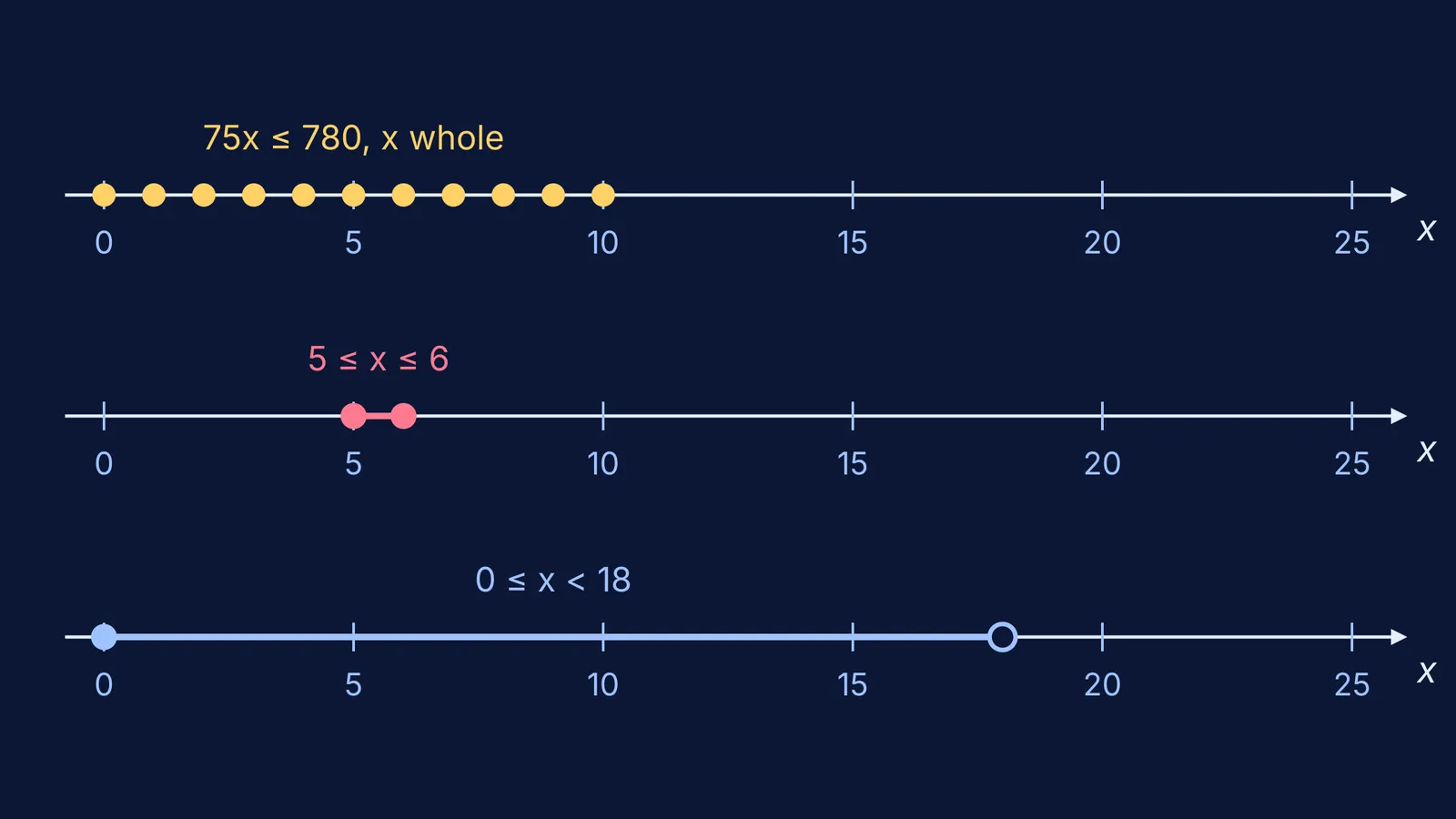
75x ≤ 780 gives x ≤ 10.4, so x ≤ 10. Mark filled dots at 0, 1, ..., 10 only. (1 for x ≤ 10.4, 1 for rounding down and the dots) A shaded line would claim she can buy 3.5 keychains.
Case study 2: How much of each flour meets a protein target?
A hostel cook mixes 10 kg of atta from two flours. Flour A has 120 g of protein per kg and costs ₹60 per kg; flour B has 80 g per kg and costs ₹40 per kg. The mix needs at least 1,000 g of protein and may cost at most ₹520. Let x kg be flour A, so 10 − x kg is flour B. (Figures made up for practice.)
(1 mark) Write the protein in the mix in terms of x.
(1 mark) Solve the protein condition.
(1 mark) Solve the cost condition.
(2 marks) Find the range for flour B. Would 4 kg of flour A work?
Answers and marking points
120x + 80(10 − x) = 800 + 40x grams. (1 mark)
800 + 40x ≥ 1000, so x ≥ 5. (1 mark)
60x + 40(10 − x) ≤ 520 gives 20x ≤ 120, so x ≤ 6. (1 mark)
So 5 ≤ x ≤ 6. Multiply by −1 and flip: −6 ≤ −x ≤ −5. Add 10: 4 ≤ 10 − x ≤ 5 kg. (1 mark, flip shown) With 4 kg of A, protein is 960 g, below 1,000 g, so no. (1 mark)
Case study 3: When is a pay-per-GB phone plan cheaper?
Arjun compares three monthly plans (made-up prices). Plan A: ₹150 plus ₹10 per GB. Plan B: ₹350 flat. Plan C: ₹60 plus ₹15 per GB. Let x be his monthly use in GB, x ≥ 0.
(1 mark) Write the monthly cost of Plan A.
(1 mark) When is Plan A cheaper than Plan B?
(1 mark) Arjun uses 18 to 25 GB. Where in that range is Plan B cheaper than A?
(2 marks) When is Plan C cheaper than both A and B?
Answers and marking points
₹(150 + 10x). (1 mark)
150 + 10x < 350, so 0 ≤ x < 20. Strict, because at 20 GB both cost ₹350. (1 mark)
B is cheaper when x > 20, so 20 < x ≤ 25. (½ for x > 20, ½ for using his range)
C below A: 60 + 15x < 150 + 10x, so x < 18. C below B: 60 + 15x < 350, so x < 19.33. Both: 0 ≤ x < 18, open circle at 18. (½ for each, 1 for combining)
How should you practise case study questions?
Name the variable and its unit first.
Translate the words: at least is ≥, at most is ≤, cheaper than is strict <.
Ask whether x can be a fraction. Keychains cannot; kilograms can.
Write the sign flip as its own line.
Test one value inside and one outside your answer in the story.
When your answer and the key disagree, the Fermi Problem Library has a step-by-step solver that explains the reasoning, so you can find the line where your working went off.
For interval notation, practise with these Sets case study questions for Class 11. The two-variable version of these budget and diet problems returns in Linear programming case study questions for CBSE Class 12.