

On this page
For the method and answer layout, see our linear programming Class 12 board exam guide.
What do case-study questions on linear programming look like?
The CBSE 2026-27 Mathematics sample paper has three case study-based questions of 4 marks each, in Section E, and calculators are not allowed. None is on this unit, but any chapter can appear, so every number below works by hand. The CBSE 2026-27 Mathematics curriculum gives Linear Programming 05 of 80 marks: the graphical method, with up to three non-trivial constraints. Every idea is in the NCERT Linear Programming chapter.
Case 1: The tiffin service
Sunita runs a home tiffin service in Indore. She cooks two kinds of thali: veg (₹30 profit each) and paneer (₹50 profit each). Her delivery partner can carry at most 40 thalis a day. A veg thali takes 10 minutes of kitchen time and a paneer thali 20 minutes, and she has 600 minutes of kitchen time a day. Let x be the number of veg thalis and y the number of paneer thalis she makes each day. She wants the most profit.
(i) The kitchen-time constraint is: (a) 10x + 20y ≥ 600 (b) 10x + 20y ≤ 600 (c) 20x + 10y ≤ 600 (d) x + y ≤ 600
(ii) Can she make 30 veg and 15 paneer thalis in a day? Give a reason.
(iii) Find the corner points of the feasible region.
(iv) Find the plan that gives the maximum daily profit, and that profit.
Answers.
(i) (b). Minutes used cannot exceed 600; this simplifies to x + 2y ≤ 60.
(ii) No. Kitchen time fits (300 + 300 = 600 minutes), but 45 thalis exceed the delivery limit of 40.
(iii) Solving x + y = 40 with x + 2y = 60 gives y = 20, x = 20. The corners are (0, 0), (40, 0), (20, 20) and (0, 30).
(iv) Z = 30x + 50y gives 0, 1200, 1600 and 1500 at those corners. The region is bounded, so the maximum is ₹1,600 a day from 20 of each.
Case 2: The paint shop's mix
A paint shop in Surat mixes two base paints for a large order. Each litre of paint P costs ₹150 and gives 2 units of pigment and 1 unit of binder. Each litre of paint Q costs ₹120 and gives 1 unit of pigment and 2 units of binder. The batch needs at least 12 units of pigment and at least 12 units of binder. Let x litres of P and y litres of Q be used. The owner wants the cheapest mix.
(i) The feasible region of this problem is: (a) bounded (b) unbounded (c) empty (d) a single point
(ii) Write the linear programming problem.
(iii) Find the cheapest mix and its cost, and justify that it is the minimum.
(iv) A supplier cuts the price of Q to ₹75 a litre. Find the new minimum cost and every mix that achieves it.
Answers.
(i) (b). Both constraints are "at least", so the region extends without end.
(ii) Minimise Z = 150x + 120y subject to 2x + y ≥ 12, x + 2y ≥ 12, x ≥ 0, y ≥ 0.
(iii) Corners (0, 12), (4, 4) and (12, 0) give Z = 1440, 1080 and 1800. Unbounded region, so check the open half plane 150x + 120y < 1080, that is 5x + 4y < 36. On the region, 5x + 4y = 2(2x + y) + (x + 2y) ≥ 24 + 12 = 36, so they share no point. Minimum: ₹1,080, with 4 litres of each.
(iv) Now Z = 150x + 75y = 75(2x + y) ≥ 75 × 12 = 900. Corners give 900, 900, 1800: the minimum ₹900 occurs at (0, 12), (4, 4) and every point between them.
Case 3: The block-printing unit
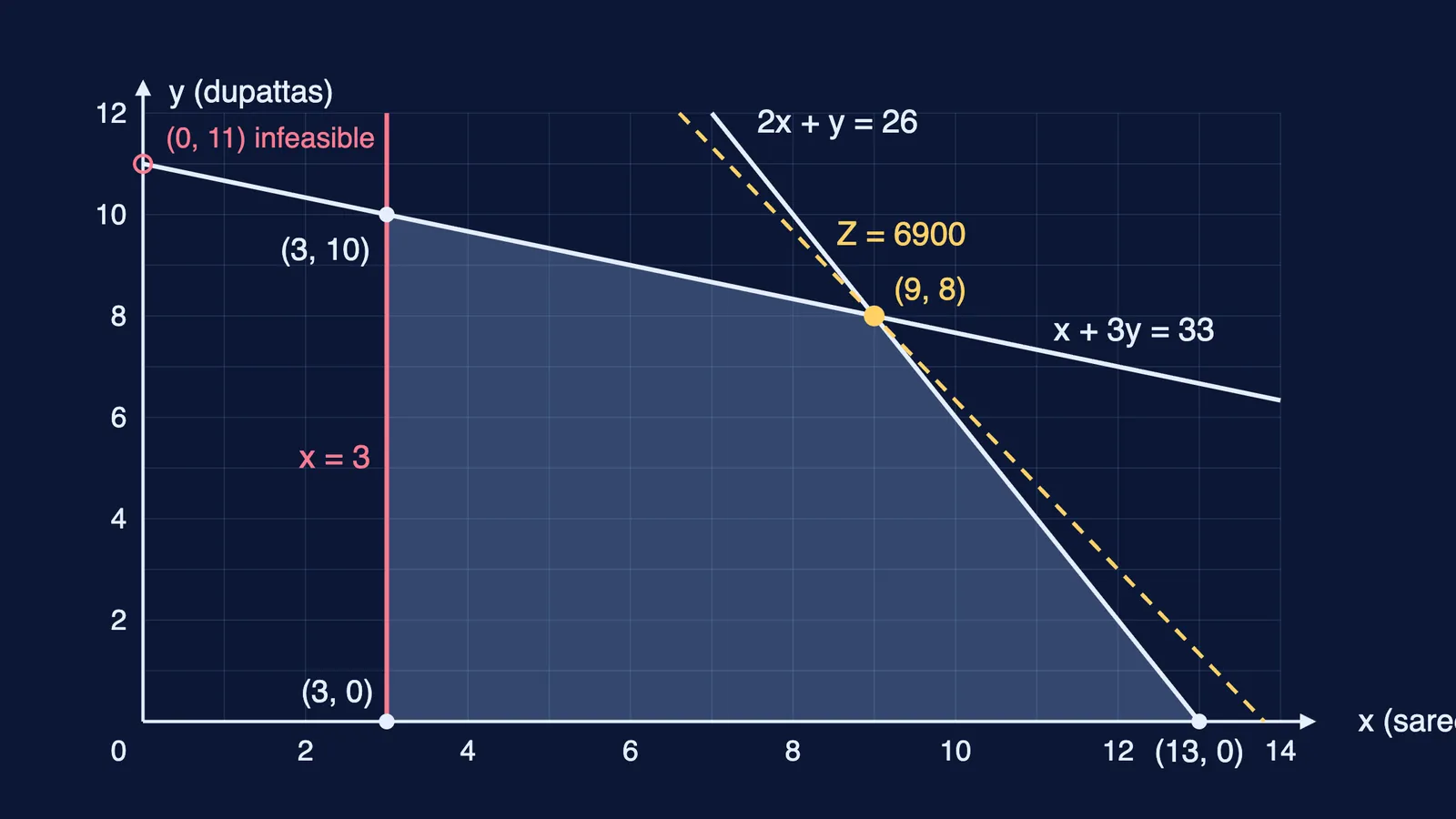
A block-printing unit in Ahmedabad makes sarees and dupattas. A saree needs 2 hours on the printing tables and a dupatta 1 hour; 26 table-hours are available each day. A saree takes 1 unit of drying-rack space and a dupatta 3 units; there are 33 units. A Mumbai shop has ordered at least 3 sarees every day, so the unit cannot drop sarees. Profit is ₹500 on a saree and ₹300 on a dupatta. Let x sarees and y dupattas be made each day.
(i) Which of these is NOT a corner point of the feasible region? (a) (3, 0) (b) (13, 0) (c) (0, 11) (d) (3, 10)
(ii) Find the corner where the printing and drying limits meet.
(iii) Find the maximum daily profit and the plan that gives it.
(iv) Keeping ₹300 a dupatta, for which saree profits p does the plan in (iii) stay the best? What happens above that range?
Answers.
(i) (c). (0, 11) is on the drying line but breaks the order constraint x ≥ 3.
(ii) Solve 2x + y = 26 and x + 3y = 33: 3 × (first) − (second) gives 5x = 45, so x = 9 and y = 8.
(iii) Corners (3, 0), (13, 0), (9, 8), (3, 10) give Z = 1500, 6500, 6900, 4500. Maximum ₹6,900 from 9 sarees and 8 dupattas, using every table-hour and rack unit.
(iv) (9, 8) gives 9p + 2400, which must be at least 13p at (13, 0) and 3p + 3000 at (3, 10), so ₹100 ≤ p ≤ ₹600. Above ₹600, (13, 0) wins: only sarees. At exactly ₹600 both give ₹7,800, so every point between them is optimal.
How should you attack case-study questions on linear programming?
Name x and y with units first; "at most" is ≤, "at least" is ≥.
Write x ≥ 0, y ≥ 0 even if the passage omits it.
Solve every corner from the two equations; never read it off the graph.
Check each corner against every constraint, as (0, 11) in Case 3 shows.
If the region is unbounded, add the open half-plane check before writing "minimum".
See also our guide to case-based questions in board exams, then try the linear programming assertion-reason set. If a step keeps going wrong, the Fermi Problem Library has worked problems with a step-by-step solver that explains the reasoning rather than printing an answer.


