

On this page
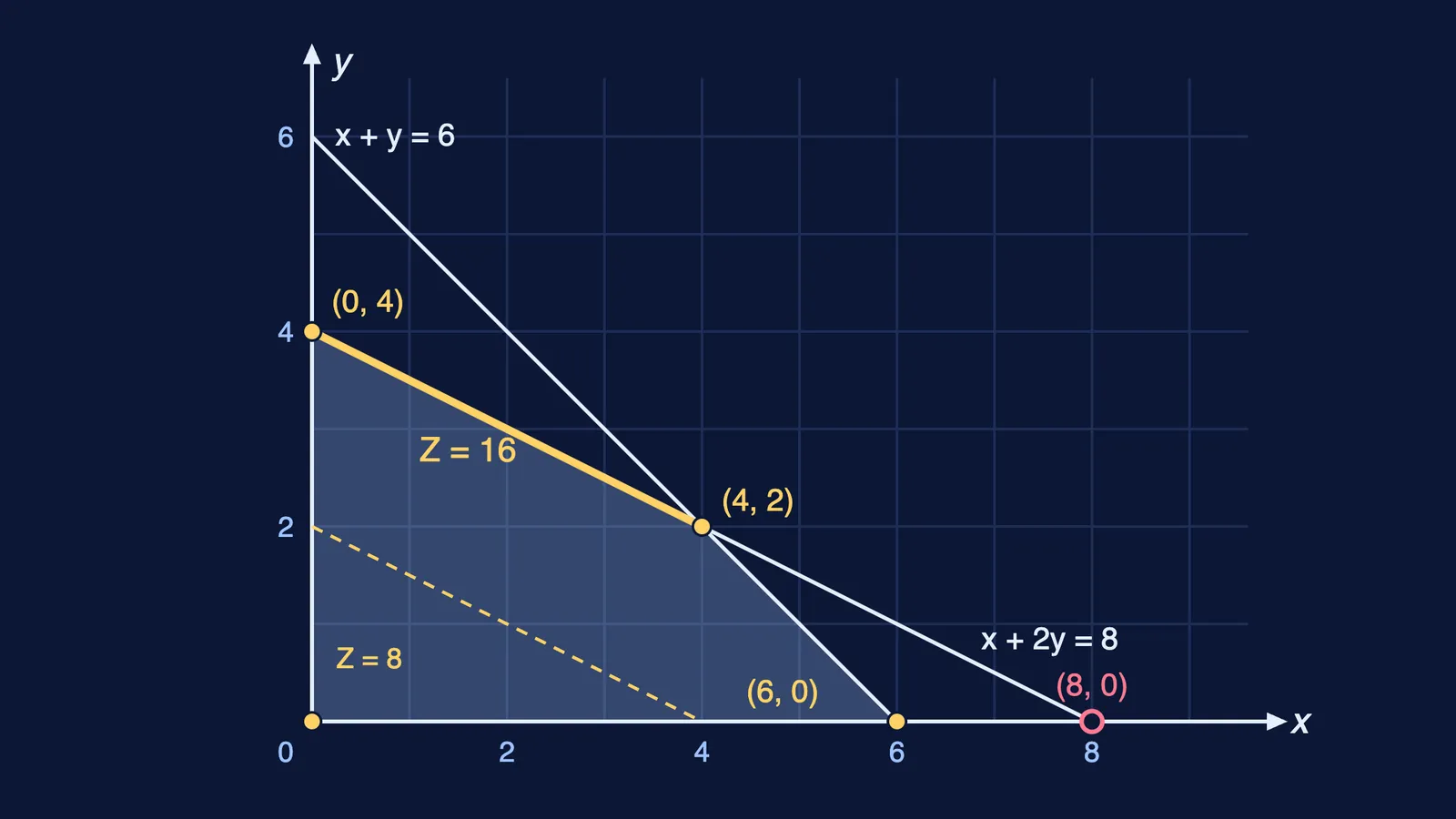
Every statement stays inside the NCERT Linear Programming chapter (Reprint 2026-27), and we checked every corner value with Python. Q4, Q8 and Q10 share the region drawn above.
How do you answer assertion-reason questions on linear programming?
The CBSE Class 12 Mathematics sample paper for 2026-27 has two 1-mark assertion-reason questions. Linear Programming is Unit V of the CBSE 2026-27 Mathematics curriculum.
Judge A, judge R, then read A, say "because", read R. More in our assertion-reason question strategy.
Assertion-reason keys:
(A) Both A and R are true and R is the correct explanation of A.
(B) Both A and R are true but R is NOT the correct explanation of A.
(C) A is true but R is false.
(D) A is false but R is true.
Statement I / Statement II keys:
(A) Both statements are correct.
(B) Both statements are incorrect.
(C) Statement I is correct, Statement II is incorrect.
(D) Statement I is incorrect, Statement II is correct.
Linear programming assertion-reason questions with answers
Q1 (easy). Assertion (A): (3, 2) is a feasible solution of x + y ≤ 6, 2x + y ≤ 8, x, y ≥ 0, even though 2x + y = 8 there. Reason (R): Points on the boundary of the feasible region, as well as inside it, are feasible solutions.
Answer: (A). 3 + 2 = 5 ≤ 6 and 2(3) + 2 = 8, a boundary point. R is the NCERT rule that counts it.
Trap: rejecting it because 8 is not "less than" 8.
Q2 (easy). Assertion (A): The feasible region of x + y ≥ 4, x, y ≥ 0 is unbounded. Reason (R): The feasible region of a linear programming problem is always convex.
Answer: (B). No circle can enclose this region, so A is true. R (NCERT) is true but says nothing about boundedness.
Trap: ticking (A) because both are textbook facts.
Q3 (medium). Assertion (A): Subject to 2x + y ≤ 8, x + 3y ≤ 9, x, y ≥ 0, the maximum of Z = 2x + 3y is 12. Reason (R): The maximum occurs at the corner with the largest y-coordinate.
Answer: (C). Corners (0, 0), (4, 0), (3, 2), (0, 3) give Z = 0, 8, 12, 9: maximum 12 at (3, 2). R is false: (0, 3) gives only 9.
Trap: picking a corner by eye instead of evaluating all of them.
Q4 (medium). Assertion (A): Subject to x + 2y ≤ 8, x + y ≤ 6, x, y ≥ 0, Z = 2x + 4y has maximum 16 at infinitely many points. Reason (R): If two corners give the same maximum, every point on the segment joining them gives it too.
Answer: (A). Corners (0, 0), (6, 0), (4, 2), (0, 4) give 0, 12, 16, 16. R, NCERT's remark on ties, is why the whole yellow edge is optimal.
Trap: writing only one point.
Q5 (hard). Assertion (A): Subject to x + 2y ≥ 4, 3x + y ≥ 6, x, y ≥ 0, the minimum of Z = x + y is 14/5. Reason (R): On every unbounded region, Z has a minimum but no maximum.
Answer: (C). Corners (0, 6), (8/5, 6/5), (4, 0) give 6, 14/5, 4, and the open half plane x + y < 14/5 misses the region, so A is true. R is false: it depends on Z too (see Q6).
Trap: memorising "unbounded means minimum only".
Q6 (hard). Assertion (A): Z = −x − 2y has no maximum subject to x + y ≥ 3, x, y ≥ 0. Reason (R): This feasible region is unbounded.
Answer: (D). Corners (3, 0) and (0, 3) give −3 and −6. The half plane x + 2y < 3 misses the region, since there x + 2y ≥ x + y ≥ 3. So the maximum is −3 at (3, 0): A is false, R is true.
Trap: skipping the half-plane check.
Statement I and Statement II questions on linear programming
Q7 (easy). Statement I: x ≥ 0, y ≥ 0 are called non-negative restrictions. Statement II: In Z = ax + by, both a and b must be positive.
Answer: (C). I is NCERT's term. In II, a and b are any constants; NCERT itself minimises Z = −50x + 20y.
Trap: assuming every objective is a profit.
Q8 (medium). For x + 2y ≤ 8, x + y ≤ 6, x, y ≥ 0: Statement I: (8, 0) is a corner point. Statement II: (6, 0) is a corner point.
Answer: (D). (8, 0) is where x + 2y = 8 meets y = 0, but 8 > 6, so it is outside the region (the pink point). (6, 0) is a true corner.
Trap: listing every intersection of boundary lines.
Q9 (medium). Statement I: x + y ≥ 10, 2x + y ≤ 8, x, y ≥ 0 have no feasible region. Statement II: Every point with x, y ≥ 0 and 2x + y ≤ 8 satisfies x + y ≤ 8.
Answer: (A). As x ≥ 0, x + y ≤ 2x + y ≤ 8, so II holds, and then x + y ≥ 10 is impossible.
Trap: reporting a "best corner" anyway.
Q10 (hard). On the region of Q4: Statement I: Z = 3x + 3y is maximum only at (6, 0). Statement II: The minimum of Z = x − y is 0, at the origin.
Answer: (B). 3x + 3y gives 0, 18, 18, 12, so 18 occurs at (6, 0), (4, 2) and every point between. x − y gives 0, 6, 2, −4, so the minimum is −4 at (0, 4).
Trap: assuming the origin gives the minimum.
How should you use this set?
Cover the answers and do all ten in one sitting.
For every miss, write the trap in your own words.
Draw the regions for Q4 to Q6 on graph paper.
If corner points or half-plane checks keep slipping, the Fermi Problem Library has worked problems with a step-by-step solver that explains the reasoning rather than printing an answer.
For step marks and a revision plan, see our linear programming Class 12 board exam guide, and for the whole paper, our section-wise CBSE Class 12 maths plan.


