On this page
A linear functional takes a vector and returns a number, linearly. Together they form a new vector space, the dual space, which reappears as "bras" in quantum mechanics and covectors in relativity.
What is the dual space of a vector space?
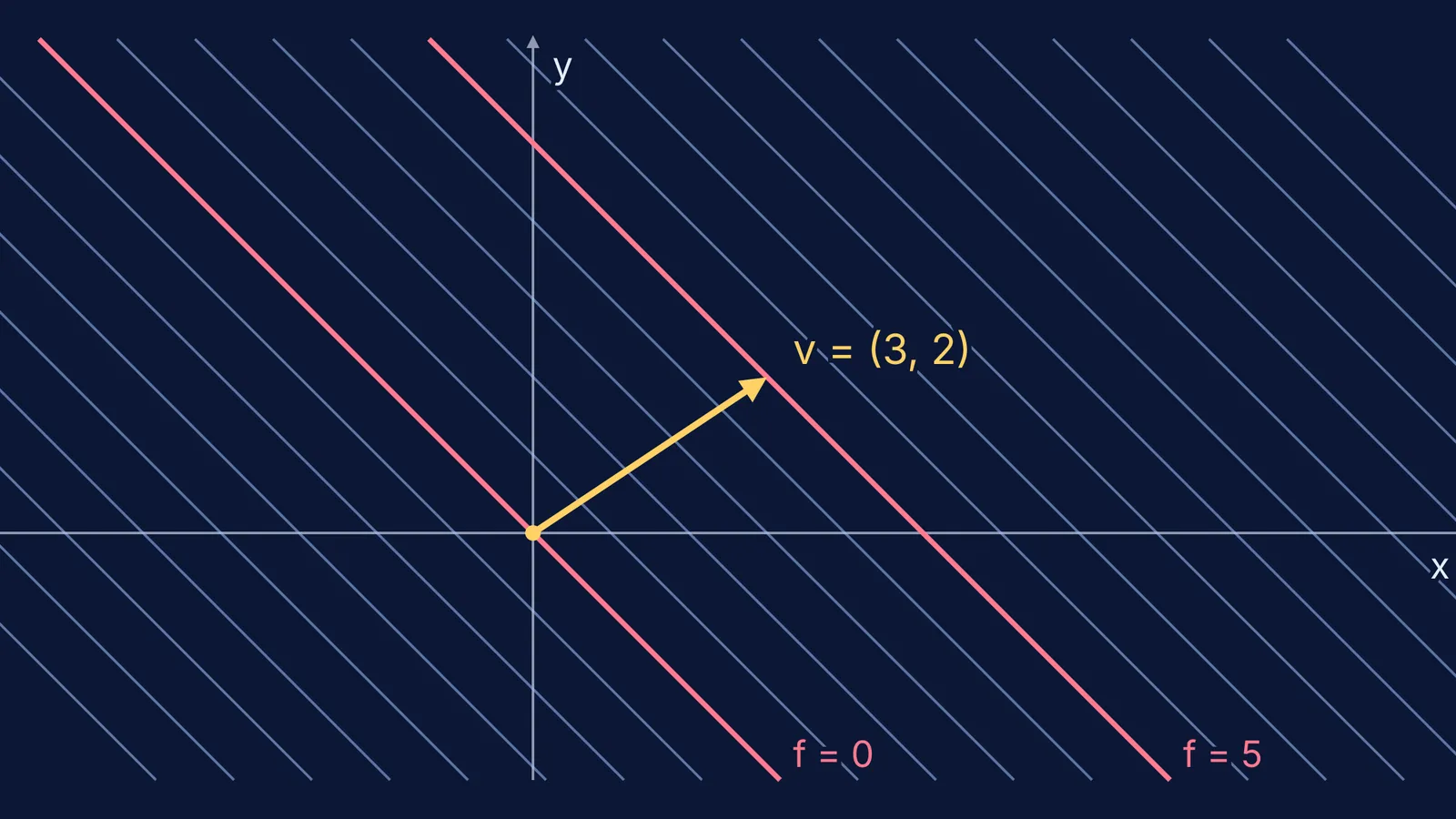
A linear functional (or linear form, one-form, covector) is a linear map from a vector space to its field of scalars, per the Wikipedia article on linear forms. Linear means f(u + v) = f(u) + f(v) and f(cv) = c f(v).
The dual space V* is the set of all linear functionals on V, following the standard definition of the dual space. Adding outputs, (f + g)(v) = f(v) + g(v), and scaling them makes V* a vector space in its own right.
Why is a linear functional a row vector?
Take ℝ³ with vectors as columns. A linear f is fixed by its values a, b, c on e1, e2, e3, so f(x, y, z) = ax + by + cz: the row [a b c] times the column (x, y, z).
When vectors are columns, linear functionals are row vectors, evaluated by a matrix product with the row on the left, as the linear form article puts it.
How do you find the dual basis? A worked example in ℝ³
For a basis v1, v2, v3, the dual basis is f1, f2, f3 with fi(vj) = 1 when i = j and 0 otherwise, the Kronecker delta condition in the dual space article.
Take v1 = (1, 0, 0), v2 = (1, 1, 0) and v3 = (1, 1, 1).
Put the basis vectors in as the columns of a matrix B, with rows [1 1 1], [0 1 1], [0 0 1].
Stack the unknown rows f1, f2, f3 into F. The condition fi(vj) = δij says FB = I, so F = B⁻¹.
Back-substitution gives B⁻¹ with rows [1 −1 0], [0 1 −1], [0 0 1].
Read off: f1(x, y, z) = x − y, f2(x, y, z) = y − z, f3(x, y, z) = z.
Check: f1(v2) = 0, f2(v3) = 0, f3(v3) = 1.
For w = (4, 7, 2), f1(w) = −3, f2(w) = 5 and f3(w) = 2, so w = −3v1 + 5v2 + 2v3. Check: (−3 + 5 + 2, 5 + 2, 2) = (4, 7, 2). The dual basis reads coordinates, as in a change of basis matrix, worked through with a 2×2 example.
Why do V and V* have the same dimension?
Any basis v1, …, vn gives n dual functionals. They span, because any f equals f(v1)f1 + … + f(vn)fn (both sides agree on each vj), and they are independent (apply a combination to each vj). So dim V* = n = dim V, and a finite-dimensional V is isomorphic to V*, as the dual space article states.
If V is not finite-dimensional, its algebraic dual is always of larger dimension than V, per the same dual space article.
Is the transpose the same as the dual map?
Yes. A linear map T from V to W gives a map the other way on functionals: T*(φ) = φ ∘ T, first apply T, then φ. The dual space article states that if T has matrix A, then T* is represented by the transpose Aᵀ with respect to the dual bases.
Check with T(x, y) = (x + 2y, 3y, x), whose matrix A has rows [1 2], [0 3], [1 0]. Take φ = [1 1 1]. Then φ(T(x, y)) = (x + 2y) + 3y + x = 2x + 5y, so T*φ = [2 5]. The row product [1 1 1]A also gives [2 5]; as columns, that is Aᵀ times (1, 1, 1). The direction flips: T* goes from (ℝ³)* to (ℝ²)*. Rows are functionals, one reason row space matters when you find the rank of a matrix with row echelon form.
Where do covectors show up in physics?
Covectors and one-forms are other names for elements of V*, as the dual space article lists. In quantum mechanics, a bra ⟨A| is an element of the dual space of kets, a linear functional mapping a ket to a complex number, per the article on bra–ket notation. So ⟨A|ψ⟩ is that functional applied to ψ.
A dot product turns each vector u into a functional v ↦ u · v. That is why, with an orthonormal basis built by Gram–Schmidt, school physics swaps rows and columns freely. Without an inner product, vectors and covectors must be kept apart.
If rows and columns keep blurring, the Fermi Concept Library covers every concept in mathematics and physics, and the Fermi Problem Library has worked problems with a step-by-step solver that explains the reasoning.