

On this page
A vector is an arrow. Its coordinates are only a description of that arrow, and the description depends on which basis you measure it against. A change of basis matrix is the tool that translates one description into the other, and it does the same for whole linear maps.
What does a change of basis actually change?
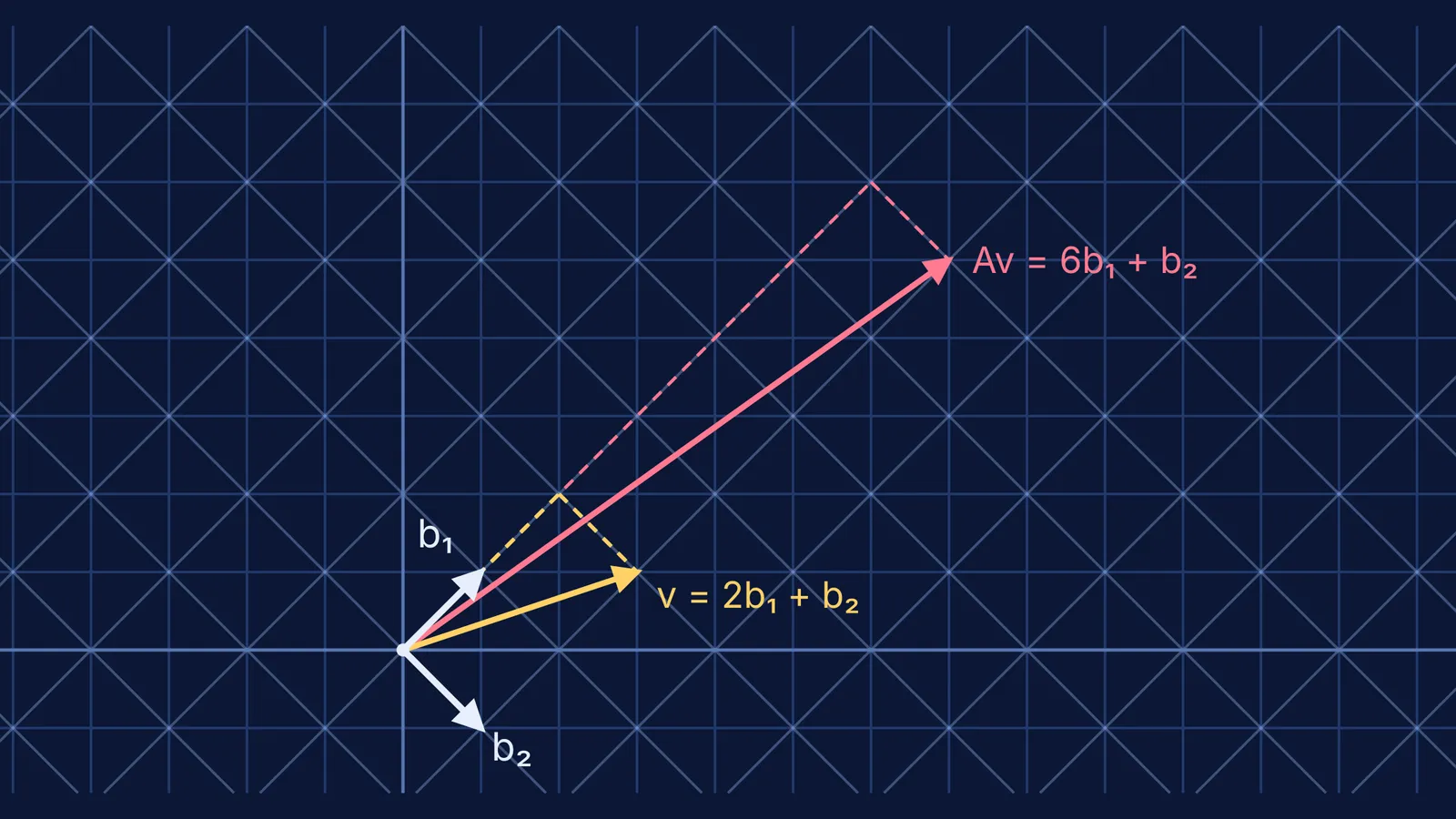
It changes the numbers, never the vector. In the standard basis, the vector v = (3, 1) means "3 steps along e₁, 1 step along e₂". Now pick a new basis B with b₁ = (1, 1) and b₂ = (1, −1). The same arrow is also 2b₁ + 1b₂, because 2(1, 1) + 1(1, −1) = (3, 1). So in basis B its coordinates are [v]_B = (2, 1).
The arrow did not move. Only the ruler did.
How do you build the change of basis matrix P?
Put the new basis vectors in as columns, each written in the old coordinates. The Wikipedia entry on change of basis defines it as the matrix whose columns are the coordinates of the new basis vectors on the old basis. For our basis:
P = [[1, 1], [1, −1]], with first column b₁ = (1, 1) and second column b₂ = (1, −1).
Multiplying P by a column of B-coordinates rebuilds the vector in standard coordinates: P(2, 1) = 2b₁ + 1b₂ = (3, 1). So the rule is v = P[v]_B. P takes new coordinates to old ones, which feels backwards at first; the same page notes that this reverse terminology "is confusing, but internationally adopted".
How do you find the coordinates of a vector in a new basis?
Undo P. Since v = P[v]_B, multiply both sides by P⁻¹ to get [v]_B = P⁻¹v. This needs P to be invertible, which is true exactly when the columns form a basis.
For our P, the determinant is (1)(−1) − (1)(1) = −2, so P⁻¹ = ½[[1, 1], [1, −1]]. Then:
P⁻¹(3, 1) = ½(3 + 1, 3 − 1) = ½(4, 2) = (2, 1).
Check by rebuilding: 2(1, 1) + 1(1, −1) = (3, 1). It matches.
Why does a linear map become P⁻¹AP in the new basis?
Read P⁻¹AP from right to left. Start with B-coordinates. P converts them to standard coordinates. A does its work in standard coordinates. P⁻¹ converts the answer back to B-coordinates. The product is the matrix of the same map, described in basis B.
The Wikipedia entry on matrix similarity calls A ↦ P⁻¹AP a similarity transformation. It states that two matrices are similar if and only if they represent the same linear map under two possibly different bases.
Worked example: a basis that makes A diagonal
Take A = [[2, 1], [1, 2]]. Notice what A does to our basis vectors:
A(1, 1) = (3, 3) = 3b₁, so b₁ is only stretched by 3.
A(1, −1) = (1, −1) = 1b₂, so b₂ is left alone.
These are eigenvectors with eigenvalues 3 and 1. Now compute the new matrix. First AP = [[3, 1], [3, −1]]. Then P⁻¹AP = ½[[1, 1], [1, −1]][[3, 1], [3, −1]] = ½[[6, 0], [0, 2]] = [[3, 0], [0, 1]].
In basis B, the map is diagonal: stretch the first coordinate by 3, keep the second. The Wikipedia entry on diagonalizable matrices states the general rule: P⁻¹AP = D exactly when the columns of P are eigenvectors of A, and each diagonal entry of D is the matching eigenvalue.
Check it on v. In B-coordinates, D(2, 1) = (6, 1). Rebuild: 6(1, 1) + 1(1, −1) = (7, 5). Directly, A(3, 1) = (6 + 1, 3 + 2) = (7, 5). Both routes land on the same arrow.
For what an eigenvalue means, see our guide to eigenvalues of a 2×2 matrix and what they mean. For the payoff of a diagonal D, see how to find large powers of a matrix by diagonalisation, where Aⁿ = PDⁿP⁻¹ turns a hard power into an easy one.
Where does this go next?
Changing basis is a habit in university maths and physics: you choose the coordinates that make a problem simple, solve it there, then translate back. Gilbert Strang covers it in MIT OpenCourseWare 18.06SC, Lecture 31: Change of Basis; Image Compression, where the course page notes that to transmit video efficiently, linear algebra is used to change the basis. When the new basis should also be orthonormal, so that P⁻¹ is just the transpose, our walkthrough of how Gram–Schmidt builds an orthonormal basis shows how to make one.
If the ideas here still feel slippery, the Fermi Concept Library gives each mathematics concept its own lesson and its place in the map, so you can revisit bases and linear maps first.


