On this page
Any subgroup splits a group into cosets. The question here is when those cosets can themselves be multiplied to form a smaller group.
What is a normal subgroup?
A subgroup N of a group G is normal when gng⁻¹ stays in N for every g in G and every n in N, which is the same as saying the left coset gN equals the right coset Ng for every g (Wikipedia: Normal subgroup). The same page notes that Évariste Galois was the first to realise the importance of normal subgroups.
If cosets, and why their sizes divide the order of the group, need a refresher, start with our post on Lagrange's theorem and the order of a group.
When do cosets multiply consistently?
The natural rule for multiplying cosets is (aN)(bN) = (ab)N. It only makes sense if the answer does not depend on which representatives a and b you pick. That works exactly when N is normal, and then the cosets form the quotient group G/N, with as many elements as the index [G:N] (Wikipedia: Quotient group).
Worked example 1: ℤ/3ℤ.Take the integers under addition and the subgroup 3ℤ = {…, −3, 0, 3, 6, …}. There are three cosets, 0 + 3ℤ, 1 + 3ℤ and 2 + 3ℤ: the numbers leaving remainder 0, 1 and 2 on division by 3. Because addition is commutative, a + 3ℤ always equals 3ℤ + a, so 3ℤ is normal.
Test the rule: from 1 + 3ℤ pick 1 or 7; from 2 + 3ℤ pick 2 or 11. The sums 3 and 18 both land in 0 + 3ℤ. That is ℤ/3ℤ: arithmetic modulo 3.
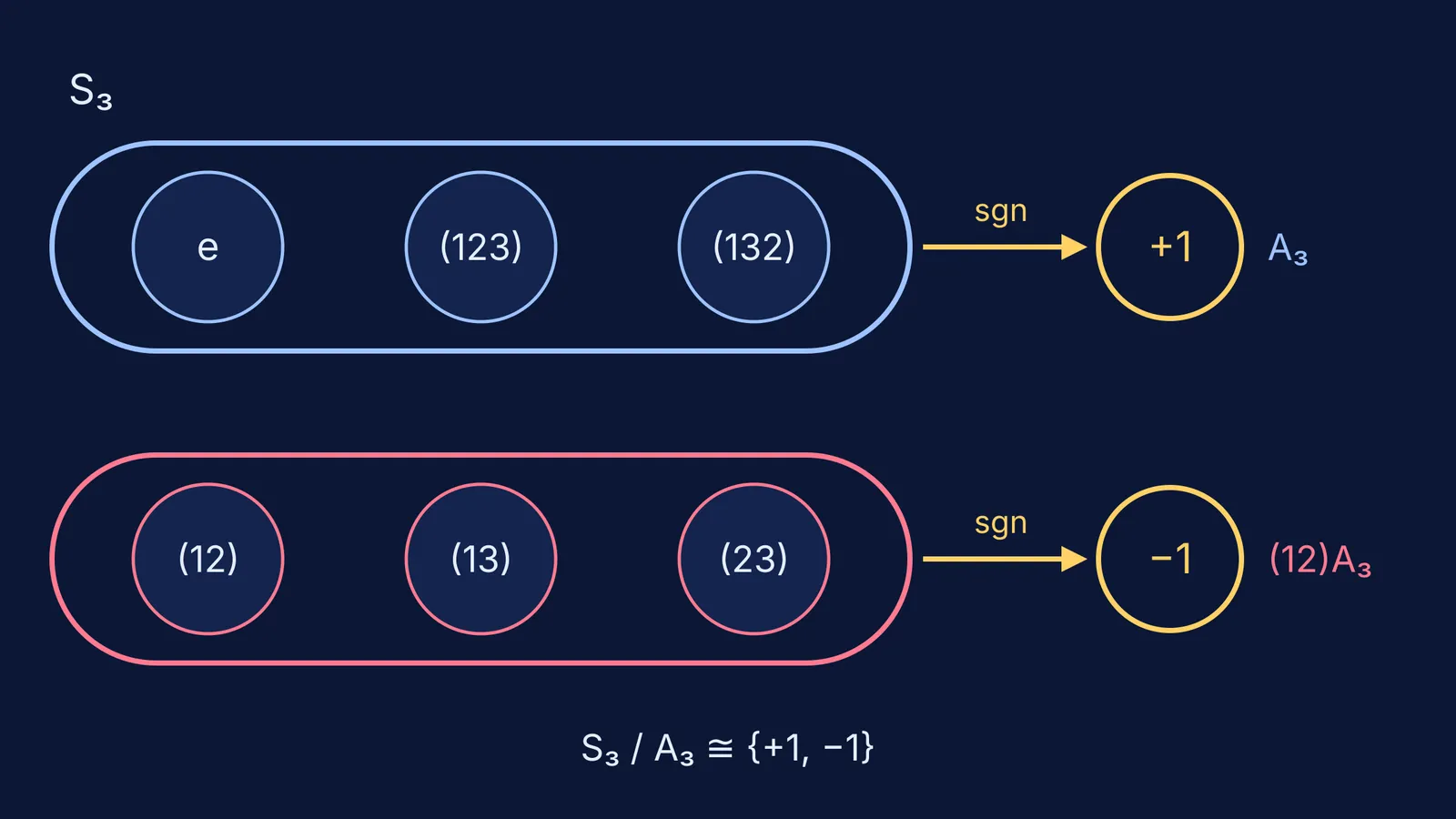
Worked example 2: S₃/A₃. S₃ is the group of all six rearrangements of {1, 2, 3}. Its subgroup A₃ = {e, (123), (132)} holds the even permutations, and its only other coset is (12)A₃ = {(12), (13), (23)}, the three swaps (Wikipedia: Normal subgroup). The same page states that any subgroup of index 2 is normal, and A₃ has 3 of the 6 elements, so A₃ is normal.
Multiplication follows parity: even times even is even, odd times odd is even, mixed is odd. So A₃ acts as the identity and (12)A₃ squared is A₃. S₃/A₃ has the shape of {+1, −1} under multiplication.
Why is {e, (12)} not normal in S₃?
Let H = {e, (12)}. The Wikipedia page on normal subgroups runs the test directly: the left coset (123)H = {(123), (13)}, but the right coset H(123) = {(123), (23)}. They differ, so H is not normal.
You can also watch the multiplication break. In the products below, apply the right-hand permutation first. The left cosets of H are H, A = {(123), (13)} and B = {(132), (23)}. Multiply a member of A by a member of B in two ways:
(123)(132) = e, which lies in H.
(13)(23) = (132), which lies in B.
Same two cosets, two different answers. "A times B" has no single meaning, so the cosets of H cannot form a group.
What does the first isomorphism theorem say?
A homomorphism is a map f from G to another group with f(ab) = f(a)f(b). Its kernel is everything f sends to the identity. The first isomorphism theorem says three things: the kernel of f is a normal subgroup of G, the image of f is a subgroup, and the image is isomorphic to G/ker f. Emmy Noether formulated them in some generality, for homomorphisms of modules, in a 1927 paper in Mathematische Annalen.
In plain words: divide out what a homomorphism forgets, and what is left is what it shows you.
Remainder mod 3, ℤ → ℤ/3ℤ, has kernel 3ℤ and image all of ℤ/3ℤ.
The sign map sgn: S₃ → {+1, −1} is a homomorphism whose kernel is the alternating group A₃ (Wikipedia: Parity of a permutation), so S₃/A₃ ≅ {+1, −1}.
The theorem also explains the failure above. Kernels are always normal, so no homomorphism out of S₃ can have {e, (12)} as its kernel. For more on even and odd permutations, see how permutation parity settles the fifteen puzzle.
How do you check a subgroup is normal in an exam?
Is the group abelian, such as ℤ or ℤ/nℤ? Then every subgroup is normal.
Is the index 2? Then it is normal.
Is N the kernel of a map you know, such as sign or remainder? Then it is normal, and G/N is that map's image.
Otherwise compute gNg⁻¹ for each generator g. One element outside N proves N is not normal.
To name G/N, find a homomorphism with kernel N and read off its image instead of building a table.
If closure and identity still feel shaky, revise binary operations, closure and identity first.
The Fermi Concept Library gives every concept in mathematics its own lesson and its place in the map, and the Fermi Problem Library has worked problems with a step-by-step solver that explains the reasoning.