

On this page
Addition and multiplication each take two numbers and give one. A binary operation is the general idea behind both, and testing a new one is a five-step routine.
What is a binary operation in maths?
A binary operation on a non-empty set A is a map f: A × A → A that is defined for every pair of elements of A and gives each pair exactly one element of A, in the definition used by Wolfram MathWorld. We usually write it as a * b instead of f(a, b).
"Every pair" means no gaps: a / b is not a binary operation on the real numbers, because b = 0 has no answer. "Of A" means the answer lands back inside the set; that condition is called closure.
How do you check closure, commutativity and associativity?
One counterexample is enough to say no.
Closure: for all a, b in A, is a * b in A? Subtraction on the natural numbers fails: 2 − 5 = −3 is not natural.
Commutativity: is a * b = b * a for all a, b? Subtraction on the integers fails: 1 − 2 = −1 but 2 − 1 = 1.
Associativity: is (a * b) * c = a * (b * c)? Subtraction fails again: (5 − 3) − 1 = 1 but 5 − (3 − 1) = 3.
Multiplication of square matrices of the same order is associative but not commutative; the CBSE 2025-26 Mathematics syllabus names its non-commutativity in the Class 12 matrices unit. Practise it with finding all matrices that commute with a given matrix.
How do you find the identity element and inverses?
An identity element e satisfies a * e = a = e * a for every a in the set, and an inverse of a is an element b with a * b = e = b * a, as listed in the properties of binary operations. Write the equation, solve it, and check the answer is in the set and works on both sides.
Worked example: a * b = a + b − ab
Run every test on the real numbers.
Closure. a + b − ab is a real number for any real a and b, so the operation is closed.
Commutativity. Swapping a and b gives b + a − ba, the same expression, so it is commutative.
Associativity. Expanding gives (a * b) * c = a + b + c − ab − bc − ca + abc. This is symmetric in a, b and c, so a * (b * c) is the same.
Identity. Solve a + e − ae = a. This gives e(1 − a) = 0 for every a, so e = 0. Check: a * 0 = a + 0 − 0 = a.
Inverses. Solve a + b − ab = 0. This gives b = a / (a − 1). For a = 2 the inverse is 2, and indeed 2 * 2 = 4 − 4 = 0. For a = 1, 1 * b = 1 for every b, so 1 has no inverse.
The shortcut: 1 − (a * b) = (1 − a)(1 − b). The operation is ordinary multiplication of the numbers 1 − a in disguise, which explains why it is commutative and associative, why 0 is the identity and why 1 has no inverse. On the real numbers without 1, it is closed and every element has an inverse, so it forms a group: closure, associativity, an identity and inverses all hold.
How do you read an operation table?
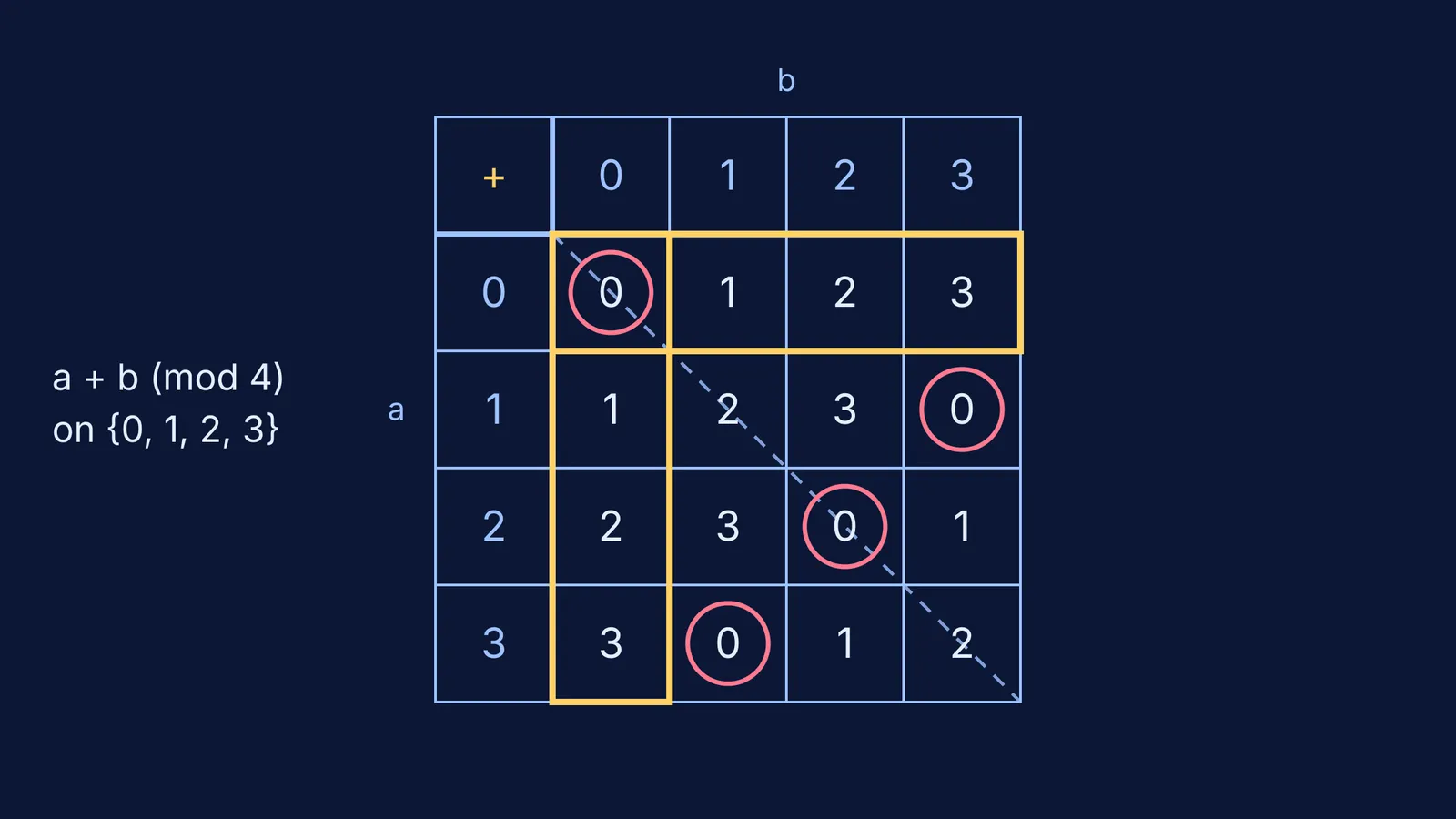
On a finite set, an operation is often given as a table: row a, column b, entry a * b. Addition mod 4 on {0, 1, 2, 3}:
Row 0: 0, 1, 2, 3
Row 1: 1, 2, 3, 0
Row 2: 2, 3, 0, 1
Row 3: 3, 0, 1, 2
Read it like this:
Closure: every entry is in the set.
Identity: find a row and column that copy the headings exactly. Row 0 does, so 0 is the identity.
Inverses: find the identity in each row. 1 and 3 are inverses, and 2 is its own inverse.
Commutativity: the table is a mirror image across its main diagonal.
Associativity: not visible at a glance; check triples.
For the vocabulary around this topic, see our Class 12 relations and functions key terms and how to prepare sets, relations and functions for JEE Main. When an expansion like the associativity check goes wrong, the Fermi Problem Library has worked problems with a step-by-step solver that explains the reasoning rather than printing an answer, and the Fermi Concept Library gives each mathematics concept its own lesson.
Faced with a new operation? Run the five tests in order: closure, commutativity, associativity, identity, inverses.


