On this page
These terms come from Chapter 1 of the NCERT Class 12 Mathematics Part I textbook (Reprint 2026-27). The reprint still has section 1.4 (composition of functions and invertible functions), but the Class XII Unit I entry in the CBSE 2026-27 Mathematics syllabus names only types of relations and one-one and onto functions, so those two topics are left out. For proofs, see our relations and functions Class 12 board exam guide.
What is a relation, in Class 12 language?
Source: NCERT sections 1.1 and 1.2.
Cartesian product (A × B): the set of all ordered pairs (a, b) with a taken from A and b taken from B. Example: A = {1, 2} and B = {x, y} give A × B = {(1, x), (1, y), (2, x), (2, y)}.
Relation from A to B: any subset of A × B; the pairs need no real-life link. Example: {(1, y)}.
Relation in a set A: a subset of A × A, so both entries of every pair come from A.
a R b: short for (a, b) ∈ R, read "a is related to b". Example: for R = {(a, b) : b = a + 1} in {1, 2, 3, 4}, 2 R 3 holds but 3 R 2 does not.
Empty relation: R contains no pairs at all, so R = φ. Example: R = {(a, b) : a − b = 10} in {1, 2, 3, 4}.
Universal relation: R contains every possible pair, so R = A × A. Example: R = {(a, b) : |a − b| ≥ 0} in the same set.
Trivial relations: a shared name for the empty and the universal relation.
Which properties can a relation have?
Source: NCERT section 1.2, Examples 2 to 5.
Reflexive: (a, a) ∈ R for every a in A. Counter-example: {(1, 1), (2, 2)} in {1, 2, 3}, because (3, 3) is missing.
Symmetric: whenever (a₁, a₂) ∈ R, (a₂, a₁) ∈ R too. Example: "is perpendicular to" on lines in a plane. Counter-example: a ≤ b on the real numbers, since 1 ≤ 2 but 2 ≤ 1 is false.
Transitive: whenever (a₁, a₂) ∈ R and (a₂, a₃) ∈ R, also (a₁, a₃) ∈ R. Counter-example: if L₁ ⊥ L₂ and L₂ ⊥ L₃, then L₁ is parallel to L₃, not perpendicular to it.
Equivalence relation: reflexive, symmetric and transitive together. Example: R = {(a, b) : 2 divides a − b} in Z, or "is congruent to" on triangles.
Property that holds with nothing to check: if no pairs trigger the "if" part, the condition holds. Example: the empty relation on a non-empty set is symmetric and transitive but not reflexive.
What is an equivalence class?
Source: NCERT section 1.2, after Example 5.
Equivalence class [a]: for an equivalence relation R in X, the set of all elements of X related to a. Example: for "2 divides a − b" in Z, [0] is the even integers and [1] the odd integers.
Partition: splitting X into non-empty, non-overlapping subsets that together make up X. The equivalence classes of any equivalence relation form a partition.
Same class, same label: if a R b, then [a] = [b]; two different classes share no element. Example: [0] = [2] = [−4] for the even-odd relation.
Classes of "3 divides a − b": Z splits into [0] = {..., −3, 0, 3, ...}, [1] = {..., −2, 1, 4, ...} and [2] = {..., −1, 2, 5, ...}. Each class is infinite, but there are only three classes.
When is a function one-one, onto or bijective?
Source: NCERT section 1.3 and Exercise 1.2.
Function f : X → Y: a relation from X to Y in which each element of X has exactly one image in Y.
Domain, codomain, range: X is the domain, Y the codomain, and the range is the set of images f actually produces. Example: f : R → R, f(x) = x² has codomain R but range [0, ∞).
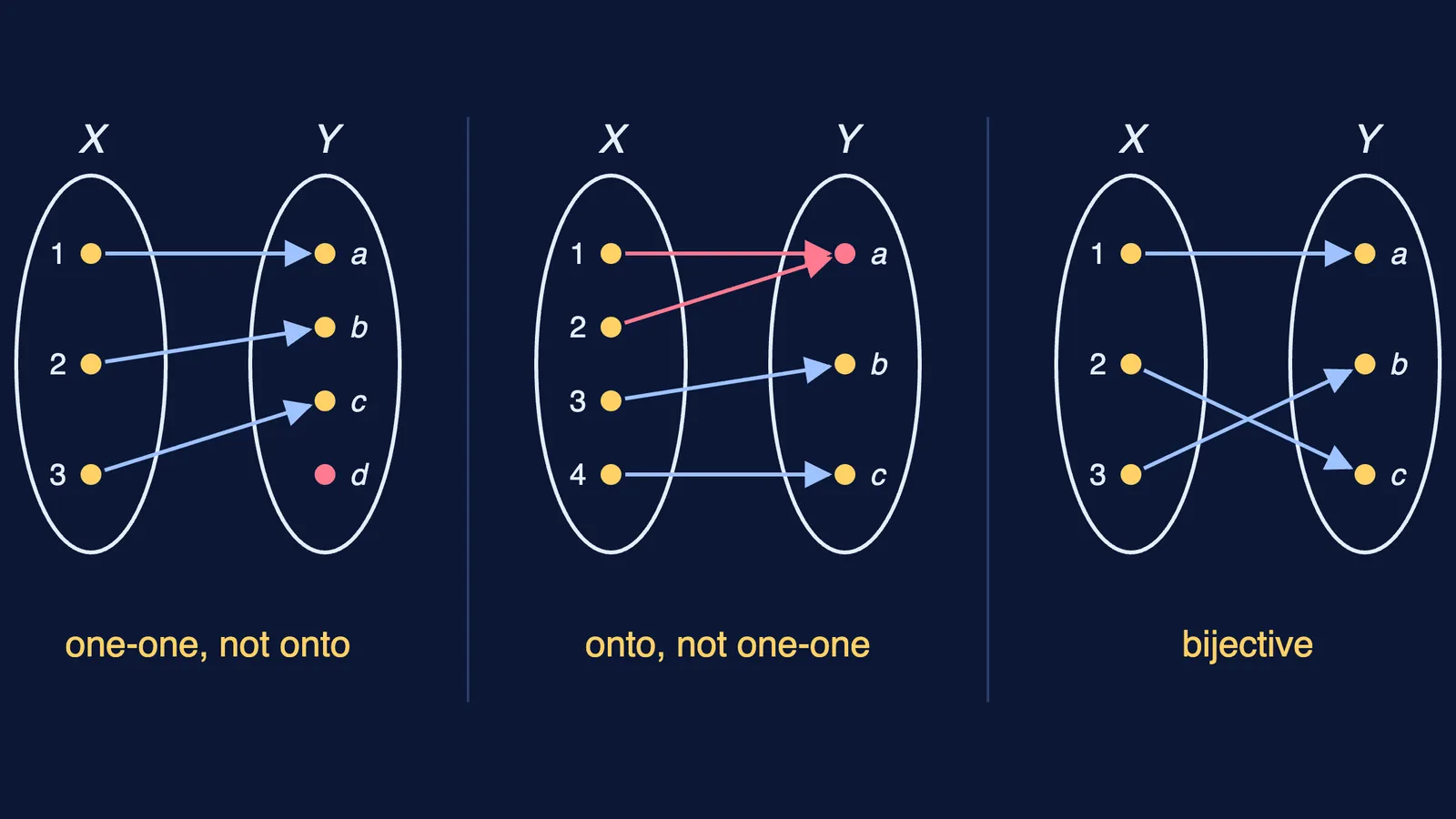
One-one (injective): different inputs give different images; to prove it, show f(x₁) = f(x₂) ⇒ x₁ = x₂. Example: f : N → N, f(x) = 2x.
Many-one: a function that is not one-one. Example: f(x) = x² on R, because f(−1) = f(1) = 1.
Onto (surjective): no element of the codomain is left out; each y in Y comes from at least one x in X, so range = codomain. Counter-example: f(x) = 2x from N to N, since no natural number maps to 1.
Bijective: one-one and onto together. Example: f : R → R, f(x) = 2x, since any y comes from x = y/2.
Finite-set property: for a finite set X, a function f : X → X is one-one exactly when it is onto. Counter-example on an infinite set: f(x) = 2x on N is one-one but not onto.
Greatest integer function [x]: the largest integer that does not exceed x. As R → R it is neither one-one ([0.2] = [0.7] = 0) nor onto (0.5 is never an output).
Modulus function |x|: x if x ≥ 0 and −x if x < 0. As R → R it is neither one-one (|−2| = |2|) nor onto (nothing gives −1).
Signum function: 1 for x > 0, 0 for x = 0 and −1 for x < 0. As R → R it is neither one-one nor onto, because its range is only {−1, 0, 1}.
How to learn these terms
Learn pairs together: empty and universal, one-one and onto, codomain and range.
Keep one counter-example per property: perpendicular lines (symmetric only), a ≤ b on the real numbers (reflexive and transitive, not symmetric), and {(1, 2), (2, 1)} in {1, 2, 3} (symmetric only, NCERT Exercise 1.1, Q6).
Draw arrow diagrams: one-one means no two arrows share a target, onto means no dot on the right is left without an arrow. If a definition feels slippery, the Fermi Concept Library gives every mathematics concept its own lesson and its place in the map.
Test yourself with our equivalence relations walkthrough and the relations and functions assertion-reason questions for Class 12.