On this page
Every statement was checked against NCERT's Relations and Functions (Reprint 2026-27), and every count recomputed.
How do you answer assertion-reason questions?
The CBSE Class 12 Maths sample question paper for 2026-27 has two assertion-reason questions, Q19 and Q20, in Section A at 1 mark each. Judge each statement alone, then ask whether R directly proves A. Keys for the six assertion-reason items:
(A) Both A and R are true and R is the correct explanation of A.
(B) Both A and R are true but R is NOT the correct explanation of A.
(C) A is true but R is false.
(D) A is false but R is true.
Keys for the four statement pairs:
(A) Both statements are correct.
(B) Both statements are incorrect.
(C) Statement I is correct, Statement II is incorrect.
(D) Statement I is incorrect, Statement II is correct.
All items stay inside Unit I of the CBSE 2026-27 Class 12 Maths syllabus.
Assertion-reason questions on relations and functions
Q1 (easy). Assertion (A): The relation S on N given by (a, b) ∈ S if a divides b is not symmetric. Reason (R): 2 divides 4, but 4 does not divide 2.
Answer: (A). R is the counterexample that breaks symmetry: (2, 4) ∈ S but (4, 2) ∉ S.
Trap: seeking a general proof when one counterexample suffices.
Q2 (easy). Assertion (A): The relation S = {(1, 1), (2, 2), (1, 2)} on X = {1, 2, 3} is reflexive. Reason (R): A relation S on X is reflexive if (x, x) ∈ S for every x ∈ X.
Answer: (D). R is the NCERT definition. A is false because (3, 3) is missing.
Trap: checking only elements that appear in the listed pairs.
Q3 (medium). Assertion (A): The relation S = {(1, 2), (2, 1)} on X = {1, 2, 3} is not transitive. Reason (R): S is not reflexive.
Answer: (B). A is true: (1, 2) and (2, 1) are in S, so transitivity needs (1, 1), which is missing. R is true but is not the cause: {(1, 2)} is not reflexive yet is transitive.
Trap: believing that symmetric and transitive together force reflexive.
Q4 (medium). Assertion (A): The relation S on Z given by (a, b) ∈ S if a + 4b is divisible by 5 is an equivalence relation. Reason (R): Every relation that is reflexive and symmetric is also transitive.
Answer: (C). A is true: a + 4a = 5a, b + 4a = 5(a + b) − (a + 4b) and a + 4c = (a + 4b) + (b + 4c) − 5b are multiples of 5. R is false: on {1, 2, 3}, {(1, 1), (2, 2), (3, 3), (1, 2), (2, 1), (2, 3), (3, 2)} is reflexive and symmetric but lacks (1, 3).
Trap: checking only two of the three properties.
Q5 (hard). Assertion (A): There is no one-one function from {1, 2, 3} to {4, 5}. Reason (R): If X and Y are finite sets and f : X → Y is one-one, then Y has at least as many elements as X.
Answer: (A). Three elements need three different images; {4, 5} has two.
Trap: thinking a function may skip a domain element.
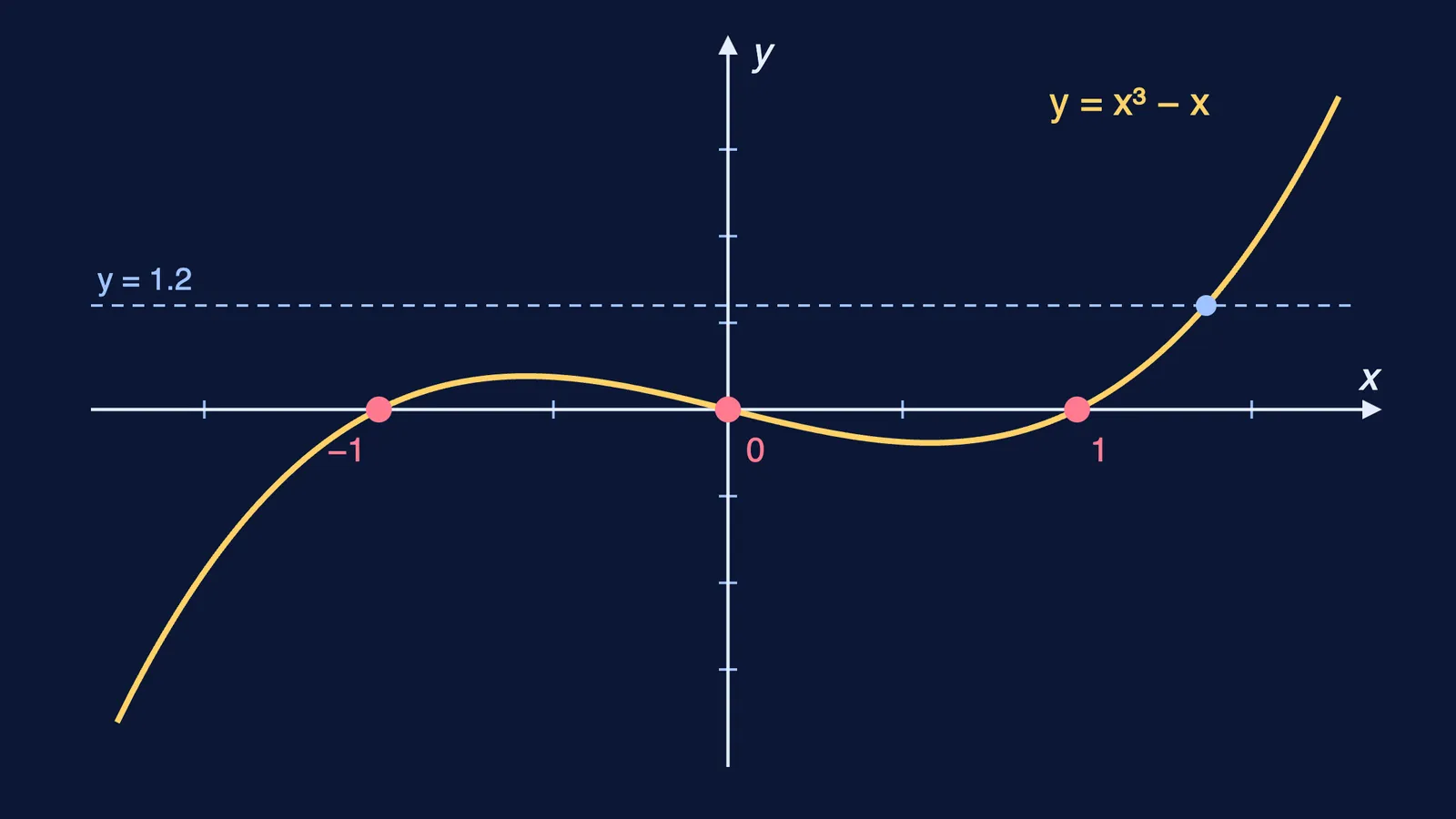
Q6 (hard). Assertion (A): The function f : R → R, f(x) = x³, is one-one. Reason (R): Every onto function from R to R is one-one.
Answer: (C). A is true: x₁³ = x₂³ gives x₁ = x₂. R is false: g(x) = x³ − x is onto R, but g(−1) = g(0) = g(1) = 0.
Trap: NCERT's "onto means one-one" result holds only for f : X → X with X finite.
Statement I and Statement II questions with answers
Q7 (easy). Statement I: f : R → R, f(x) = 5x − 2, is one-one and onto. Statement II: g : N → N, g(x) = 5x − 2, is onto.
Answer: (C). In I, x = (y + 2)/5 is a pre-image of any real y, and 5x₁ − 2 = 5x₂ − 2 gives x₁ = x₂. In II, 5x − 2 = 1 gives x = 3/5, not a natural number, so 1 has no pre-image.
Trap: copying the R → R answer to N → N.
Q8 (medium). Statement I: f : R → R, f(x) = |x − 3|, is one-one. Statement II: g(x) = |x − 3| from X = {x ∈ R : x ≥ 3} to Y = {y ∈ R : y ≥ 0} is one-one and onto.
Answer: (D). I fails since f(2) = f(4) = 1. On X, g(x) = x − 3, a bijection onto Y.
Trap: judging the formula, not the domain and co-domain.
Q9 (hard). Statement I: There are exactly 5 equivalence relations on {1, 2, 3}. Statement II: The empty relation on {1, 2, 3} is symmetric and transitive but not reflexive.
Answer: (A). Each equivalence relation splits {1, 2, 3} into classes: all separate, one pair together (three ways), or all together: 1 + 3 + 1 = 5. In II, no pair breaks symmetry or transitivity, but (1, 1) is missing.
Trap: forgetting the identity and universal relations.
Q10 (hard). Statement I: The number of one-one functions from {1, 2, 3} to {a, b, c, d} is 12. Statement II: The number of onto functions from {1, 2, 3, 4} to {a, b} is 16.
Answer: (B). One-one functions: 4 × 3 × 2 = 24. Of the 2⁴ = 16 functions to {a, b}, two are constant, so 14 are onto.
Trap: counting all functions, not onto ones.
How should you use this set?
Attempt all ten in 12 minutes, marking each statement T or F first.
For each miss, note whether you misjudged A, R or the link.
Redo Q3, Q4 and Q6 by writing your own counterexample.
Turn one missed definition into a new pair.
If reflexive, symmetric and transitive still blur together, the Fermi Concept Library gives every concept in mathematics its own lesson and its place in the map.
For proofs and step marks, read our guide to relations and functions for the Class 12 board exam. For the three properties, see equivalence relations in Class 12; for the method, our assertion-reason strategy guide.