On this page
Every item stays inside the Linear Inequalities chapter of the CBSE 2026-27 Class XI Mathematics syllabus, which lists "Algebraic solutions of linear inequalities in one variable and their representation on the number line". Each was checked against the NCERT Linear Inequalities chapter (Reprint 2026-27). If a rule feels shaky, open its lesson in the Fermi Concept Library, where every concept in mathematics has its own lesson and its place in the map.
How do you answer assertion-reason questions on linear inequalities?
Judge A alone, then R alone. If both are true, ask whether R produces A or is only a true fact nearby. In this chapter, R is usually one of the two NCERT rules: adding or subtracting the same number keeps the sign, and multiplying or dividing both sides by a negative number reverses it. Our three-check method for assertion-reason questions has the full routine.
(A) Both A and R are true and R is the correct explanation of A.
(B) Both A and R are true but R is NOT the correct explanation of A.
(C) A is true but R is false.
(D) A is false but R is true.
Linear inequalities assertion-reason questions with answers
Q5, Q7 and Q9 follow the shape of the marks, temperature and acid-mixture examples in the NCERT chapter (Examples 7, 12 and 13), with new numbers.
Q1 (easy). A: The solution set of −4x > 12 is x < −3. R: When both sides of an inequality are divided by a negative number, the sign of inequality is reversed.
Answer: (A). Dividing by −4 flips > to <, giving exactly A. Trap: writing x > −3.
Q2 (easy). A: Since 7 > 5, it follows that −7 > −5. R: Multiplying both sides of an inequality by a negative number reverses its sign.
Answer: (D). Multiplying by −1 gives −7 < −5, so A is false.
Q3 (easy). A: If x is a natural number, the solution set of 2x + 3 ≤ 11 is {1, 2, 3, 4}. R: On a number line, x ≤ 4 is shown with an open circle at 4.
Answer: (C). 2x ≤ 8, so x ≤ 4: the natural numbers 1 to 4. R is false: NCERT uses a dark circle for ≤ and ≥, a plain circle for < and >.
Q4 (medium). A: The solution of −2 < 1 − 3x ≤ 7 is −2 ≤ x < 1. R: x = 0 satisfies −2 < 1 − 3x ≤ 7.
Answer: (B). Subtract 1: −3 < −3x ≤ 6. Divide by −3 and flip both signs: 1 > x ≥ −2. R is true (at x = 0, 1 − 3x = 1), but one test value cannot prove a whole solution set.
Q5 (medium). A: A student scored 58 and 71 in two unit tests; to average at least 65 over three tests, she needs at least 66 in the third. R: A linear inequality in one variable has the form ax + b < 0 (or >, ≤, ≥) with a ≠ 0.
Answer: (B). (58 + 71 + x)/3 ≥ 65 gives 129 + x ≥ 195, so x ≥ 66. R is a true definition, but it does not produce 66. Trap: picking (A) because R is on topic.
Q6 (medium). A: The system 2x − 1 > 5 and 3x + 2 < 8 has no real solution. R: The solution of a system of inequalities is the union of their solution sets.
Answer: (C). The first gives x > 3, the second x < 2; nothing satisfies both. R is false: a system needs the values common to all.
Q7 (medium). A: If 25 < C < 30 and F = (9/5)C + 32, then 77 < F < 86. R: Multiplying all parts of an inequality by a positive number, or adding the same number to all parts, keeps the signs unchanged.
Answer: (A). Multiply by 9/5: 45 < (9/5)C < 54. Add 32: 77 < F < 86. Both steps are exactly R.
Q8 (hard). A: If a < b, then a/c < b/c for every non-zero real number c. R: If a < b and c < 0, then ac > bc.
Answer: (D). Take a = 1, b = 2, c = −1: a/c = −1 and b/c = −2, and −1 > −2, so A is false. R is true. Trap: reading "non-zero" as "positive".
Q9 (hard). A: To 400 litres of a 10% acid solution you add x litres of a 25% solution. For the mixture to be more than 15% but less than 20% acid, 200 < x < 800. R: The pure acid in the mixture equals the pure acid in the first solution plus the pure acid in the second.
Answer: (A). R gives 0.25x + 40 > 0.15(x + 400), so x > 200, and 0.25x + 40 < 0.20(x + 400), so x < 800. Trap: taking 15% of 400 instead of 15% of (x + 400).
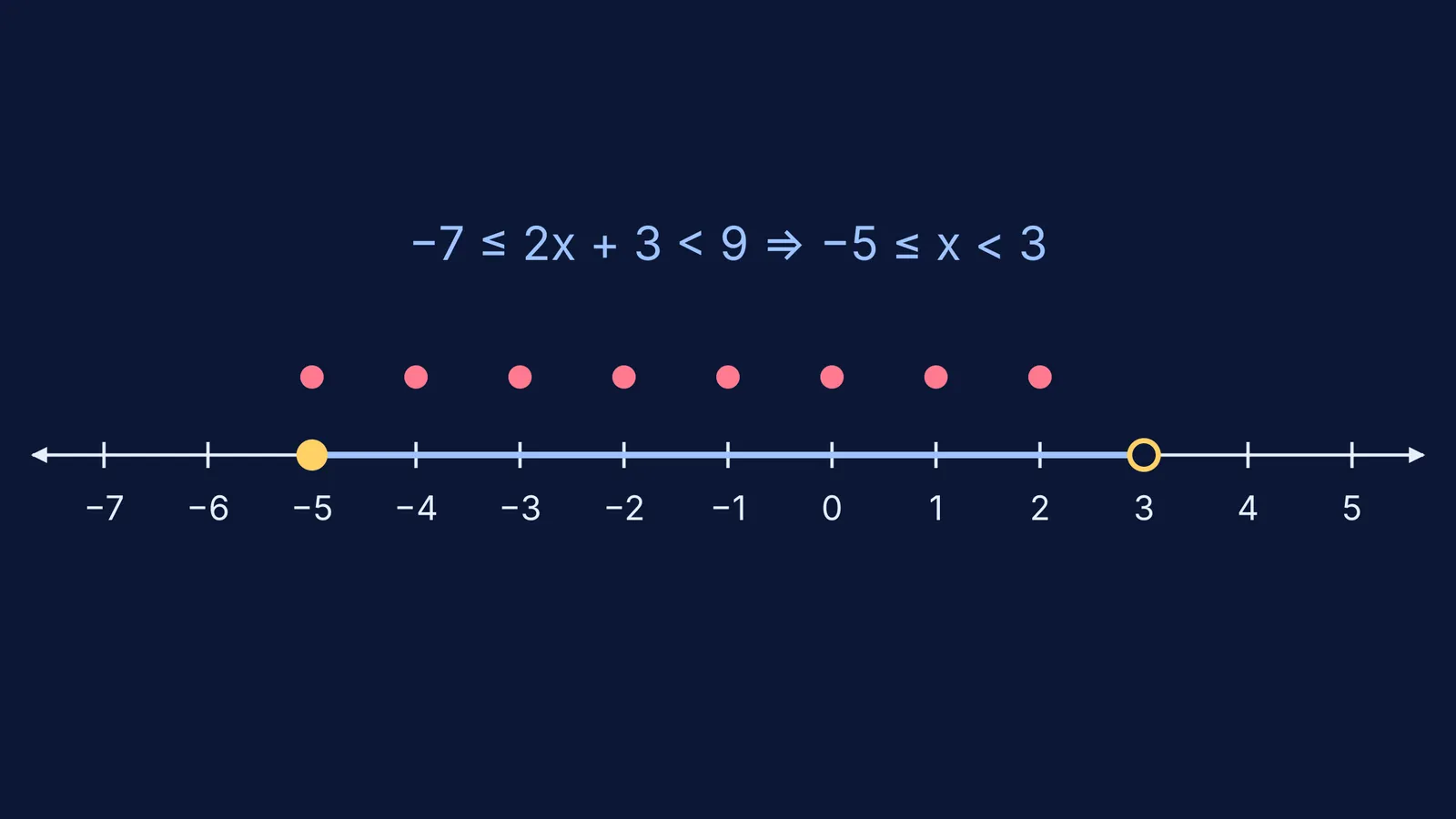
Q10 (hard). A: Exactly 8 integers satisfy −7 ≤ 2x + 3 < 9. R: For integers m < n, the closed interval [m, n] contains n − m integers.
Answer: (C). −10 ≤ 2x < 6 gives −5 ≤ x < 3: the integers −5 to 2, which is 8 (see the diagram at the top). R is false: [m, n] contains n − m + 1 integers.
Which mistakes cost the most marks in this chapter?
The sign flip. Multiplying or dividing by a negative number reverses every sign, including both sides of a double inequality.
The endpoint. Strict (< or >) means an open circle and a round bracket; slack (≤ or ≥) means a filled circle and a square bracket.
True but not the reason. A true R that does not produce A is (B).
How should you use this set?
Cover the answers and key all ten in one sitting.
Label each miss: wrong call on A, wrong call on R, or wrong "because" link.
Redo the matching NCERT example for each wrong call on A.
If a step keeps going wrong, the Fermi Problem Library has worked problems with a step-by-step solver that explains the reasoning rather than printing an answer, so you can compare each line with your own working.
Next in the Algebra unit, try our complex numbers assertion-reason questions and permutations and combinations assertion-reason questions.