On this page
Three original case studies on locker numbers, a dairy chiller and a housing-society survey, each with four parts that get harder and worked answers. For the theory and a solved example first, read our Sets Class 11 guide.
What do these Sets case study questions cover?
Each case is a short real-life passage followed by four parts. Every part stays inside Chapter 1 of NCERT Class 11 Mathematics (Reprint 2026-27) and the Sets topics in the CBSE 2026-27 Class XI Mathematics curriculum: roster and set-builder forms, the empty set, subsets, intervals, the universal set, Venn diagrams, union, intersection, difference and complement.
Case 1: Lockers in a Kochi school
A school in Kochi gives the 30 students of Class 11-B lockers numbered 1 to 30, so take U = {1, 2, 3, ..., 30}. The class teacher marks two groups. P is the set of lockers whose numbers are perfect squares; they get a blue sticker. T is the set of lockers whose numbers are multiples of 6; they get a red sticker. Students with no sticker will help set up the science exhibition.
(i) The set of lockers that get both stickers is: (a) {36} (b) {6} (c) φ (d) {1}
(ii) Write T in roster form and in set-builder form, and give n(T).
(iii) Let Q = {x : x ∈ P and x is odd}. Write Q in roster form. Is Q a proper subset of P?
(iv) Are P and T disjoint? Write (P ∪ T)′ in words and find how many students help with the exhibition.
Answers.
(i) (c) φ. P = {1, 4, 9, 16, 25} and T = {6, 12, 18, 24, 30} have no common element; 36 is a square and a multiple of 6, but it is not in U.
(ii) T = {6, 12, 18, 24, 30} = {x : x is a natural number, x ≤ 30 and x is a multiple of 6}, and n(T) = 5.
(iii) Q = {1, 9, 25}. Yes: every element of Q is in P, but 4 ∈ P and 4 ∉ Q, so Q ⊂ P and Q ≠ P.
(iv) Yes, because P ∩ T = φ. (P ∪ T)′ is the set of lockers with no sticker. P ∪ T has 5 + 5 = 10 elements, so (P ∪ T)′ has 30 − 10 = 20: twenty students help.
Case 2: The chiller at a dairy in Anand
A milk-collection centre near Anand logs its chiller temperature t in °C. The sensor reads only from −2 °C to 10 °C, so take U = [−2, 10]. In this case, the centre's manual calls the band S = [1, 5) "safe", and the screen shows a green light for G = (0, 4].
(i) Which reading lies in S? (a) 0.5 °C (b) 1 °C (c) 5 °C (d) 5.5 °C
(ii) Write S in set-builder form and find its length.
(iii) Write S ∩ G and S ∪ G as intervals.
(iv) Find S − G, and the complement S′ with respect to U. What does a reading in S − G mean for the operator?
Answers.
(i) (b) 1 °C. The square bracket includes 1; the round bracket leaves out 5.
(ii) S = {t : t ∈ R, 1 ≤ t < 5}. Its length is 5 − 1 = 4.
(iii) S ∩ G = [1, 4], since both conditions hold from 1 up to and including 4. S ∪ G = (0, 5): G covers just above 0 to 4, and S carries on to just below 5.
(iv) S − G = (4, 5), and S′ = [−2, 1) ∪ [5, 10]. A reading in (4, 5) is safe but shows no green light: time to check the chiller.
Case 3: Vehicles in a Hyderabad housing society
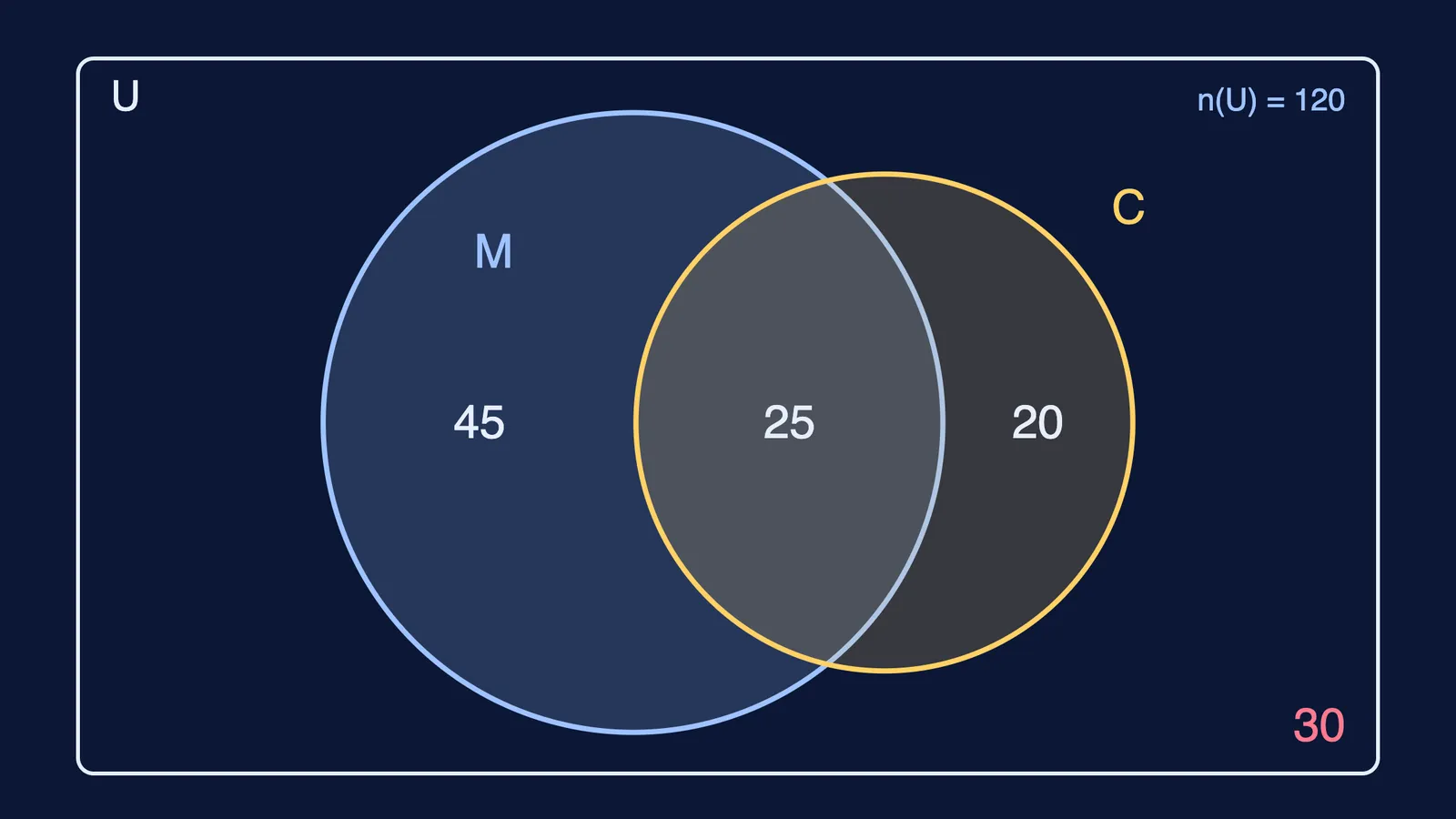
A housing society in Hyderabad has 120 flats. The secretary records which flats own a two-wheeler (set M) and which own a car (set C). In this case, n(M) = 70, n(C) = 45 and n(M ∩ C) = 25. Flats with neither will get space for a cycle stand.
(i) n(M − C) equals: (a) 25 (b) 45 (c) 70 (d) 95
(ii) Find n(C − M) and n(M ∪ C).
(iii) How many flats own neither vehicle? Write this set in two ways.
(iv) Visitor passes go to every flat that does not own both vehicles. Write this set using complements, apply De Morgan's law, and count it.
Answers.
(i) (b) 45. M − C and M ∩ C are disjoint and together make up M, so n(M − C) = 70 − 25 = 45.
(ii) n(C − M) = 45 − 25 = 20. M − C, M ∩ C and C − M are mutually disjoint, so n(M ∪ C) = 45 + 25 + 20 = 90.
(iii) 120 − 90 = 30 flats. The set is (M ∪ C)′, which by De Morgan's law equals M′ ∩ C′: flats without a two-wheeler and without a car.
(iv) The set is (M ∩ C)′ = M′ ∪ C′: flats with no two-wheeler or no car. n = 120 − 25 = 95. Check with the Venn regions: everything outside the overlap is 45 + 20 + 30 = 95.
How do you attack case-study questions on Sets?
Write every set in roster form first when it is finite; most MCQs are settled once you see the elements.
Check the universal set before you take a complement. In Case 1, 36 is a square multiple of 6, but it is outside U.
For intervals, draw a number line with filled and open dots, then read off the answer.
For counting, split the Venn diagram into M − C, M ∩ C and C − M, which never overlap, and fill the middle first.
Turn "not both" and "neither" into symbols with De Morgan's law before you count.
To explore how the regions of a Venn diagram fit together, try our interactive Venn diagram, and for a general method, read how to answer case-based questions. If a symbol like ⊂ or ′ still feels shaky, the Fermi Concept Library gives every concept in mathematics its own lesson.