On this page
Three original cases, easy to hard. Theory first? Read our real numbers Class 10 chapter guide.
What do case-study questions on real numbers look like?
The CBSE 2026-27 Class 10 Mathematics Standard sample paper says: "In Section E, Question number 36 to 38 are case study-based questions carrying 4 marks each." And: "Use of calculators is not allowed." All numbers work out by hand.
The CBSE 2026-27 Class 10 Mathematics syllabus lists the Fundamental Theorem of Arithmetic and proofs that numbers like √2, √3 and √5 are irrational. The NCERT chapter on real numbers states the theorem: every composite number is a product of primes, unique apart from the order of the factors. HCF takes the smallest power of each common prime; LCM takes the greatest power of each prime involved.
Case 1: Packing sweets for Diwali
A sweet shop in Kolkata has 396 kaju barfis and 468 besan ladoos left after the Diwali rush. The owner wants to pack all of them into gift boxes. Every box must hold the same number of sweets, each box must hold only one kind, and nothing may be left over. She wants as few boxes as possible, so as many sweets per box as the rules allow. Her son, in Class 10, works it out with prime factors before the boxes are ordered.
(i) The prime factorisation of 468 is: (a) 2 × 3² × 13 (b) 2² × 3² × 13 (c) 2² × 3 × 13² (d) 2³ × 3 × 13
(ii) What is the greatest number of sweets each box can hold?
(iii) How many boxes are needed in all?
(iv) Before packing starts, 270 kaju katlis arrive and all three kinds are packed by the same rules. What is the new greatest number per box, and how many boxes are needed?
Answers.
(i) (b). 4 × 9 × 13 = 468.
(ii) 396 = 2² × 3² × 11 and 468 = 2² × 3² × 13. So HCF = 2² × 3² = 36 sweets per box.
(iii) 396 ÷ 36 = 11 boxes of barfi and 468 ÷ 36 = 13 boxes of ladoos, so 24 boxes.
(iv) 270 = 2 × 3³ × 5 has only one 2, so HCF(396, 468, 270) = 2 × 3² = 18. Boxes: 22 + 26 + 15 = 63.
Case 2: Quality checks on a bottling line
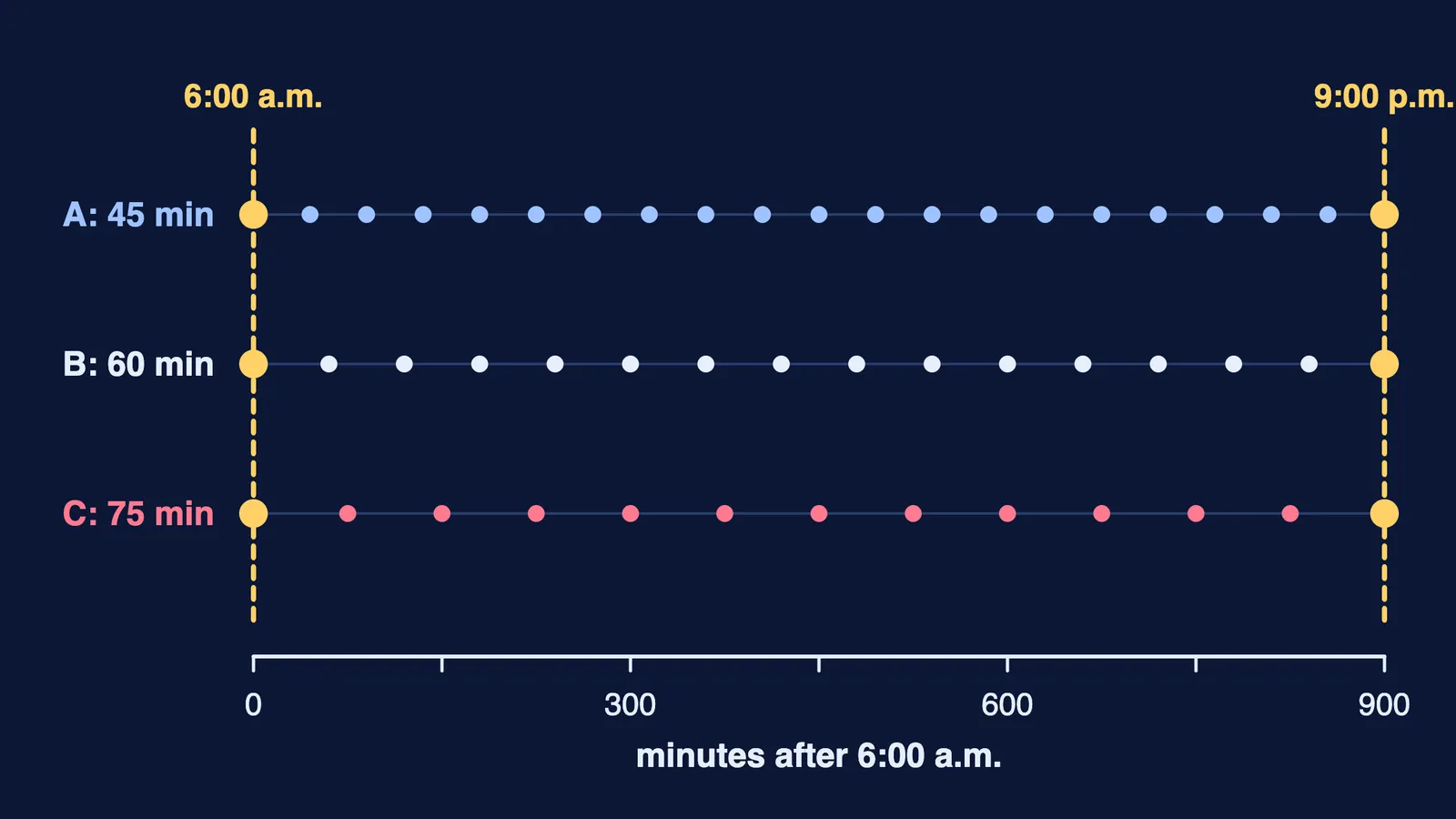
A water-bottling plant near Chennai runs three machines on one production line. A supervisor checks the filling machine (A) every 45 minutes, the capping machine (B) every 60 minutes and the labelling machine (C) every 75 minutes. All three were checked together at 6:00 a.m. The manager wants the next moment all three checks fall together, so one senior engineer can sign off all of them.
(i) After 6:00 a.m., machines A and B are first checked together after: (a) 15 minutes (b) 90 minutes (c) 180 minutes (d) 2,700 minutes
(ii) At what time are all three machines next checked together?
(iii) The trainee claims HCF(45, 60, 75) × LCM(45, 60, 75) = 45 × 60 × 75. Is he right?
(iv) Suppose B had instead been checked every 50 minutes from 6:00 a.m. When would the next joint check be, and how many times would A be checked from 6:00 a.m. up to and including it?
Answers.
(i) (c). 45 = 3² × 5 and 60 = 2² × 3 × 5, so LCM = 2² × 3² × 5 = 180.
(ii) With 75 = 3 × 5², LCM(45, 60, 75) = 2² × 3² × 5² = 900 minutes = 15 hours, so 9:00 p.m.
(iii) No. HCF = 15, and 15 × 900 = 13,500, but 45 × 60 × 75 = 2,02,500. The rule holds only for two numbers.
(iv) 50 = 2 × 5², so LCM(45, 50, 75) = 2 × 3² × 5² = 450 minutes = 7 h 30 min, which is 1:30 p.m. A is checked 450 ÷ 45 + 1 = 11 times, counting both ends.
Case 3: A diagonal strip on a square tile
In a Bhopal school's art room, students decorate square ceramic tiles of side 10 cm. Each tile gets a thin copper strip along one diagonal, and a copper frame around its four edges. Riya measures the diagonal with her ruler and reads 14.1 cm. Her friend Kabir uses a digital calliper and reads 14.14 cm. Each insists their reading is the exact length. Their teacher asks them to settle the argument with algebra, not with a better instrument, and then to work out the copper needed per tile.
(i) Which of these numbers is irrational? (a) √49 (b) 22/7 (c) 10√2 (d) 0.25
(ii) Find the exact length of the diagonal.
(iii) Show that neither 14.1 cm nor 14.14 cm can be the exact length.
(iv) The copper used for one tile is the frame plus the diagonal strip. Given that √2 is irrational, prove that this total length is irrational.
Answers.
(i) (c). √49 = 7, 22/7 and 0.25 = 1/4 are rational.
(ii) By Pythagoras, d² = 10² + 10² = 200, so d = √200 = 10√2 cm.
(iii) 14.1² = 198.81 and 14.14² = 199.9396, and neither is 200. Both are rational (141/10, 1414/100); 10√2 is not.
(iv) The total is 40 + 10√2 cm. Suppose it is rational, equal to a/b with integers a, b and b ≠ 0. Then √2 = (a − 40b)/(10b), which is rational because a, b, 40 and 10 are integers. This contradicts √2 being irrational, so 40 + 10√2 is irrational.
How to attack case-study questions on real numbers?
Factorise every number into prime powers first; HCF and LCM then take one line each.
Never use HCF × LCM = product for three numbers.
Convert minutes to clock times at the end, and say whether the start is counted.
For an irrationality proof, assume the number is rational, isolate √2, and show √2 would then be rational. State the contradiction in words.
For more practice, see our guide to case-based questions in board exams and the assertion-reason set on real numbers. If a step keeps slipping, the Fermi Problem Library has worked problems with a step-by-step solver that explains the reasoning rather than printing an answer.