On this page
Three original cases, easy to hard. Need the formulas first? Read our Areas related to circles Class 10 guide.
What do case-study questions on areas related to circles look like?
The CBSE Class 10 Maths (Standard) sample paper for 2026-27 says Questions 36 to 38 in Section E "are case study-based questions carrying 4 marks each", that each has "three sub parts (i), (ii), (iii) of marks 1, 1, 2 respectively", and that "Use of calculators is not allowed." The practice cases below have four parts each, without mark labels.
The CBSE 2026-27 Maths syllabus restricts segment problems to a central angle of 60°, 90° or 120° only; Case 1 uses 45° only for sectors and arcs. The rationalised NCERT Class 10 Chapter 11, Areas Related to Circles (Reprint 2026-27) gives three results: the area of a sector of angle θ is (θ/360) × πr², the arc length is (θ/360) × 2πr, and the area of a segment is the area of the sector minus the area of the triangle. Use π = 22/7 unless a case says otherwise.
Case 1: Pizza night in Indore
A pizza shop in Indore sells a family pizza with a diameter of 42 cm. The cook cuts it into 8 equal slices with straight cuts through the centre, so every slice has two straight edges and a curved crust. Riya's family orders one such pizza and eats 3 slices; the rest are boxed for Monday. The menu will print the area of one slice, and the box maker needs the crust length. Use π = 22/7.
(i) The angle at the centre of each slice is: (a) 30° (b) 45° (c) 60° (d) 90°
(ii) What is the radius of the pizza?
(iii) Find the area of one slice.
(iv) Find the perimeter of one slice and the area of pizza boxed for later.
Answers.
(i) (b). 360° ÷ 8 = 45°.
(ii) Radius = 42 ÷ 2 = 21 cm.
(iii) Area = (45/360) × (22/7) × 21 × 21 = (1/8) × 1386 = 173.25 cm².
(iv) Crust = (45/360) × 2 × (22/7) × 21 = 132 ÷ 8 = 16.5 cm, so the perimeter is 21 + 21 + 16.5 = 58.5 cm. Five slices are left: 5 × 173.25 = 866.25 cm².
Case 2: The giant wheel at the Mysuru Dasara fair
A giant wheel at the Mysuru Dasara fair has radius 10.5 m and 12 cabins fixed at equal spacing on its rim. Kabir rides in one cabin. The organisers fit a coloured LED panel in the region between the rim and a straight steel bar that joins two cabins four places apart, so the bar subtends 120° at the centre O. Use π = 22/7 and √3 = 1.73.
(i) The angle at O between two neighbouring cabins is: (a) 15° (b) 24° (c) 30° (d) 36°
(ii) How far along the rim is it from one cabin to the next?
(iii) Kabir's cabin moves four places on. How far does it travel along the rim, and how long is the straight bar joining the start and end positions?
(iv) Find the area of the LED panel.
Answers.
(i) (c). 360° ÷ 12 = 30°.
(ii) Arc = (30/360) × 2 × (22/7) × 10.5 = 66 ÷ 12 = 5.5 m.
(iii) Four places is 4 × 30° = 120°, so the arc is 4 × 5.5 = 22 m. Drop the perpendicular OM to the bar: it bisects the bar and the angle, so each half is 10.5 × sin 60° and the bar is 10.5√3 = 10.5 × 1.73 = 18.165 m, about 18.17 m.
(iv) Sector = (120/360) × (22/7) × 10.5 × 10.5 = 115.5 m². Triangle = ½ × bar × OM = ½ × 10.5√3 × 5.25 = (√3/4) × 10.5² ≈ 47.68 m². Panel (segment) ≈ 115.5 − 47.68 = 67.82 m².
Case 3: The table that had to fit the wall
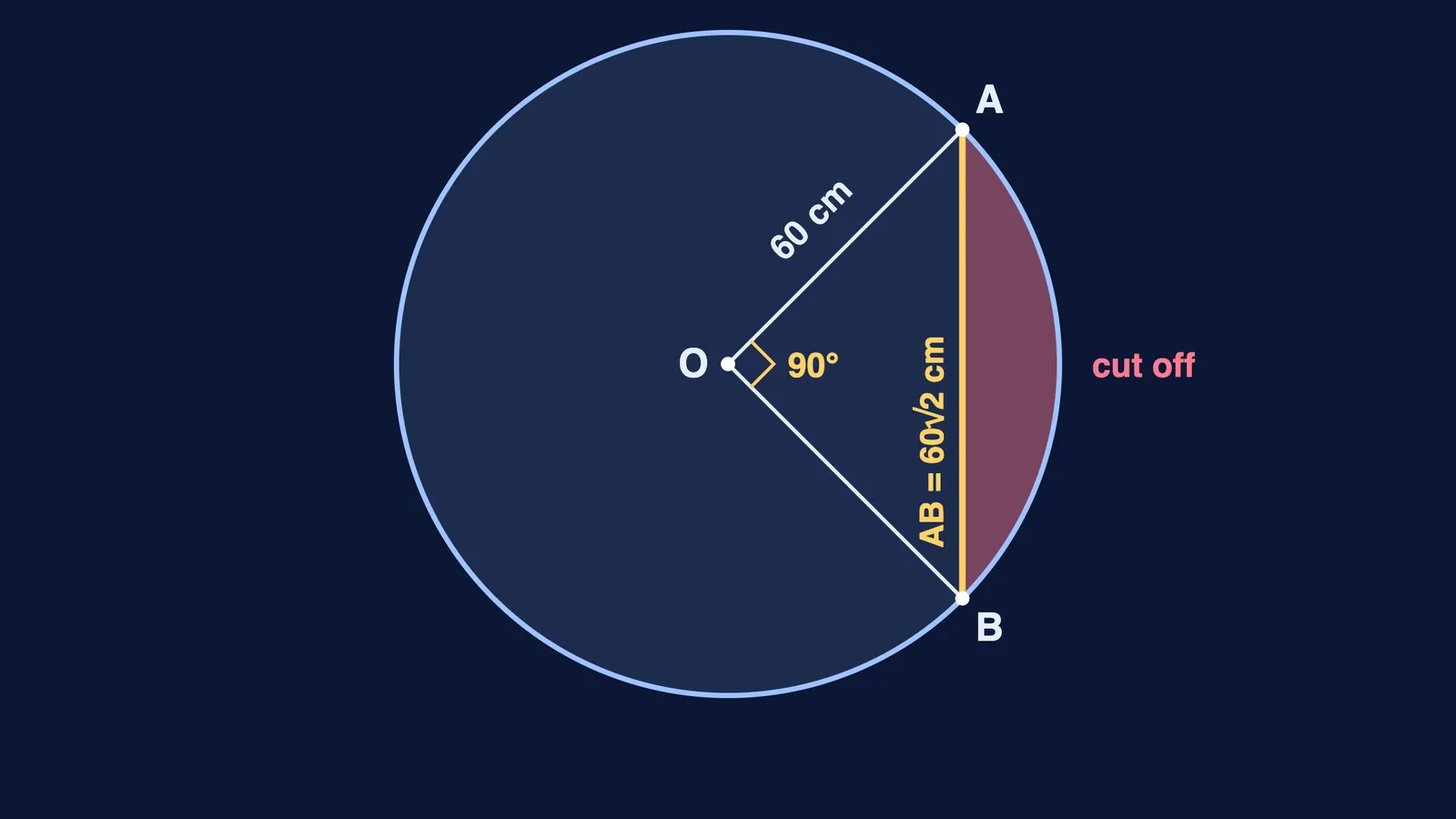
A family in Chennai owns a round wooden dining table top of radius 60 cm, centre O. To push it flat against a wall, a carpenter saws off a strip along a straight chord AB. The chord subtends a right angle at O, so triangle OAB is right-angled at O. The family wants the new edge's length, the wood removed and what remains. Use π = 3.14 and √2 = 1.414.
(i) The piece cut off is: (a) a minor sector (b) a minor segment (c) a major segment (d) a quadrant
(ii) Find the length of the chord AB.
(iii) Find the area of the piece cut off.
(iv) Find the area and the perimeter of the remaining table top.
Answers.
(i) (b). It lies between chord AB and the minor arc.
(ii) In right triangle OAB, AB = √(60² + 60²) = 60√2 ≈ 60 × 1.414 = 84.84 cm.
(iii) Sector OAB = (90/360) × 3.14 × 60 × 60 = 2826 cm². Triangle OAB = ½ × 60 × 60 = 1800 cm². Piece cut off = 2826 − 1800 = 1026 cm².
(iv) Whole top = 3.14 × 3600 = 11,304 cm², so 11,304 − 1026 = 10,278 cm² remains (the major segment). Its edge is the major arc, (270/360) × 2 × 3.14 × 60 = 282.6 cm, plus the chord, 84.84 cm: a perimeter of 367.44 cm.
How do you attack case-study questions on areas related to circles?
Find the central angle first: n equal parts means 360° ÷ n.
Name the shape: arc (a length), sector (two radii and an arc) or segment (chord and arc).
For a perimeter, add both radii (or the chord) to the arc; the arc alone is not the perimeter.
For a segment at 60°, 90° or 120°, find the triangle with the perpendicular from O, or as ½ × r × r at 90°.
Check the size: a 45° sector is one-eighth of the circle, and a segment is smaller than its sector.
See our guide to case-based questions in board exams and the areas related to circles assertion-reason set. If a step keeps slipping, the Fermi Problem Library has worked problems with a step-by-step solver that explains the reasoning rather than printing an answer.