On this page
Three original cases, easy to hard, with worked answers. For the formulas and step marks, read our Application of Integrals Class 12 board guide first.
What do case-study questions on Application of Integrals look like?
The CBSE 2026-27 Mathematics sample paper has three case study-based questions of 4 marks each in Section E, and calculators are not allowed. The CBSE 2026-27 Mathematics syllabus lists "area under simple curves, especially lines, circles/parabolas/ellipses (in standard form only)". Every case below uses only the core result of the rationalised NCERT Chapter 8 (Reprint 2026-27): area between a curve and the x-axis, with |A₁| + A₂ across a crossing. Every number works by hand.
Case 1: The parabolic subway arch
A municipal corporation in Pune is building a pedestrian subway under a busy road. The front face of the opening is a parabolic arch standing on the floor. Taking the floor as the x-axis and the centre line of the arch as the y-axis, with lengths in metres, the arch is y = 4 − x²/4. The contractor must fit a steel grille over the whole face of the opening before the rains. The grille costs ₹150 per square metre, fitted.
(i) The arch meets the floor at: (a) x = ±2 (b) x = ±4 (c) x = ±8 (d) x = ±16
(ii) How tall is the arch at its centre?
(iii) Using symmetry, write the integral for the area of the opening.
(iv) Find the area of the opening and the cost of the grille.
Answers.
(i) (b). Set y = 0: x²/4 = 4, so x² = 16 and x = ±4. The opening is 8 m wide.
(ii) At x = 0, y = 4, so the arch is 4 m tall.
(iii) The arch is symmetric about the y-axis, so the area is 2 ∫ from 0 to 4 of (4 − x²/4) dx.
(iv) 2[4x − x³/12] from 0 to 4 = 2(16 − 16/3) = 64/3 m². Cost = (64/3) × 150 = ₹3,200.
Case 2: Cutting a hill road
Engineers in Uttarakhand are widening a hill road. Across one cross-section, 10 m wide, they measure the ground height above the planned road level. Taking x as the distance in metres from the valley edge, the ground height is h(x) = (x − 4)/2 metres for 0 ≤ x ≤ 10. Where the ground is above road level, earth must be cut away; where it is below, earth must be filled in. The site engineer needs both areas of this cross-section.
(i) The ground is exactly at road level at: (a) x = 2 (b) x = 4 (c) x = 5 (d) x = 10
(ii) Find the area of the cross-section that must be filled.
(iii) Find the area of the cross-section that must be cut.
(iv) A trainee computes ∫ from 0 to 10 of h(x) dx = 5 m² and reports it as the total earthwork area. Explain the error and give the correct total.
Answers.
(i) (b). h(x) = 0 when x = 4.
(ii) On [0, 4], h is negative. ∫ from 0 to 4 of (x − 4)/2 dx = [(x − 4)²/4] from 0 to 4 = 0 − 4 = −4, so the fill area is |−4| = 4 m².
(iii) ∫ from 4 to 10 of (x − 4)/2 dx = [(x − 4)²/4] from 4 to 10 = 36/4 = 9 m².
(iv) The single integral subtracts the fill from the cut: 9 − 4 = 5. Area is never negative, so split at x = 4 and add the sizes, as NCERT's |A₁| + A₂ rule says: 4 + 9 = 13 m².
Case 3: The flower bed in a Mysuru park
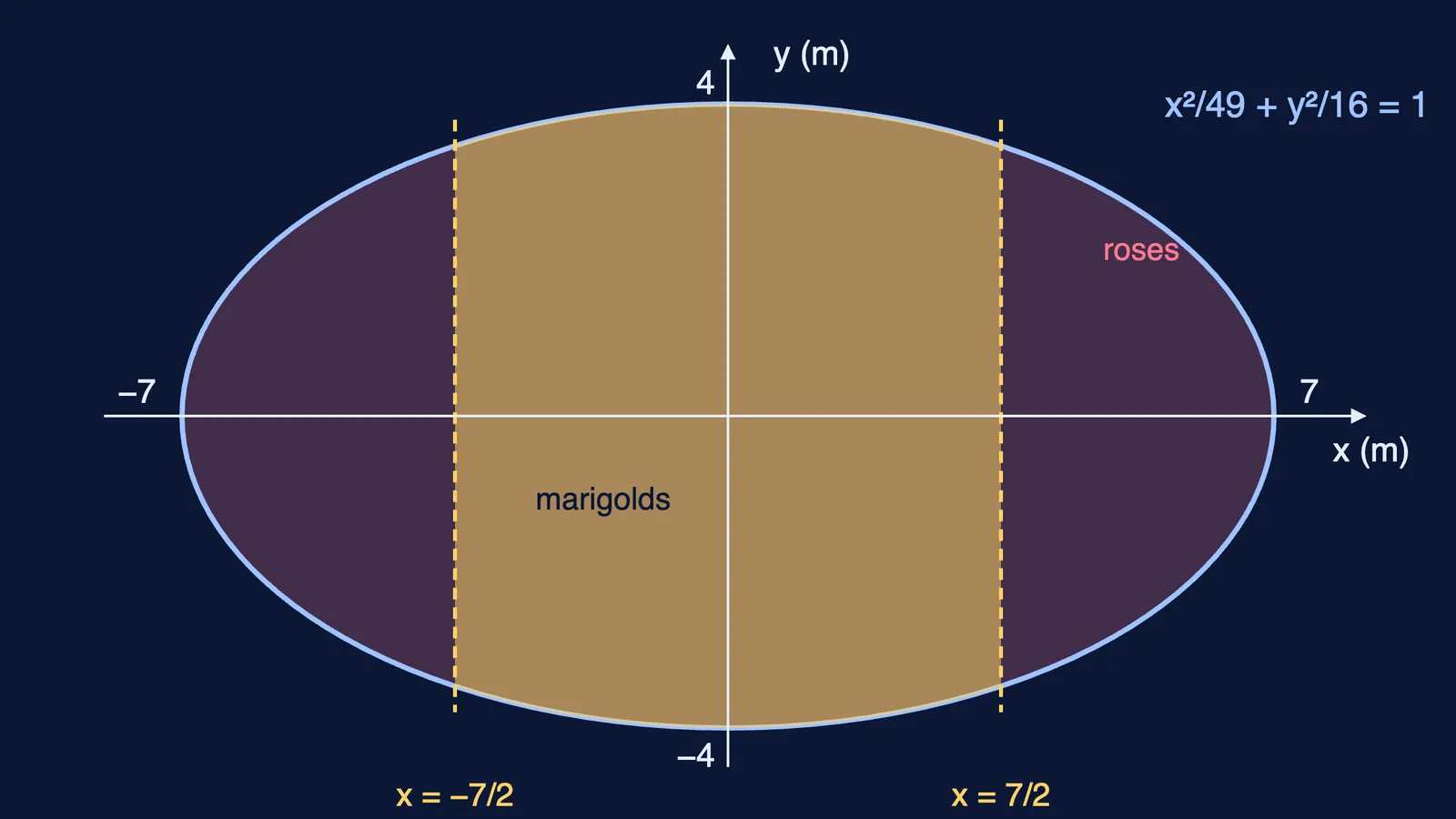
A horticulture team in Mysuru is laying out an elliptical flower bed, 14 m long and 8 m wide, at the centre of a park. With the centre of the bed as the origin and the long axis along the x-axis, lengths in metres, they plant marigolds in a central strip between the lines x = −7/2 and x = 7/2. The two curved ends get roses. The team needs the area of each section. Take π = 22/7 and √3 ≈ 1.732.
(i) The boundary of the bed is: (a) x²/196 + y²/64 = 1 (b) x²/49 + y²/16 = 1 (c) x²/7 + y²/4 = 1 (d) x²/16 + y²/49 = 1
(ii) Find the area of the whole bed.
(iii) Write the integral, using symmetry, for the area of the marigold strip.
(iv) Evaluate the marigold area and find the area left for roses.
Answers.
(i) (b). The semi-axes are a = 7 and b = 4, so a² = 49 and b² = 16.
(ii) Area = πab = (22/7) × 7 × 4 = 88 m².
(iii) In the first quadrant y = (4/7)√(49 − x²), and the strip is symmetric about both axes, so the area is 4 ∫ from 0 to 7/2 of (4/7)√(49 − x²) dx.
(iv) Use ∫√(a² − x²) dx = (x/2)√(a² − x²) + (a²/2) sin⁻¹(x/a). At x = 7/2 this gives 49√3/8 + 49π/12, and 0 at x = 0. Multiply by 16/7: the area is 14√3 + 28π/3 ≈ 24.25 + 29.33 = 53.6 m². Roses get about 88 − 53.6 = 34.4 m².
How do you solve case-study questions on Application of Integrals?
Sketch the region first and mark where the curve meets the axis. Those points are your limits.
Use symmetry only after checking it: an arch about the y-axis, an ellipse about both axes.
If the curve dips below the axis, split the integral at the crossing and add absolute values.
For circles and ellipses, write the standard result for ∫√(a² − x²) dx before substituting, and keep sin⁻¹ values exact until the last line.
Give the answer in square units from the passage, and check it against a rectangle or πab.
Next, try our assertion-reason set on Application of Integrals and the guide to case-based questions in board exams. If a step keeps slipping, the Fermi Problem Library has worked problems with a step-by-step solver that explains the reasoning rather than printing an answer.