On this page
Case studies on Introduction to Trigonometry hide a right triangle in a real object. Below are three original cases, easiest first, with worked answers.
What do trigonometry case study questions test in Class 10?
The CBSE 2026-27 Maths Standard sample paper says Section E has case study-based questions carrying 4 marks each, with three sub parts (i), (ii), (iii) of marks 1, 1, 2 respectively. Use of calculators is not allowed.
The CBSE 2026-27 Class 10 maths syllabus covers the ratios of an acute angle, their values at 0°, 30°, 45°, 60° and 90°, the identity sin²A + cos²A = 1, and only simple identities.
The NCERT chapter notes that sin A and cos A never exceed 1, while sec A and cosec A are always at least 1 where defined. For the chapter recap, read our Introduction to Trigonometry guide for Class 10; for method, see how to answer case-based questions in board exams.
Case 1: The godown loading ramp
A rice wholesaler in Raipur is building a straight ramp for handcarts from the yard up to the godown floor. The floor is 0.9 m above the yard, and the ramp starts 4.0 m from the godown wall, along the level yard. Let θ be the angle the ramp makes with the yard. Meera, in Class 10, sketches the side view as a right triangle.
(i) tan θ equals: (a) 9/41 (b) 40/41 (c) 9/40 (d) 41/9
(ii) Find the length of the ramp's sloping surface.
(iii) Write sin θ and cos θ, and check that sin²θ + cos²θ = 1.
(iv) Find sec θ − tan θ and sec θ + tan θ. What is their product, and which identity explains it?
Answers.
(i) (c). tan θ = opposite/adjacent = 0.9/4.0 = 9/40.
(ii) By Pythagoras, √(0.9² + 4.0²) = √(0.81 + 16) = √16.81 = 4.1 m.
(iii) sin θ = 0.9/4.1 = 9/41 and cos θ = 4.0/4.1 = 40/41. Then 81/1681 + 1600/1681 = 1681/1681 = 1.
(iv) sec θ = 41/40, so sec θ − tan θ = 32/40 = 4/5 and sec θ + tan θ = 50/40 = 5/4. The product is 1, because (sec θ − tan θ)(sec θ + tan θ) = sec²θ − tan²θ = 1.
Case 2: The diagonal path in a colony park
A residents' association in Pune is laying a straight path from one corner of a rectangular park to the opposite corner. The park is 35 m long and 12 m wide. Let A be the angle between the path and the longer side. Later, it plans a second park of the same shape, 70 m by 24 m, with a matching path.
(i) The length of the path is: (a) 37 m (b) 47 m (c) 23 m (d) 36 m
(ii) Find sec A and cosec A.
(iii) Show that tan A + cot A = sec A × cosec A for this path, using the numbers.
(iv) Is tan A for the path in the second park different? Explain in one or two lines.
Answers.
(i) (a). √(35² + 12²) = √(1225 + 144) = √1369 = 37 m.
(ii) cos A = 35/37, so sec A = 37/35. sin A = 12/37, so cosec A = 37/12.
(iii) tan A + cot A = 12/35 + 35/12 = (144 + 1225)/420 = 1369/420. sec A × cosec A = (37/35)(37/12) = 1369/420. They are equal.
(iv) No. tan A = 24/70 = 12/35 again. The two right triangles are similar, so the ratios depend only on the angle, not on the size of the park.
Case 3: The boom barrier at a toll plaza
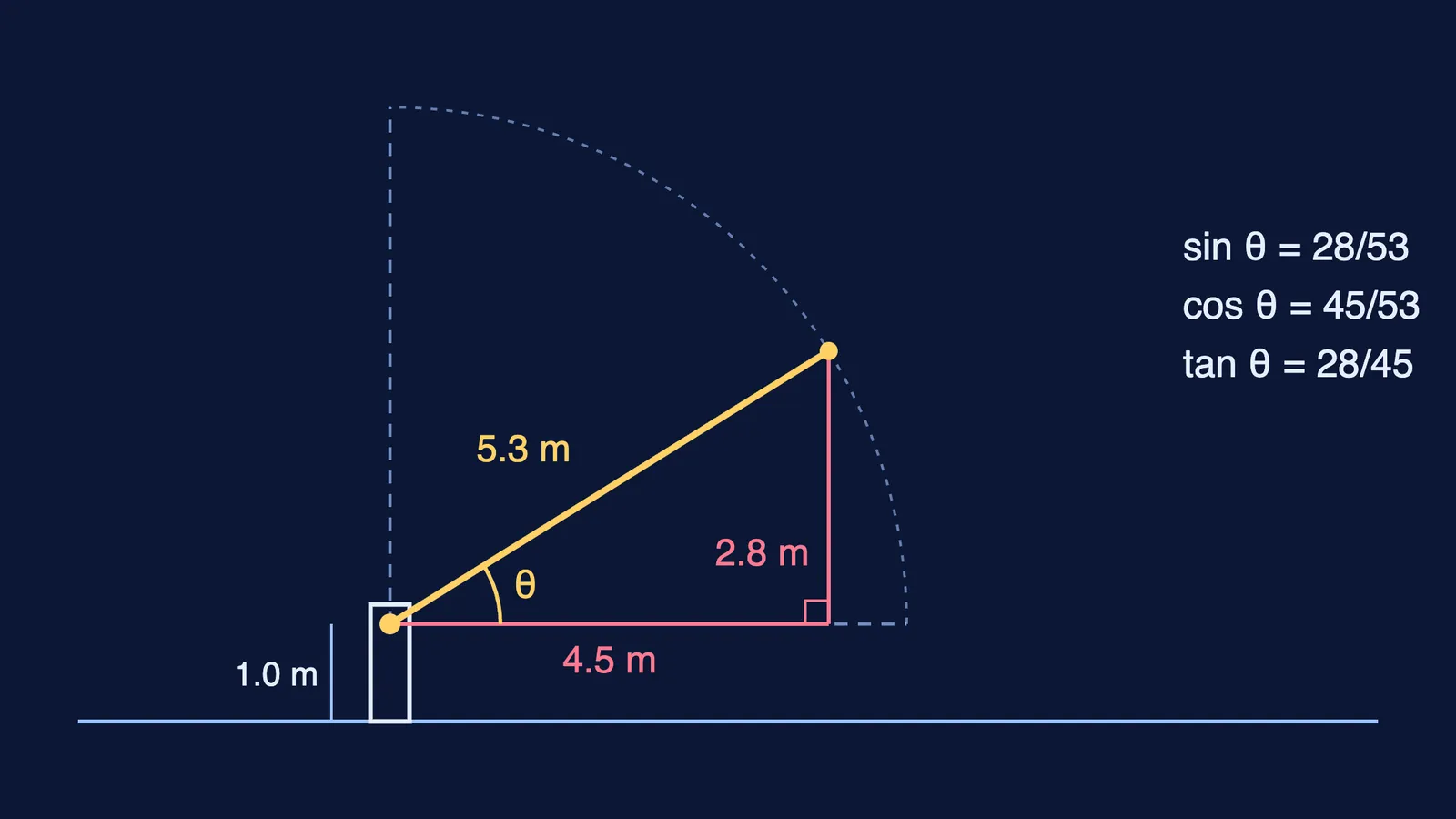
At a toll plaza on a highway near Nagpur, a boom barrier arm 5.3 m long swings upward about a pivot fixed 1.0 m above the road. When closed, the arm is horizontal (θ = 0°); when fully open, it is vertical (θ = 90°). Let θ be the angle between the arm and the horizontal. For any θ, the tip is 5.3 sin θ metres above the pivot and 5.3 cos θ metres out from it, horizontally. A sensor reports the tip's height above the pivot.
(i) At θ = 90°, which ratio is not defined? (a) sin θ (b) cos θ (c) tan θ (d) cosec θ
(ii) How high above the road is the tip when θ = 30°?
(iii) At what angle are the tip's height above the pivot and its horizontal distance from the pivot equal? Find that distance (take √2 ≈ 1.414).
(iv) The sensor reads 2.8 m above the pivot. Without finding θ, find the horizontal distance of the tip, then sin θ, cos θ and tan θ.
Answers.
(i) (c). tan 90° = sin 90°/cos 90° = 1/0, which is not defined.
(ii) Height above pivot = 5.3 × sin 30° = 5.3 × ½ = 2.65 m, so the tip is 1.0 + 2.65 = 3.65 m above the road.
(iii) 5.3 sin θ = 5.3 cos θ gives tan θ = 1, so θ = 45°. Each distance is 5.3 × 1/√2 = 2.65√2 ≈ 2.65 × 1.414 ≈ 3.75 m.
(iv) From sin²θ + cos²θ = 1, (height)² + (reach)² = 5.3², so reach = √(28.09 − 7.84) = √20.25 = 4.5 m. Then sin θ = 2.8/5.3 = 28/53, cos θ = 4.5/5.3 = 45/53 and tan θ = 28/45.
How do you attack case-study questions?
Draw and label the triangle first. Label opposite, adjacent and hypotenuse before any ratio.
Find the missing side with Pythagoras. Two sides give the third, and with it every ratio.
Reach for an identity when a part says "without finding the angle". sin²θ + cos²θ = 1 and sec²θ − tan²θ = 1 turn one known ratio into the rest.
Remember the limits. sin and cos never exceed 1, and tan 90° is not defined; a value like sin θ = 41/40 means a slip.
Keep fractions and surds to the last line. Use decimals only when asked.
If one ratio keeps turning into the wrong side, the Fermi Concept Library has every concept in mathematics with its own lesson. For a different style of practice, try our trigonometry assertion-reason questions for Class 10.