On this page
For the full chapter, read our differential equations Class 12 board exam guide.
What do differential equations case-study questions test?
The CBSE Mathematics curriculum for 2026-27 lists the scope: order and degree, general and particular solutions, separation of variables, homogeneous equations of first order and first degree, and linear equations. These cases stay inside the NCERT chapter (Reprint 2026-27).
The CBSE 2026-27 sample paper says Section E "comprises of 3 case-study/passage-based questions of 4 marks each". Its case studies are on other chapters. See also our guide to case-based questions in board exams.
Case 1: Emptying a rooftop tank
Before the monsoon, a family in Jaipur cleans the water tank on its roof. At 9 am the water is 2.25 m deep, and they open the drain valve at the bottom. The water runs out quickly at first, then more slowly, as less water presses down on the valve. A plumber who has timed similar tanks models the depth h (in metres) t hours after opening by dh/dt = −0.3√h. The family wants to know when they can start scrubbing.
(i) The order and degree of dh/dt = −0.3√h are: (A) 1 and 1 (B) 1 and 2 (C) 2 and 1 (D) order 1, degree not defined
(ii) Write the equation with the variables separated.
(iii) Find h as a function of t.
(iv) At what time is the water 0.25 m deep, and when is the tank empty?
Answers.
(i) (A). The only derivative is dh/dt, to power 1; the root is on h, not on the derivative.
(ii) dh/√h = −0.3 dt (for h > 0).
(iii) So 2√h = −0.3t + C. At t = 0, √h = 1.5, so C = 3 and √h = 1.5 − 0.15t. Hence h = (1.5 − 0.15t)² for 0 ≤ t ≤ 10.
(iv) √h = 0.5 gives t = 20/3 hours, so 3:40 pm. It is empty when 1.5 − 0.15t = 0: t = 10, or 7 pm.
Case 2: Salt in a pickle unit's brine tank
A pickle unit in Guntur keeps a 2,000-litre tank of brine with 40 kg of salt dissolved in it. It is too weak for the next batch of mango pickle, so the supervisor pumps in brine containing 0.05 kg of salt per litre at 20 litres per minute. A stirrer keeps the tank evenly mixed, and brine flows out at the same 20 litres per minute, so the volume stays 2,000 litres. Let S kg be the salt in the tank after t minutes. Take ln 2 = 0.693.
(i) The rate of change dS/dt equals: (A) 1 − S/100 (B) 1 − S/2000 (C) 20 − S/100 (D) 1 + S/100
(ii) Write the equation in the form dS/dt + PS = Q and find its integrating factor.
(iii) Find S as a function of t.
(iv) How long does the tank take to hold 70 kg of salt, and what amount does S approach?
Answers.
(i) (A). Salt enters at 20 × 0.05 = 1 kg/min and leaves at 20 × S/2000 = S/100 kg/min.
(ii) dS/dt + S/100 = 1, so P = 1/100 and Q = 1. I.F. = e^(∫P dt) = e^(t/100).
(iii) S e^(t/100) = ∫e^(t/100) dt = 100e^(t/100) + C, so S = 100 + Ce^(−t/100). At t = 0, S = 40, so C = −60 and S = 100 − 60e^(−t/100).
(iv) 70 = 100 − 60e^(−t/100) gives e^(−t/100) = 1/2, so t = 100 ln 2 ≈ 69.3 minutes. As e^(−t/100) tends to 0, S approaches 100 kg.
Case 3: A curved path in a Kolkata park
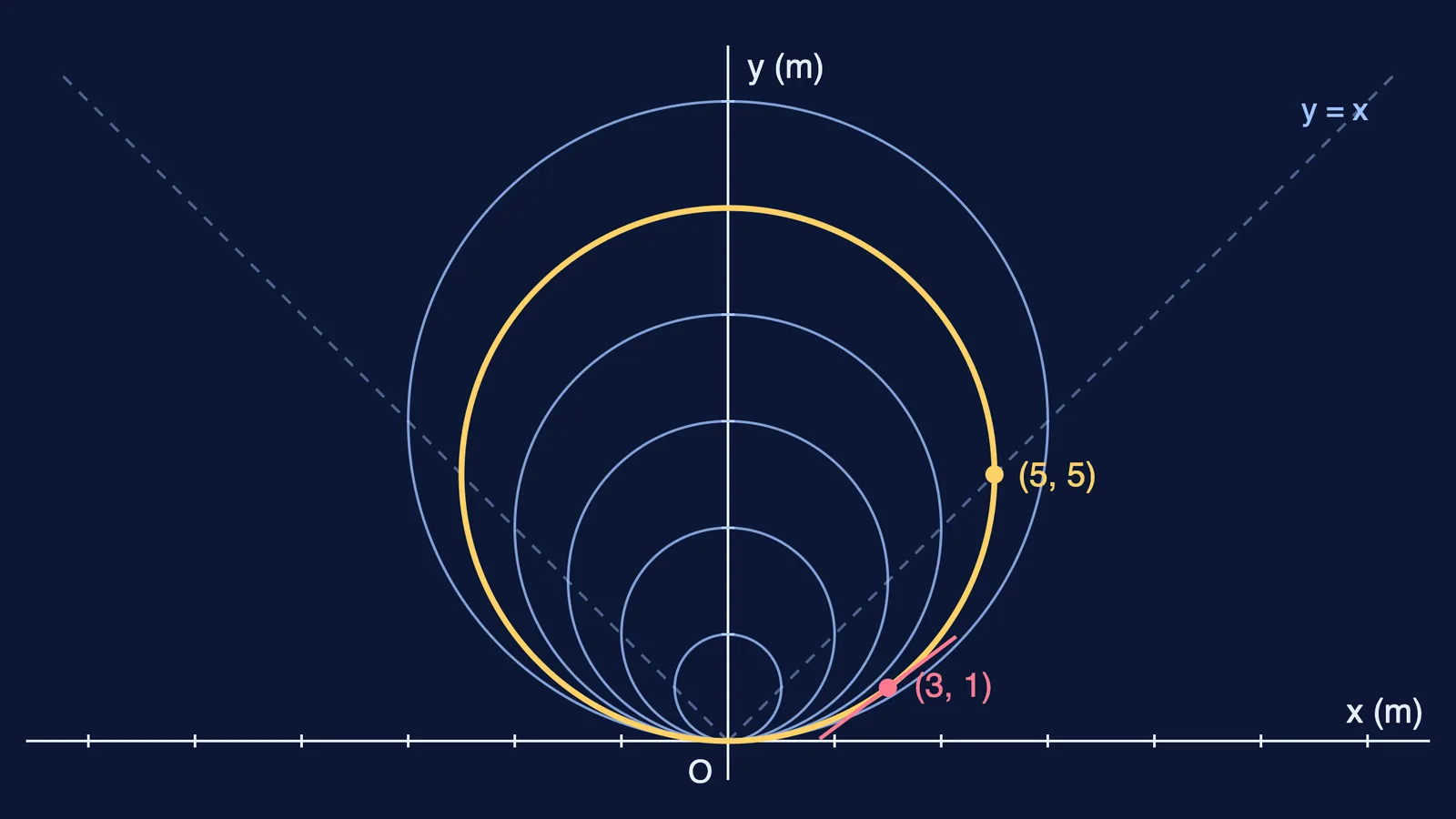
A landscape architect is laying a curved garden path in a Kolkata park. On her plan, axes are in metres, with the origin O at the entrance gate and the x-axis along the boundary wall. So that the path leaves the wall smoothly, its slope at each point (x, y) is dy/dx = 2xy/(x² − y²). It must also pass a lamp post at (3, 1). Before ordering paving stones, she needs the path's equation and shape.
(i) The function F(x, y) = 2xy/(x² − y²) is homogeneous of degree: (A) 0 (B) 1 (C) 2 (D) it is not homogeneous
(ii) Put y = vx. Write the equation in v and x with the variables separated.
(iii) Show that the general solution is x² + y² = Cy.
(iv) Find the path through the lamp post. Describe its shape and find its point with the largest x.
Answers.
(i) (A). Replacing x, y by λx, λy multiplies top and bottom by λ², so F(λx, λy) = F(x, y).
(ii) As dy/dx = v + x dv/dx, x dv/dx = 2v/(1 − v²) − v = (v + v³)/(1 − v²). So (1 − v²)/(v(1 + v²)) dv = dx/x.
(iii) By partial fractions the left side is 1/v − 2v/(1 + v²), so log|v| − log(1 + v²) = log|x| + log K and v/(1 + v²) = Kx. With v = y/x, y/(x² + y²) = K, so x² + y² = Cy (C = 1/K).
(iv) At (3, 1), 9 + 1 = C, so the path is x² + y² = 10y, or x² + (y − 5)² = 25: a circle of radius 5 m with centre (0, 5), through the gate. The point with the largest x is (5, 5). There y = x, so x² − y² = 0 and the tangent is vertical.
How do you attack case-study questions on differential equations?
Translate the words first: "rate of change", "slope of the tangent" and "per minute" all mean a derivative.
Name the type: separable, homogeneous (F(λx, λy) = F(x, y)) or linear (make the derivative's coefficient 1, then read P).
Add + C as you integrate; find it on its own line.
Interpret the answer: when does the tank empty, what shape is the path?
Check: substitute the given point and differentiate your answer once.
If a step keeps failing, the Fermi Problem Library has worked problems with a step-by-step solver that explains the reasoning rather than printing an answer. For one-mark practice, try our assertion-reason questions on Class 12 differential equations.