On this page
Every statement stays inside the NCERT Differential Equations chapter (Reprint 2026-27), and we checked every solution with Python.
How do you answer assertion-reason questions on differential equations?
The CBSE Class 12 Mathematics sample paper for 2026-27 has two 1-mark assertion-reason questions (Q19 and Q20). Differential equations sit in Unit III, Calculus, of the CBSE 2026-27 Mathematics curriculum.
Judge A, judge R, then read A, say "because", read R. Here the usual trick is a fact about degree offered as the reason for something that depends on order. More in our assertion-reason question strategy.
Assertion-reason keys:
(A) Both A and R are true and R is the correct explanation of A.
(B) Both A and R are true but R is NOT the correct explanation of A.
(C) A is true but R is false.
(D) A is false but R is true.
Statement I / Statement II keys:
(A) Both statements are correct.
(B) Both statements are incorrect.
(C) Statement I is correct, Statement II is incorrect.
(D) Statement I is incorrect, Statement II is correct.
Differential equations assertion-reason questions with answers
Q1 (easy). Assertion (A): The differential equation 3(y″)² + (y′)⁵ + y = 0 has degree 2. Reason (R): When a differential equation is a polynomial in its derivatives, its degree is the highest power of the highest order derivative in it.
Answer: (A). The highest order derivative is y″, raised to power 2. R is NCERT's definition of degree, so it explains A.
Trap: picking 5, the biggest power anywhere.
Q2 (easy). Assertion (A): The differential equation y″ + tan(y′) = 0 has degree 1. Reason (R): The degree of a differential equation is defined only when it is a polynomial equation in its derivatives.
Answer: (D). tan(y′) is not a polynomial in y′, so the degree is not defined and A is false. R is NCERT's condition.
Trap: seeing y″ with no visible power and writing 1.
Q3 (medium). Assertion (A): y = ax + b, with a and b arbitrary constants, is the general solution of d²y/dx² = 0. Reason (R): The degree of d²y/dx² = 0 is 1.
Answer: (B). Integrating twice gives y = ax + b, and the degree is 1, so both are true. The two constants come from the order being 2, not the degree.
Trap: mixing up order (how many constants) with degree.
Q4 (medium). Assertion (A): dy/dx = (x² + y²)/(xy) is a homogeneous differential equation. Reason (R): (x² + y²)/(xy) is a homogeneous function of degree 2.
Answer: (C). Replacing x, y by λx, λy leaves the fraction unchanged: degree 0, so A is true and R is false.
Trap: reading the degree off the numerator alone.
Q5 (hard). Assertion (A): y = a·e^(x + b), with a and b arbitrary constants, is the general solution of d²y/dx² = y. Reason (R): The general solution of a second order differential equation contains two arbitrary constants.
Answer: (D). a·e^(x + b) = (a·e^b)·e^x has only one independent constant and misses y = e^(−x), so A is false. R is NCERT's rule.
Trap: counting letters instead of independent constants.
Q6 (hard). Assertion (A): dy/dx = 1/(x + y²) can be solved as a linear equation, with integrating factor e^(−y). Reason (R): An equation of the form dx/dy + P₁x = Q₁, where P₁ and Q₁ are constants or functions of y only, is linear, with integrating factor e^(∫P₁ dy).
Answer: (A). Flipping gives dx/dy − x = y², so P₁ = −1 and the integrating factor is e^(−y). R is the rule that makes A work.
Trap: giving up because the equation is not linear in y.
Statement I and Statement II questions on differential equations
Q7 (easy). Statement I: The differential equation dy/dx = e^(x − y) can be solved by separating the variables. Statement II: Its general solution is e^y = e^x + C.
Answer: (A). e^(x − y) = e^x·e^(−y), so e^y dy = e^x dx. Integrating both sides gives e^y = e^x + C.
Trap: thinking an exponent of x − y cannot be split.
Q8 (medium). Statement I: If dy/dx = g(y/x), the substitution y = vx turns it into an equation in v and x whose variables separate. Statement II: F(x, y) = x² + xy + 1 is a homogeneous function of degree 2.
Answer: (C). I is the NCERT method: x dv/dx = g(v) − v separates. In II, the constant 1 does not scale by λ².
Trap: checking only the terms that have x and y in them.
Q9 (medium). Statement I: The integrating factor of x dy/dx − y = x³ (x > 0) is x. Statement II: Its general solution is y = x³/2 + Cx.
Answer: (D). Dividing by x gives dy/dx − y/x = x², so P = −1/x and the integrating factor is e^(−log x) = 1/x; I is incorrect. Then y/x = x²/2 + C, which gives II.
Trap: reading P before dividing through, or dropping the minus sign.
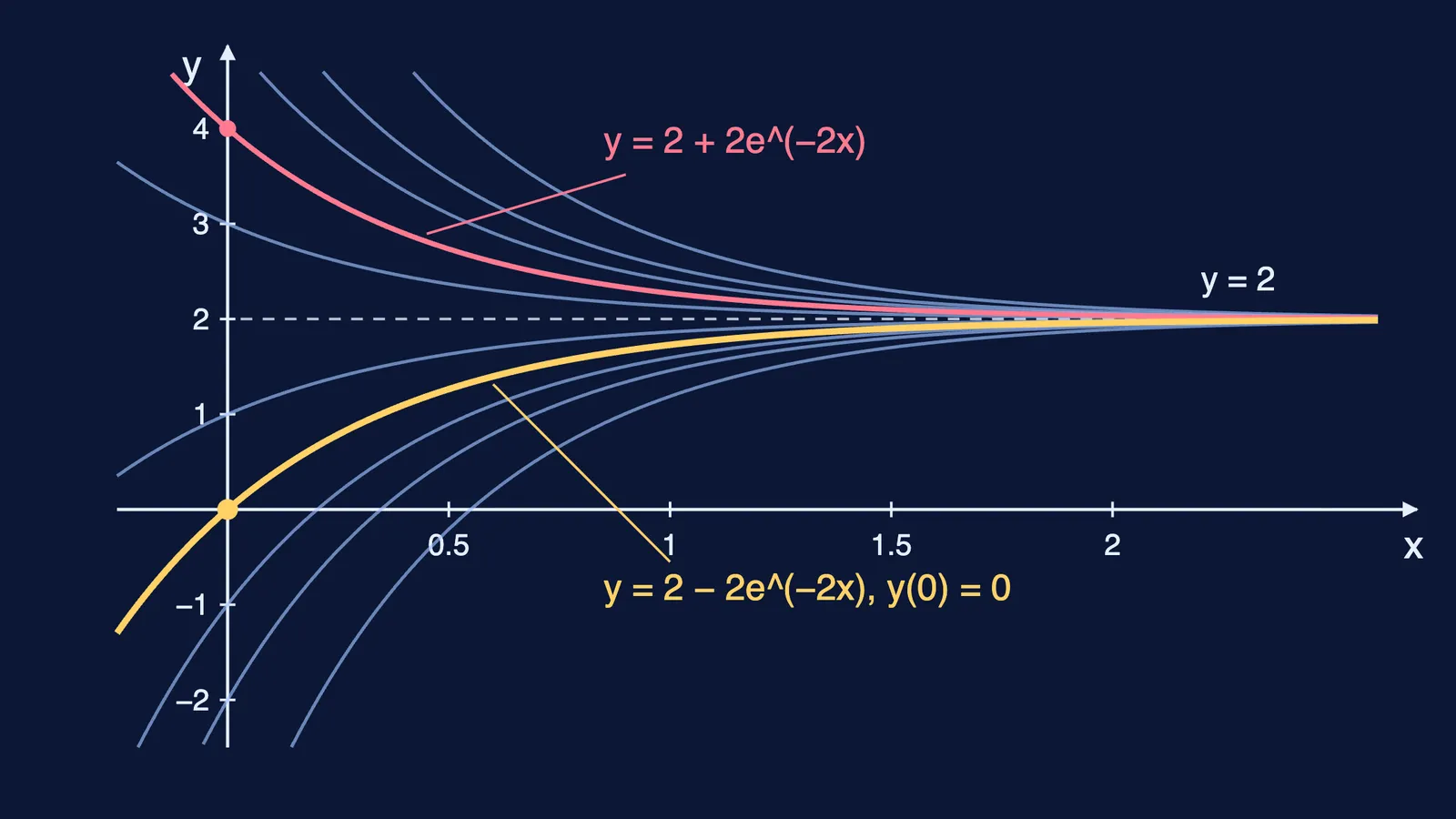
Q10 (hard). Statement I: The particular solution of dy/dx + 2y = 4 with y(0) = 0 is y = 2 + 2e^(−2x). Statement II: Every solution of dy/dx + 2y = 4 approaches 0 as x grows large.
Answer: (B). With integrating factor e^(2x), y = 2 + Ce^(−2x); y(0) = 0 gives C = −2, so the answer is y = 2 − 2e^(−2x) and I is incorrect. Every solution approaches 2, not 0, so II is incorrect.
Trap: a sign slip on C, and assuming solutions die away to zero.
How should you use this set?
Cover the answers and do all ten in one timed sitting.
For every miss, write the trap in your own words; redo it later in the week.
Solve Q6, Q9 and Q10 fully on paper.
If your answers keep going wrong at the same step, the Fermi Problem Library has worked problems with a step-by-step solver that explains the reasoning rather than printing an answer. For step marks and a revision plan, see our differential equations Class 12 board exam guide, and for the whole paper, our section-wise CBSE Class 12 maths plan.