On this page
Three original cases, easy to hard, with worked answers. For definitions, rules and answer layout, read our continuity and differentiability Class 12 board answer guide first.
What do case-study questions on continuity and differentiability look like?
The CBSE 2026-27 Mathematics sample paper has three case study-based questions of 4 marks each in Section E, and calculators are not allowed. Every number below works out by hand. Each case stays inside the CBSE 2026-27 Mathematics syllabus and the rationalised NCERT Chapter 5 (Reprint 2026-27): continuity, differentiability, parametric forms, exponential and logarithmic functions and second order derivatives.
Case 1: The cab fare rule
A cab company in Bengaluru writes its fare as a function of the trip length x km. For 0 < x ≤ 2, the fare is a flat ₹60. For 2 < x ≤ 10, it is F(x) = 60 + 18(x − 2) rupees, charged on the exact distance with no rounding. The company now wants a cheaper rate for long trips: for x > 10, F(x) = 15x + k. Its app developer insists that the fare must never jump suddenly at a boundary, so riders are not surprised by a sudden change of a few rupees.
(i) The fare for a 5 km trip is: (a) ₹90 (b) ₹114 (c) ₹150 (d) ₹96
(ii) Is F continuous at x = 2?
(iii) Find k so that F is continuous at x = 10.
(iv) Is F differentiable at x = 2? Justify with one-sided derivatives.
Answers.
(i) (b). F(5) = 60 + 18 × 3 = ₹114.
(ii) Yes. The left-hand limit is 60, the right-hand limit is 60 + 18 × 0 = 60, and F(2) = 60. All three are equal.
(iii) From the left, F(10) = 60 + 18 × 8 = 204. From the right, the limit is 150 + k. So 150 + k = 204, giving k = 54.
(iv) No. The left-hand derivative at 2 is 0 (the fare is constant there) and the right-hand derivative is 18. They differ, so the graph has a corner at x = 2: continuous but not differentiable.
Case 2: The garden fountain
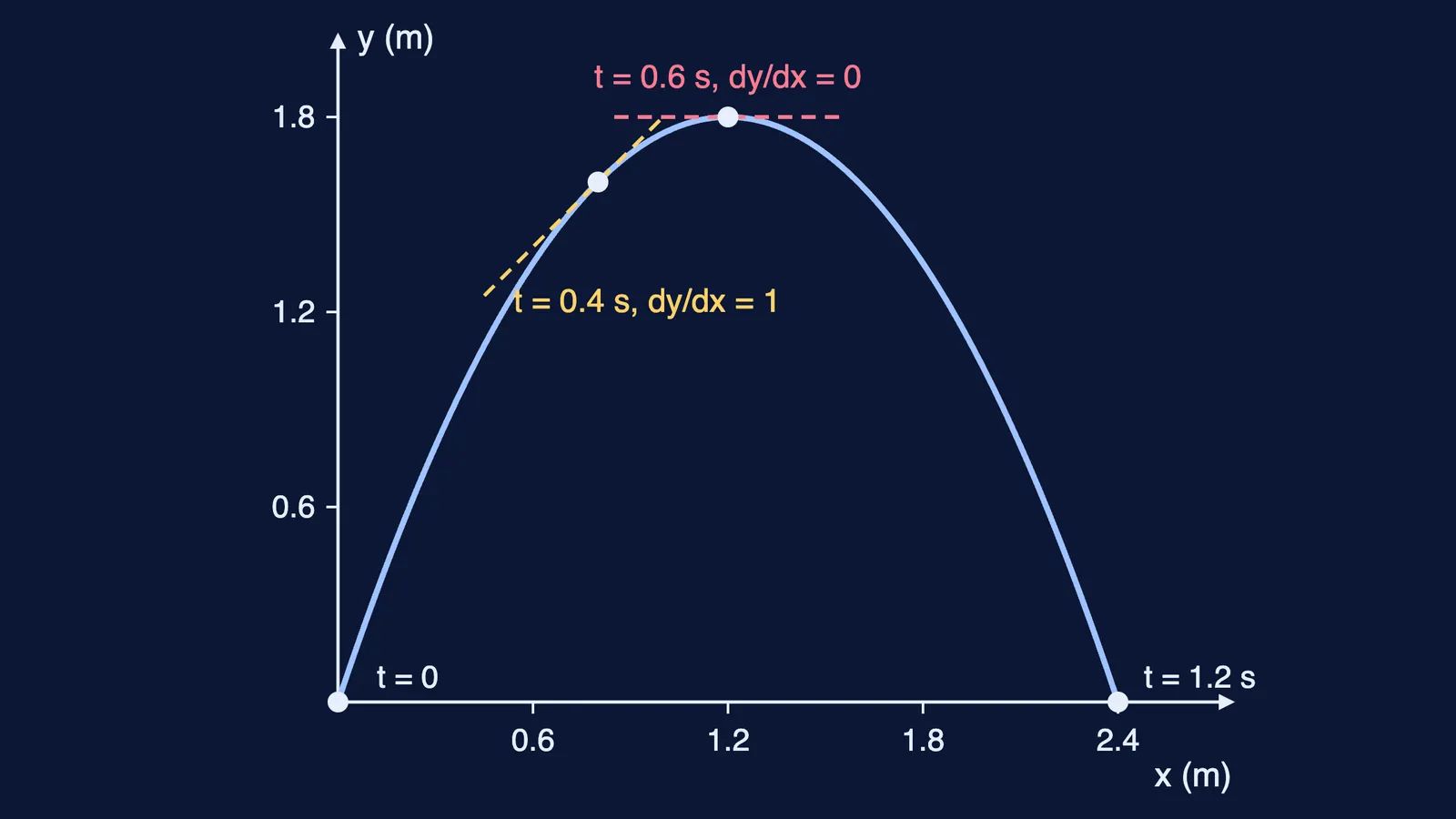
A fountain in a Mysuru park throws a thin jet of water from ground level. An engineering student films it and models a drop of water by x = 2t and y = 6t − 5t², where x and y are its horizontal distance and height in metres and t is the time in seconds after it leaves the nozzle. She wants the slope of the path at different moments, the highest point, and how quickly the slope itself changes, so that a sloping rail planned for the side of the pool can follow the shape of the jet.
(i) dx/dt equals: (a) 2 (b) 2t (c) 6 − 10t (d) 0
(ii) Find dy/dx in terms of t, and its value at t = 1 s.
(iii) At what time is the jet horizontal, and where is the drop then?
(iv) Find d²y/dx².
Answers.
(i) (a).
(ii) dy/dx = (dy/dt)/(dx/dt) = (6 − 10t)/2 = 3 − 5t. At t = 1 s, dy/dx = 3 − 5 = −2: the drop is already falling.
(iii) dy/dx = 0 when t = 0.6 s. Then x = 1.2 m and y = 3.6 − 1.8 = 1.8 m: the top of the jet.
(iv) d²y/dx² = d/dt(3 − 5t) ÷ dx/dt = −5/2. Check: eliminating t gives y = 3x − 5x²/4, so dy/dx = 3 − 5x/2 and d²y/dx² = −5/2.
Case 3: The cooling chai
At a tea stall in Kolkata, a student logs the temperature of a cup of chai left on the counter in a 25 °C room. The data fit the model T(t) = 25 + 65e^(−0.1t), where T is in °C and t in minutes after pouring. The stall owner wants to know how fast the chai cools at first, and when it is down to 50 °C, the temperature at which he hands cups to younger customers. Natural logarithms (log to base e) may be left unevaluated in your answers.
(i) dT/dt equals: (a) 65e^(−0.1t) (b) −6.5e^(−0.1t) (c) −0.1e^(−0.1t) (d) 6.5e^(−0.1t)
(ii) How fast is the chai cooling just after it is poured?
(iii) Show that dT/dt = −0.1(T − 25). When is T = 50 °C, and how fast is it cooling then?
(iv) Find d²T/dt² and show that d²T/dt² + 0.1 dT/dt = 0. What does its sign tell the stall owner?
Answers.
(i) (b), by the chain rule: d/dt e^(−0.1t) = −0.1e^(−0.1t).
(ii) At t = 0, dT/dt = −6.5, so it cools at 6.5 °C per minute.
(iii) 65e^(−0.1t) = T − 25, so dT/dt = −0.1(T − 25). T = 50 gives e^(−0.1t) = 25/65 = 5/13, so t = 10 log(13/5) minutes (about 9.6). Then dT/dt = −0.1 × 25 = −2.5 °C per minute.
(iv) d²T/dt² = 0.65e^(−0.1t) = −0.1 dT/dt, so the sum is 0. It is always positive: the cooling rate shrinks as the chai nears room temperature.
How do you attack case-study questions on continuity and differentiability?
For a piecewise rule, write the left-hand limit, the right-hand limit and the value at the boundary as three separate lines before you decide.
To test differentiability at a join, compare the slopes of the two pieces only after checking continuity there; a jump already rules out a derivative.
In parametric questions, find dx/dt and dy/dt first, and keep t in the answer unless the case asks for x.
For exponential models, rewrite the derivative in terms of the original quantity (like T − 25); later parts usually need that form.
Give units with every rate: °C per minute, rupees per km, metres per metre.
For practice on the theory behind these cases, try our assertion-reason set on continuity and differentiability and our guide to case-based questions in board exams. If a step keeps slipping, the Fermi Problem Library has worked problems with a step-by-step solver that explains the reasoning rather than printing an answer.