

On this page
These 10 original questions target what students half-know in NCERT Chapter 5: continuity on a domain, continuous versus differentiable, and careless derivative rules.
How do you answer assertion-reason questions in continuity and differentiability?
The CBSE Class 12 Mathematics sample paper for 2026-27 has two assertion-reason questions, Q19 and Q20, of 1 mark each. Everything here stays inside the CBSE 2026-27 Mathematics syllabus and the NCERT chapter, Reprint 2026-27, with no Rolle's theorem or Mean Value Theorem.
Keys for Q1 to Q6:
(A) Both A and R are true and R is the correct explanation of A.
(B) Both A and R are true but R is NOT the correct explanation of A.
(C) A is true but R is false.
(D) A is false but R is true.
Keys for Q7 to Q10:
(A) Both statements are correct.
(B) Both statements are incorrect.
(C) Statement I is correct, Statement II is incorrect.
(D) Statement I is incorrect, Statement II is correct.
Judge each statement alone first. For more, see our assertion-reason strategy guide.
Assertion-reason questions with answers
Q1 (easy). Assertion (A): f(x) = sin x + x³ is continuous at every real number. Reason (R): The sum of two continuous functions is continuous.
Answer: (A). sin x and x³ are continuous everywhere, and R is the rule that makes their sum continuous.
Trap: checking one point and calling the whole function continuous.
Q2 (easy). Assertion (A): f(x) = 1/(x − 2), x ≠ 2, is a continuous function. Reason (R): A function whose graph cannot be drawn without lifting the pen is not a continuous function.
Answer: (C). NCERT calls f continuous if it is continuous at every point of its domain; 2 is not in the domain, so A is true. R is false: NCERT notes that a continuous function may need the pen lifted, but only where it is not defined.
Trap: "the graph breaks, so f is discontinuous". Continuity is judged only on the domain.
Q3 (medium). Assertion (A): f(x) = |x² − 4| is differentiable at x = 2. Reason (R): f is continuous at x = 2.
Answer: (D). R is true: the limit and f(2) are both 0. A is false: x² − 4 changes sign at 2, so the one-sided derivatives there are −4 and +4.
Trap: assuming continuous implies differentiable. NCERT proves only the reverse.
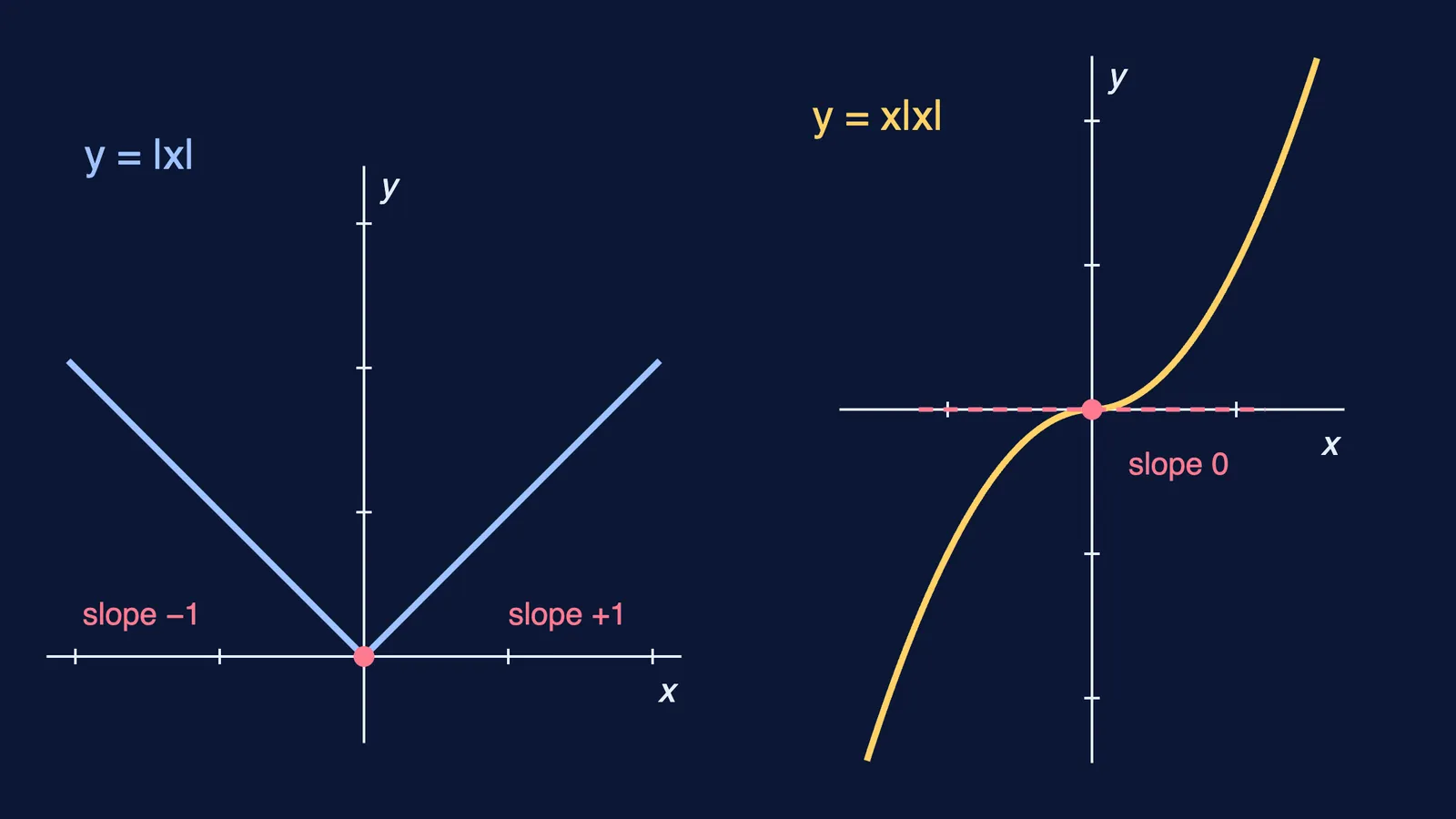
Q4 (medium). Assertion (A): f(x) = x|x| is differentiable at x = 0. Reason (R): f is continuous at x = 0.
Answer: (B). Both are true: (f(h) − f(0))/h = |h| → 0 from both sides, so f′(0) = 0. But continuity cannot explain differentiability: |x| is continuous at 0 and not differentiable there.
Trap: picking (A) because R sounds supportive.
Q5 (medium). Assertion (A): f(x) = [2x], where [ ] is the greatest integer function, is not differentiable at x = 1/2. Reason (R): f is not continuous at x = 1/2.
Answer: (A). As x → 1/2, 2x → 1, so the left-hand limit is 0 and the right-hand limit is 1: f jumps. By NCERT's Theorem 3, differentiable implies continuous, so the jump rules out a derivative: R explains A.
Trap: computing derivatives before noticing the jump.
Q6 (hard). Assertion (A): If x = t² and y = t³ (t ≠ 0), then d²y/dx² = 3/(4t). Reason (R): For any parametric curve, d²y/dx² = (d²y/dt²) ÷ (d²x/dt²).
Answer: (C). dy/dx = 3t²/2t = 3t/2, so d²y/dx² = d/dt(3t/2) × dt/dx = (3/2) × 1/(2t) = 3/(4t): A is true. R is false; here it gives 6t/2 = 3t.
Trap: dividing second derivatives.
Statement I and Statement II questions with answers
Q7 (medium). Statement I: d/dx [log(x²)] = 2/x holds only for x > 0. Statement II: For x < 0, d/dx [log|x|] = 1/x.
Answer: (D). log(x²) is defined for every x ≠ 0, and the chain rule gives 2x/x² = 2/x on that whole domain, so Statement I is wrong. For x < 0, log|x| = log(−x), with derivative −1/(−x) = 1/x.
Trap: rewriting log(x²) as 2 log x, which drops all negative x.
Q8 (medium). Statement I: If f is continuous at c and g is discontinuous at c, then f + g can be continuous at c. Statement II: If f and g are both discontinuous at c, then f + g must be discontinuous at c.
Answer: (B). If f + g were continuous, g = (f + g) − f would be continuous too, a contradiction; Statement I is wrong. With f(x) = [x], g = −f and c = 1, both jump yet f + g = 0, so Statement II is wrong.
Trap: assuming two discontinuous functions always add up to one.
Q9 (hard). For the circle x² + y² = 25: Statement I: At (3, 4), dy/dx = −3/4. Statement II: d²y/dx² = −25/y³ wherever y ≠ 0.
Answer: (A). Implicitly, 2x + 2y(dy/dx) = 0, so dy/dx = −x/y = −3/4 at (3, 4). Differentiating again and using x² + y² = 25 gives d²y/dx² = −(x² + y²)/y³ = −25/y³.
Trap: forgetting to substitute dy/dx in the second step. Practise more with our implicit and logarithmic differentiation guide.
Q10 (hard). Let y = x^x for x > 0. Statement I: dy/dx = x^x for every x > 0. Statement II: The value of dy/dx at x = 1 is 1.
Answer: (D). Taking logs, log y = x log x, so dy/dx = x^x(1 + log x), which equals x^x only at x = 1. At x = 1 it gives 1 × (1 + 0) = 1, so only Statement II is right.
Trap: using the power rule on a variable exponent.
How should you use this set?
Cover the answers and mark each statement true or false before choosing a key.
For every (A) or (B) call, write the rule linking R to A, or "no rule".
Redo misses two days later, without notes.
For step marks on 2- and 3-mark answers, read our continuity and differentiability Class 12 board answer guide. If you got a key right but cannot say why, the Fermi Concept Library has a lesson for every concept in mathematics, each with its place in the map.


