On this page
Three original cases with worked answers, easiest first. For the methods, read our Integrals Class 12 board exam guide first.
What do case-study questions on Integrals look like?
In the CBSE 2026-27 Mathematics sample paper, Section E (questions 36 to 38) has three "case study-based questions carrying 4 marks each", and calculators are not allowed. The first two have three sub-parts worth 1, 1 and 2 marks; the third has two sub-parts of 2 marks each. Every case stays inside the CBSE 2026-27 Mathematics syllabus and the rationalised NCERT Chapter 7, Integrals (Reprint 2026-27).
Case 1: The housing society water tank
In a Jaipur housing society, a pump fills an overhead tank from a tanker. The flow rises as the motor warms up: t minutes after switching on, water enters at r(t) = 30 + 12√t litres per minute, for 0 ≤ t ≤ 16. The volume added between two times is the integral of r(t) over that interval. The tank holds 1,200 litres, and when the pump starts there are already 208 litres in it. No water is drawn from the tank while it fills.
(i) An antiderivative of 12√t is: (a) 6/√t (b) 8t^(3/2) (c) 18t^(3/2) (d) 24t^(3/2)
(ii) How many litres enter in the first 4 minutes?
(iii) How many litres enter between the 4th and the 9th minute?
(iv) Write the volume V(t) in the tank and show that it is exactly full at t = 16 minutes, not before.
Answers.
(i) (b). Since ∫ t^(1/2) dt = (2/3)t^(3/2), 12 × (2/3) = 8.
(ii) ∫₀⁴ (30 + 12√t) dt = [30t + 8t^(3/2)]₀⁴ = 120 + 64 = 184 litres.
(iii) [30t + 8t^(3/2)]₄⁹ = (270 + 216) − (120 + 64) = 302 litres.
(iv) V(t) = 208 + 30t + 8t^(3/2). V(16) = 208 + 480 + 512 = 1,200 litres. As r(t) > 0, V is increasing, so it is full only at t = 16.
Case 2: The braked trolley
In a Bengaluru school lab, students push a trolley along a straight track past a strong magnet, which acts as a brake. A motion sensor records its speed, and the class fits a formula to the readings: the speed t seconds after passing the start mark is v(t) = 12/((t + 1)(t + 3)) m/s. The distance it covers between two times is the integral of v(t). Take log 3 ≈ 1.10 and log 2 ≈ 0.69, where log is the natural logarithm.
(i) 12/((t + 1)(t + 3)) in partial fractions is: (a) 6/(t + 1) + 6/(t + 3) (b) 6/(t + 1) − 6/(t + 3) (c) 12/(t + 1) − 12/(t + 3) (d) 3/(t + 1) − 3/(t + 3)
(ii) What is the trolley's speed at the start mark, and 1 second later?
(iii) How far does it travel in the first second?
(iv) Find the distance covered in the first T seconds, and show that the trolley never covers 7 m, however long the track.
Answers.
(i) (b). Write 12 = A(t + 3) + B(t + 1). Putting t = −1 gives A = 6; putting t = −3 gives B = −6.
(ii) v(0) = 12/3 = 4 m/s and v(1) = 12/8 = 1.5 m/s.
(iii) ∫₀¹ [6/(t + 1) − 6/(t + 3)] dt = 6[log((t + 1)/(t + 3))]₀¹ = 6(log(1/2) − log(1/3)) = 6 log(3/2) ≈ 6(1.10 − 0.69) ≈ 2.5 m.
(iv) Similarly, D(T) = 6 log(3(T + 1)/(T + 3)). Now 3(T + 1)/(T + 3) = 3 − 6/(T + 3), which is less than 3 for every T, so D(T) < 6 log 3 ≈ 6.6 m, short of 7 m.
Case 3: The rooftop solar panel
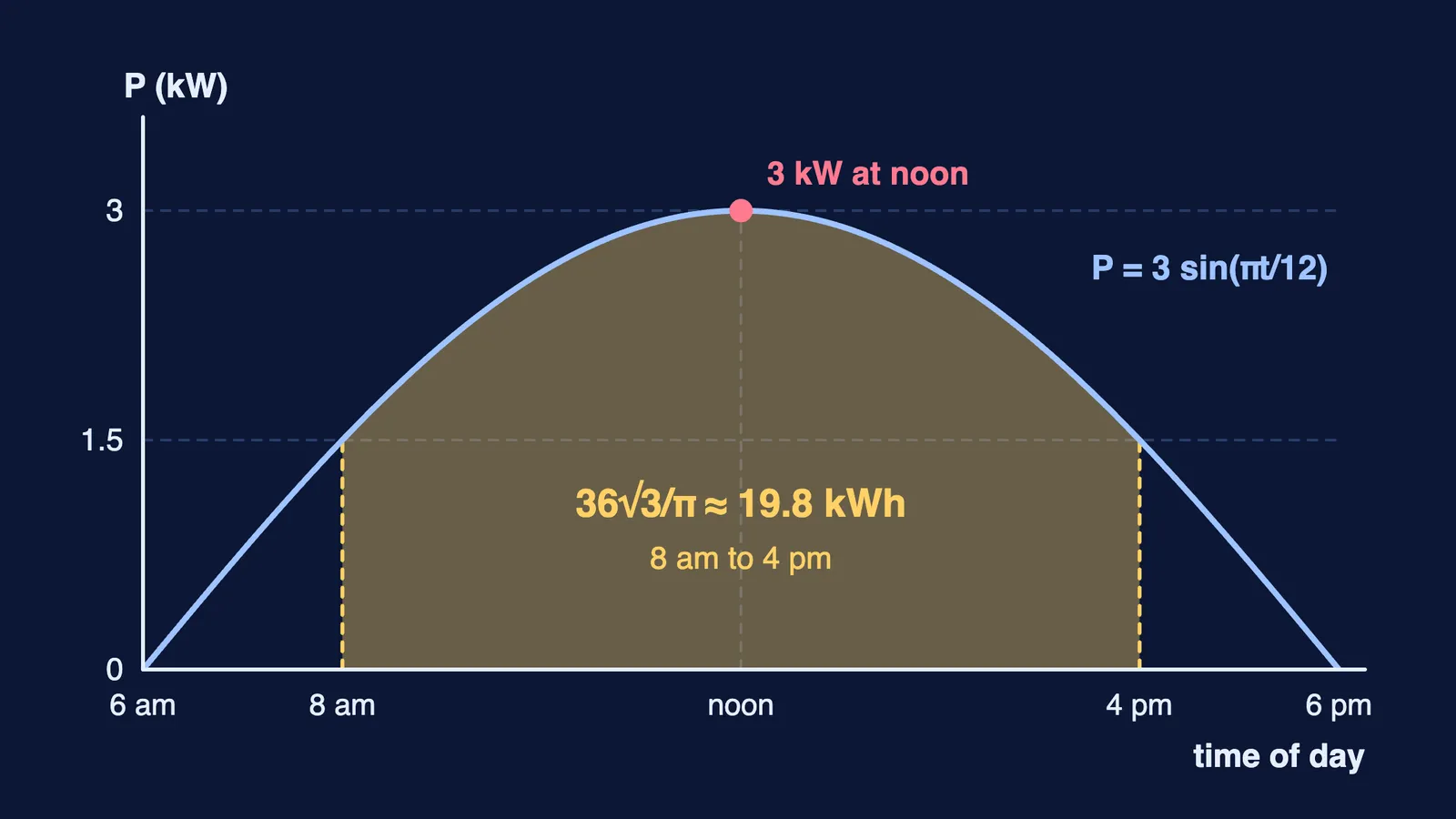
A school in Jodhpur has rooftop solar panels. Their output rises from zero at sunrise, peaks at noon and falls back to zero at sunset. On a clear day, an idealised model of the power output is P(t) = 3 sin(πt/12) kW, where t is the number of hours after 6 am, 0 ≤ t ≤ 12. The energy produced, in kWh, between two times is the integral of P(t) over that interval. Take π ≈ 3.14 and √3 ≈ 1.73.
(i) ∫ sin(πt/12) dt equals: (a) (12/π) cos(πt/12) + C (b) −(π/12) cos(πt/12) + C (c) −(12/π) cos(πt/12) + C (d) −12 cos(πt/12) + C
(ii) How much energy do the panels produce from 6 am to noon?
(iii) How much do they produce between 8 am and 4 pm, and what share of the day's total is that?
(iv) Using a property of definite integrals, show that ∫₀¹² t P(t) dt = 6 ∫₀¹² P(t) dt, and hence find its value.
Answers.
(i) (c). Differentiating −(12/π) cos(πt/12) gives sin(πt/12).
(ii) ∫₀⁶ 3 sin(πt/12) dt = −(36/π)[cos(πt/12)]₀⁶ = (36/π)(1 − 0) = 36/π ≈ 11.5 kWh.
(iii) 8 am to 4 pm is t = 2 to t = 10: (36/π)(cos(π/6) − cos(5π/6)) = 36√3/π ≈ 19.8 kWh. The whole day gives 72/π ≈ 22.9 kWh, so the share is √3/2, about 87%.
(iv) Let I = ∫₀¹² t P(t) dt. By property P4, I = ∫₀¹² (12 − t) P(12 − t) dt, and P(12 − t) = 3 sin(π − πt/12) = P(t). So I = ∫₀¹² (12 − t) P(t) dt. Adding the two forms, 2I = 12 ∫₀¹² P(t) dt, so I = 6 × 72/π = 432/π ≈ 137.6.
How do you attack case-study questions on Integrals?
Underline the rate, its unit and the interval; the answer's unit is the rate's unit times time.
Pick the method from the integrand: linear factors in the denominator (partial fractions), sin(kt) (substitution), t times a function (by parts or a property).
Write the antiderivative in square brackets with its limits before substituting.
For "show that" parts, test properties P3 to P7 first.
Keep exact answers such as 6 log(3/2) or 36/π, and approximate only at the end with the values the passage gives.
For the format, see our guide to case-based questions in board exams, then try the assertion-reason set on Integrals. If a step keeps slipping, the Fermi Problem Library has worked problems with a step-by-step solver that explains the reasoning rather than printing an answer.