On this page
These ten original items cover the Integrals chapter of the CBSE Class 12 Mathematics curriculum 2026-27 and NCERT Class 12 Mathematics Part II, Chapter 7. Every answer was checked against the Reprint 2026-27 text and with SymPy. The CBSE 2026-27 sample paper uses this format, with an assertion-reason item on integrals as Q19. For methods, see our Integrals Class 12 board exam guide.
How do you answer assertion-reason questions in maths?
Work in three steps:
Is the Assertion true on its own?
Is the Reason true on its own?
Only if both are true: is R the result that actually produces A?
More in our assertion-reason strategy post.
Keys for Q1 to Q6:
(A) Both A and R are true and R is the correct explanation of A.
(B) Both A and R are true but R is NOT the correct explanation of A.
(C) A is true but R is false.
(D) A is false but R is true.
Keys for Q7 to Q10:
(A) Both statements are correct.
(B) Both statements are incorrect.
(C) Statement I is correct, Statement II is incorrect.
(D) Statement I is incorrect, Statement II is correct.
Assertion-reason questions on Integrals
Q1 (easy). Assertion (A): For x ≠ 0, ∫ (1/x) dx = log|x| + C. Reason (R): For every x ≠ 0, the derivative of log|x| is 1/x.
Answer: (A). Both are true. Integration reverses differentiation, so R is exactly why A holds for negative x too.
Trap: writing log x and losing every negative x.
Q2 (easy). Assertion (A): ∫ eˣ (tan x + sec²x) dx = eˣ tan x + C. Reason (R): ∫ eˣ [f(x) + f′(x)] dx = eˣ f′(x) + C.
Answer: (C). A is true: with f(x) = tan x, f′(x) = sec²x and the integrand is eˣ [f(x) + f′(x)]. R is false: NCERT's result is eˣ f(x) + C, not eˣ f′(x) + C.
Trap: misremembering which function sits outside.
Q3 (medium). Assertion (A): ∫ dx/(x² + 4) = (1/2) tan⁻¹(x/2) + C. Reason (R): ∫ dx/(x² − a²) = (1/(2a)) log|(x − a)/(x + a)| + C.
Answer: (B). Both are true standard integrals. But A has a plus sign and comes from the tan⁻¹ formula for x² + a², so R, the formula for x² − a², does not explain it.
Trap: picking (A) because both lines are "standard forms with a²".
Q4 (medium). Assertion (A): With t = x², ∫₀² x e^(x²) dx = (1/2) ∫₀² eᵗ dt. Reason (R): After substituting t = g(x) in a definite integral, the limits change to g(a) and g(b).
Answer: (D). A is false: when x = 2, t = 4, so the new limits are 0 and 4 and the value is (e⁴ − 1)/2. R is true, and it is exactly the rule A breaks.
Trap: changing dx but keeping the old limits.
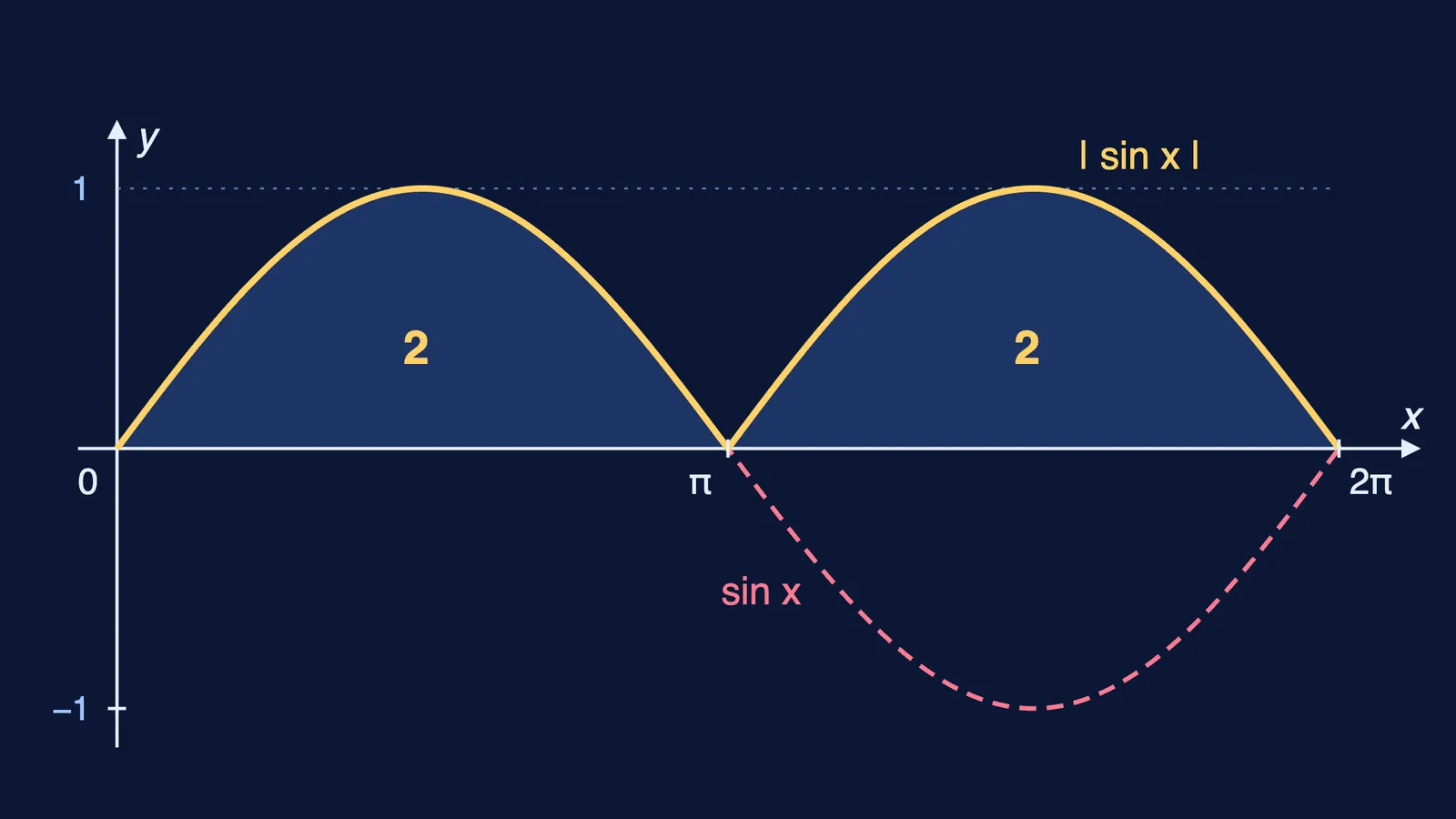
Q5 (hard). Assertion (A): ∫₀^(2π) |sin x| dx = 4. Reason (R): ∫₀^(2π) sin x dx = 0.
Answer: (B). Both are true. A comes from splitting at π: ∫₀^π sin x dx = 2, and on [π, 2π] |sin x| = −sin x, which also gives 2. R is the cancellation the modulus removes, so it cannot explain A (see the diagram).
Trap: thinking R makes A false, and choosing (D).
Q6 (hard). Assertion (A): ∫ from −1 to 1 of x² · log((3 + x)/(3 − x)) dx = 0. Reason (R): g(x) = x² · log((3 + x)/(3 − x)) satisfies g(−x) = −g(x).
Answer: (A). Both are true. x² is even and the log factor is odd, so g is odd, and property P7 gives 0 for an odd function on [−a, a]. R is the direct reason.
Trap: integrating by parts before testing for odd or even.
Statement I and Statement II questions on Integrals
Q7 (easy). Statement I: ∫ dx/√(a² − x²) = sin⁻¹(x/a) + C. Statement II: ∫ tan x dx = log|cos x| + C.
Answer: (C). Statement I is correct. Statement II is incorrect: the derivative of log|cos x| is −tan x, so the answer is −log|cos x| + C, or log|sec x| + C.
Trap: dropping the minus sign.
Q8 (medium). Statement I: (x² + 3)/((x − 2)(x + 1)) can be written as A/(x − 2) + B/(x + 1) for constants A and B. Statement II: (2x + 3)/((x + 1)²(x − 3)) can be written as A/(x + 1) + B/(x + 1)² + C/(x − 3).
Answer: (D). Statement I is incorrect: numerator and denominator both have degree 2, so the fraction is improper; divide first to get 1 + 7/(3(x − 2)) − 4/(3(x + 1)). Statement II is correct: a repeated factor needs both terms.
Trap: splitting an improper fraction without dividing.
Q9 (medium). Statement I: ∫₁⁴ x²/(x² + (5 − x)²) dx = 3/2. Statement II: ∫ x cos 2x dx = (x sin 2x)/2 + (cos 2x)/4 + C.
Answer: (A). Both are correct. For I, property P3 replaces x by 1 + 4 − x = 5 − x; adding the two forms gives 2I = ∫₁⁴ 1 dx = 3. For II, take x as the first function in integration by parts.
Trap: using 4 − x instead of 5 − x.
Q10 (hard). Statement I: ∫₋₁¹ dx/x² = [−1/x] from −1 to 1 = −2. Statement II: ∫₀^π cos³x dx = 2 ∫₀^(π/2) cos³x dx.
Answer: (B). Both are incorrect. In I, the fundamental theorem needs f continuous on [a, b], and 1/x² breaks at 0. In II, cos³(π − x) = −cos³x, so property P6 gives 0, not 4/3.
Trap: applying a formula without checking its condition.
How should you use this set?
Cover the answers and write your key for all ten.
Wrong on whether a statement is true? Redo the integral or differentiate your answer. Wrong between (A) and (B)? Name the property that produces A.
Then move on to areas in our Application of integrals board guide.
If a trap keeps catching you in the working, such as the limits in Q4, the Fermi Problem Library has worked problems with a step-by-step solver that explains the reasoning rather than printing an answer.