On this page
What do case-study questions on this chapter test?
The CBSE Class 12 Mathematics syllabus for 2026-27 lists two ideas for this chapter: types of relations (reflexive, symmetric, transitive, equivalence) and one-one and onto functions. Composition and invertible functions are in the NCERT chapter but not in that list, so no case uses them.
The CBSE 2026-27 Class 12 Maths sample paper says its Section E "comprises of 3 case-study/passage-based questions of 4 marks each". Every definition here matches the NCERT chapter Relations and Functions (Reprint 2026-27); the scenarios and numbers are our own. For the theory and proofs, start with our Relations and functions Class 12 board exam guide.
Case 1: Which flats share a floor?
A three-storey building in Jaipur has nine flats. Floor 1 has flats 101, 102 and 103; floor 2 has 201 and 202; floor 3 has 301, 302, 303 and 304. On the set A of the nine flats, the secretary defines R = {(a, b) : flat a and flat b are on the same floor}. For the lift schedule she also defines S = {(a, b) : flat a is on a lower floor than flat b}.
(i) R is (a) reflexive but not symmetric (b) symmetric but not transitive (c) an equivalence relation (d) the universal relation
(ii) Write the equivalence class [201].
(iii) How many ordered pairs does R contain?
(iv) Check whether S is reflexive, symmetric and transitive.
Answers.
(i) (c). Every flat is on its own floor (reflexive); "same floor" works both ways (symmetric); if a shares a floor with b and b with c, then a shares it with c (transitive).
(ii) [201] = {201, 202}, the flats on floor 2.
(iii) Floor by floor: 3² + 2² + 4² = 9 + 4 + 16 = 29.
(iv) Not reflexive: (101, 101) ∉ S, since no flat is below itself. Not symmetric: (101, 201) ∈ S but (201, 101) ∉ S. Transitive: if a's floor is below b's and b's is below c's, then a's is below c's.
Case 2: Is the library's check-digit rule one-one?
A school library in Kochi tags each book with a single-digit code d from D = {0, 1, 2, ..., 9}. To catch typing errors, the scanner also prints f(d) = the last digit of 3d. A volunteer suggests the simpler rule g(d) = the last digit of 2d. Both f and g are functions from D to D.
(i) f(7) equals (a) 1 (b) 7 (c) 21 (d) 3
(ii) Is g one-one? Give a reason.
(iii) Find the range of g and state whether g is onto.
(iv) Show that f is one-one and onto. For which multipliers k in {1, 2, ..., 9} is the rule "last digit of kd" a bijection on D?
Answers.
(i) (a). 3 × 7 = 21, whose last digit is 1.
(ii) No. g(0) = 0 and g(5) = last digit of 10 = 0, so two different codes share an image.
(iii) Range of g = {0, 2, 4, 6, 8}. It is not onto, because 1 (or any odd digit) is not the image of any code.
(iv) The images f(0), ..., f(9) are 0, 3, 6, 9, 2, 5, 8, 1, 4, 7: all ten digits, each once. So f is one-one, and its range is D, so it is onto. NCERT notes that a function from a finite set to itself is one-one exactly when it is onto, so checking one property settles both. Trying each k, the bijections are k = 1, 3, 7 and 9; the even multipliers and 5 repeat an image.
Case 3: Where is a profit function one-one?
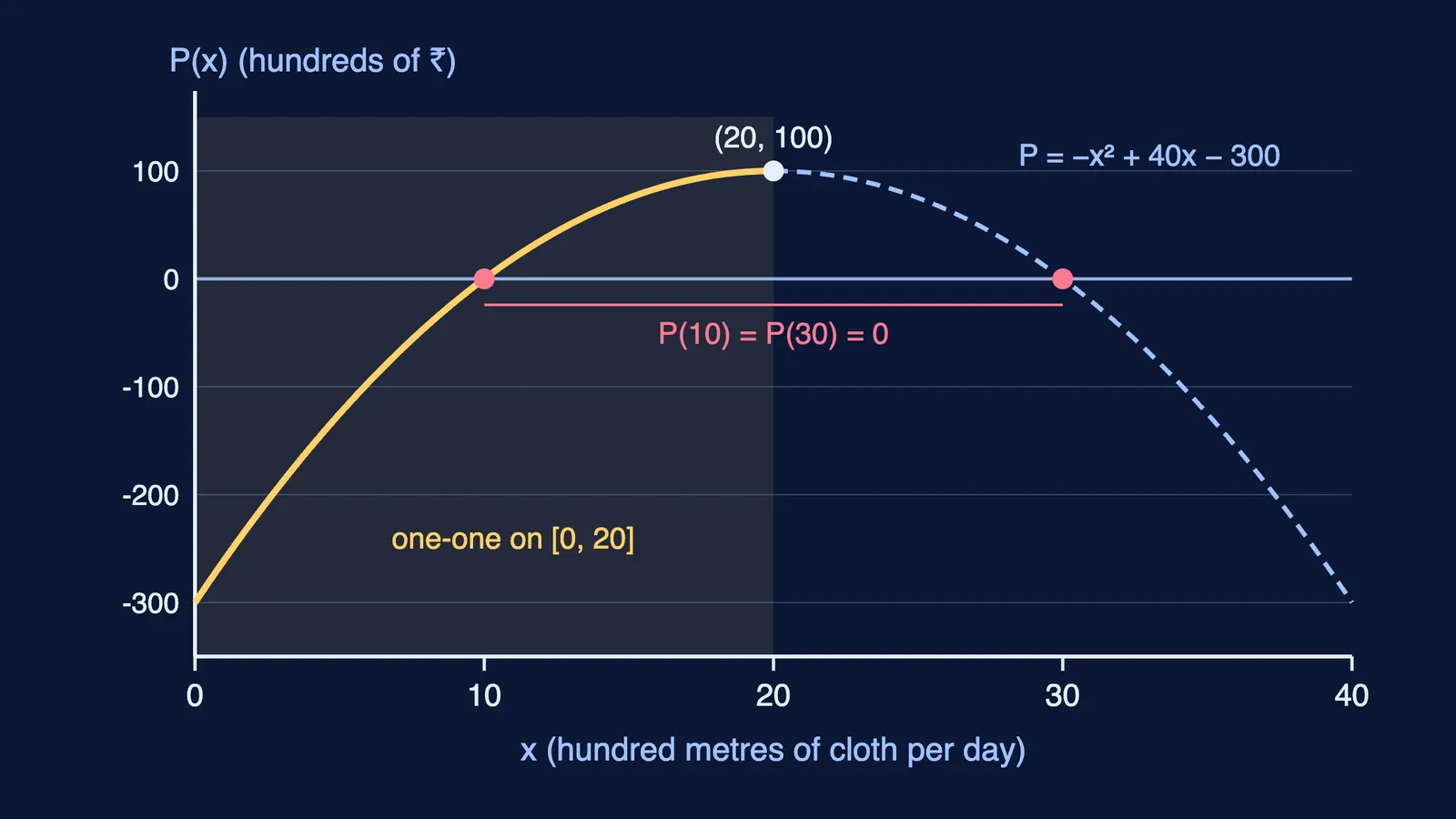
A small dyeing unit in Surat processes x hundred metres of cloth a day. Its accountant models the daily profit as P(x) = −x² + 40x − 300, in hundreds of rupees. A negative value is a loss. She first treats P as a function from R to R.
(i) P(10) and P(30) are (a) 0 and 0 (b) 100 and 0 (c) 0 and 100 (d) −300 and 0
(ii) Is P : R → R one-one?
(iii) Show that P : R → R is not onto.
(iv) Show that P : [0, 20] → [−300, 100] is one-one and onto.
Answers.
(i) (a). P(10) = −100 + 400 − 300 = 0 and P(30) = −900 + 1200 − 300 = 0. These are the break-even outputs.
(ii) No. P(10) = P(30) = 0 with 10 ≠ 30.
(iii) Write P(x) = 100 − (x − 20)², so P(x) ≤ 100 for every real x. Then 150 in the co-domain R has no pre-image, and P is not onto.
(iv) One-one: P(a) = P(b) gives (a − b)(40 − a − b) = 0, so a = b or a + b = 40. On [0, 20], a + b = 40 only when a = b = 20, so a = b. Onto: for y in [−300, 100], take x = 20 − √(100 − y). Since 0 ≤ 100 − y ≤ 400, x lies in [0, 20], and P(x) = y. So the restricted P is a bijection.
How to attack case-study questions
Translate the story into a set and a rule before reading the sub-questions.
For relations, test reflexive, symmetric and transitive in that order, and give one concrete pair as your counterexample when a property fails.
For "one-one", look for two inputs with the same output; for "onto", find one co-domain value with no pre-image, or solve f(x) = y and check that x lies in the domain.
When the set is small and finite, list every image, as in Case 2.
In the last sub-part, prove both halves of a bijection.
If you keep choosing the wrong method on parts like Case 3 (iv), the Fermi Problem Library has worked problems with a step-by-step solver that explains the reasoning rather than printing an answer.
For pacing all three Section E cases, see our guide to case-based questions in board exams, then test your definitions with our assertion-reason questions on relations and functions.