On this page
Three original cases, easy to hard, each with four sub-questions and worked answers. Every fact is checked against Unit 5 of NCERT Class 12 Chemistry Part I, Reprint 2026-27, and Coordination Compounds is Unit 5 of the CBSE Chemistry syllabus for 2026-27, listed at 7 of the 70 theory marks.
The CBSE 2026-27 Chemistry sample paper has Section D with 2 case-based questions carrying 4 marks each, and calculators are not allowed, so these numbers work by hand. For the whole chapter, start with our Coordination Compounds Class 12 board exam guide.
Case 1: Which formula fits each bottle of CoCl₃·5NH₃·H₂O?
A college stockroom in Kolkata has two old bottles, both labelled CoCl₃·5NH₃·H₂O (M = 268.46 g mol⁻¹). Bottle A holds red crystals and bottle B violet crystals. A student dissolves 0.805 g from each bottle in water and adds excess silver nitrate. Bottle A gives 1.29 g of AgCl and bottle B gives 0.860 g (AgCl = 143.32 g mol⁻¹). Conductivity shows A behaves as a 1:3 electrolyte and B as a 1:2 electrolyte.
(i) What is the coordination number (secondary valence) of cobalt in both compounds?
(ii) Which formula fits bottle B? (a) [Co(NH₃)₅(H₂O)]Cl₃ (b) [CoCl(NH₃)₅]Cl₂·H₂O (c) [CoCl₂(NH₃)₄]Cl·NH₃·H₂O (d) [CoCl₃(NH₃)₃]·2NH₃·H₂O
(iii) Name the type of isomerism shown by A and B, and give the IUPAC name of the complex cation in A.
(iv) Show by calculation that the two AgCl masses fit the formulas you chose.
Answers.
(i) Six. In both, six groups (five NH₃ plus either H₂O or Cl⁻) stay bonded to Co³⁺, so the secondary valence is 6.
(ii) (b). A 1:2 electrolyte releases two free Cl⁻ per formula unit, so one chloride is inside the bracket and the water sits outside as lattice water.
(iii) Solvate (hydrate) isomerism: in A the water is bonded to cobalt, in B it is free in the crystal. The cation in A, [Co(NH₃)₅(H₂O)]³⁺, is pentaammineaquacobalt(III).
(iv) Moles of compound = 0.805 ÷ 268.46 = 3.00 × 10⁻³ mol. A has 3 ionisable Cl⁻: 3 × 3.00 × 10⁻³ × 143.32 = 1.29 g. B has 2: 2 × 3.00 × 10⁻³ × 143.32 = 0.860 g. Both match.
Case 2: How hard is borewell water by EDTA titration?
A housing society in Bengaluru sends a borewell sample to a water lab. The analyst titrates 50.0 mL of it with 0.0100 M Na₂EDTA. The end point needs 13.6 mL. Each EDTA⁴⁻ ion wraps around one Ca²⁺ or Mg²⁺ ion, so metal ions and EDTA react 1 : 1. The lab reports total hardness as milligrams of CaCO₃ per litre (CaCO₃ = 100.09 g mol⁻¹).
(i) What is the denticity of EDTA⁴⁻? (a) 2 (b) 4 (c) 5 (d) 6
(ii) Which donor atoms does EDTA⁴⁻ use to bind the metal ion?
(iii) Why are the Ca²⁺ and Mg²⁺ complexes of EDTA more stable than complexes of the same ions with unidentate ligands, and how can Ca²⁺ and Mg²⁺ be estimated separately?
(iv) Calculate the total moles of Ca²⁺ + Mg²⁺ per litre and the hardness in mg CaCO₃ per litre.
Answers.
(i) (d). EDTA⁴⁻ is hexadentate.
(ii) Two nitrogen atoms and four oxygen atoms, all binding the same metal ion.
(iii) EDTA is a chelating ligand, and chelate complexes tend to be more stable than similar complexes with unidentate ligands. The calcium and magnesium complexes have different stability constants, which allows selective estimation.
(iv) Moles of EDTA = 0.0100 × 0.0136 = 1.36 × 10⁻⁴ mol, which equals the moles of Ca²⁺ + Mg²⁺ in 50.0 mL. Per litre: 1.36 × 10⁻⁴ ÷ 0.0500 = 2.72 × 10⁻³ mol L⁻¹. As CaCO₃: 2.72 × 10⁻³ × 100.09 × 1000 = 272 mg L⁻¹.
Case 3: Why is [Fe(CN)₆]⁴⁻ diamagnetic but [Fe(H₂O)₆]²⁺ not?
A project team in Pune compares two iron(II) solutions. Solution X is Mohr's salt, FeSO₄·(NH₄)₂SO₄·6H₂O, in water, where iron is present as [Fe(H₂O)₆]²⁺. Solution Y is potassium hexacyanidoferrate(II), K₄[Fe(CN)₆]. A magnetic balance gives 4.9 BM for X and 0 BM for Y. Only X gives the usual test for Fe²⁺ ions. Both complexes are octahedral, and the team uses the spin-only formula μ = √(n(n + 2)) BM.
(i) Why does only solution X give the test for Fe²⁺?
(ii) Which statement is correct? (a) H₂O is a stronger field ligand than CN⁻ (b) For [Fe(CN)₆]⁴⁻, Δo is greater than the pairing energy P (c) Both complexes have the same number of unpaired electrons (d) [Fe(H₂O)₆]²⁺ is diamagnetic
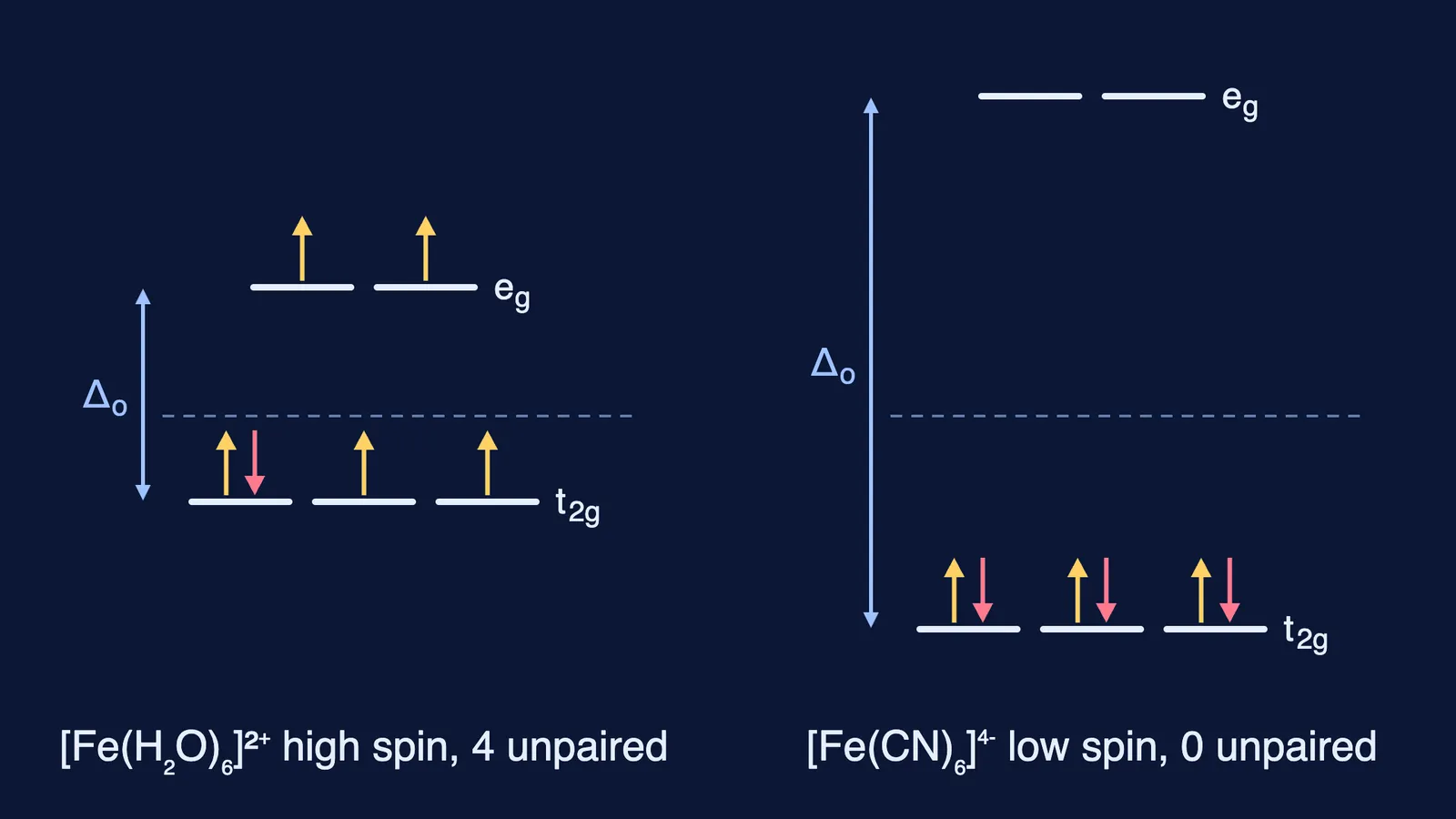
(iii) Write the t₂g/eg configuration of each complex and check it against the measured moments.
(iv) Using t₂g at −(2/5)Δo and eg at +(3/5)Δo, find the energy of the d electrons in each complex relative to the average, and say what the cyanide complex pays for the extra stabilisation.
Answers.
(i) Mohr's salt is a double salt, so it dissociates completely into simple ions, including Fe²⁺. [Fe(CN)₆]⁴⁻ is a complex ion and does not dissociate into Fe²⁺ and CN⁻.
(ii) (b). CN⁻ sits near the strong end of the spectrochemical series, so Δo > P and the six d electrons pair up in t₂g.
(iii) Fe²⁺ is 3d⁶. X: t₂g⁴eg² with 4 unpaired electrons, μ = √(4 × 6) = 4.90 BM, which matches the measured 4.9 BM. Y: t₂g⁶eg⁰ with none unpaired, μ = 0, so it is diamagnetic.
(iv) X: 4(−0.4Δo) + 2(+0.6Δo) = −0.4Δo. Y: 6(−0.4Δo) = −2.4Δo. Y has three electron pairs against X's one, so it pays two extra pairing energies (2P). Low spin wins only because cyanide makes Δo larger than P.
How do you attack case-study questions on coordination compounds?
Count ions before you name anything. AgCl moles or conductivity give the counter ions outside the bracket.
Find the oxidation state, then the d-count. Then write 3dⁿ; magnetism and colour follow.
Place the ligand in the spectrochemical series. Weak-field ligands such as F⁻ and H₂O favour high spin; strong-field ligands such as CN⁻ and CO favour pairing.
Check your answer against the data. 4.90 BM computed against 4.9 BM measured is a match.
If t₂g and eg still feel abstract, the Fermi Concept Library gives every concept in chemistry its own lesson and its place in the map. For more practice on this chapter, try our assertion-reason questions on coordination compounds, and for timing across subjects, see our advice on answering case-based questions in board exams.