On this page
These three case studies on Chapter 8, Microbes in Human Welfare, run from easy to hard. Every fact in the answers matches the NCERT Class 12 Biology chapter (reprint 2026-27); the people and numbers in the passages are invented for practice, and the towns are only settings. For the whole chapter with model answers, use our Microbes in Human Welfare Class 12 board exam guide.
What do case-based questions on microbes in human welfare test?
The CBSE Biology sample paper for 2026-27 has 2 case-based questions of 4 marks each, in Section D. A case on this chapter can ask you to name the microbe behind a process, read a small data set, or predict what happens when a condition changes. Our guide to case-based questions in board exams covers the general method.
Case 1: Curd and batter in a Madurai kitchen
On a warm evening, Kavya warms 500 mL of milk, stirs in one spoon of yesterday's curd and leaves the bowl covered. She also grinds rice and urad dal into 1.2 litres of idli batter. By morning the milk has set into firm, sour curd and the batter has risen to 1.8 litres, with small bubbles all through it. Her cousin tries the same recipe but first boils the spoon of curd with the milk to "make it safe". Her bowl is still liquid milk the next morning.
(i) The microbes that turn milk into curd are: (a) *Saccharomyces cerevisiae* (b) *Lactobacillus* and other lactic acid bacteria (c) *Propionibacterium sharmanii* (d) *Aspergillus niger*.
(ii) Which gas makes the batter rise?
(iii) By what percentage did the batter's volume increase overnight?
(iv) Explain why the cousin's milk did not set, and give one way curd is nutritionally better than milk.
Answers.
(i) (b) *Lactobacillus* and other lactic acid bacteria (LAB), which produce acids that coagulate and partially digest milk proteins.
(ii) Carbon dioxide, produced by the bacteria fermenting the dough.
(iii) (1.8 − 1.2) ÷ 1.2 × 100 = 50%.
(iv) The spoon of curd is the starter, carrying millions of LAB that multiply at a suitable temperature; boiling killed them, so nothing converted the milk. Curd has more vitamin B12 than the milk it came from.
Case 2: Reading the BOD log at a riverside plant
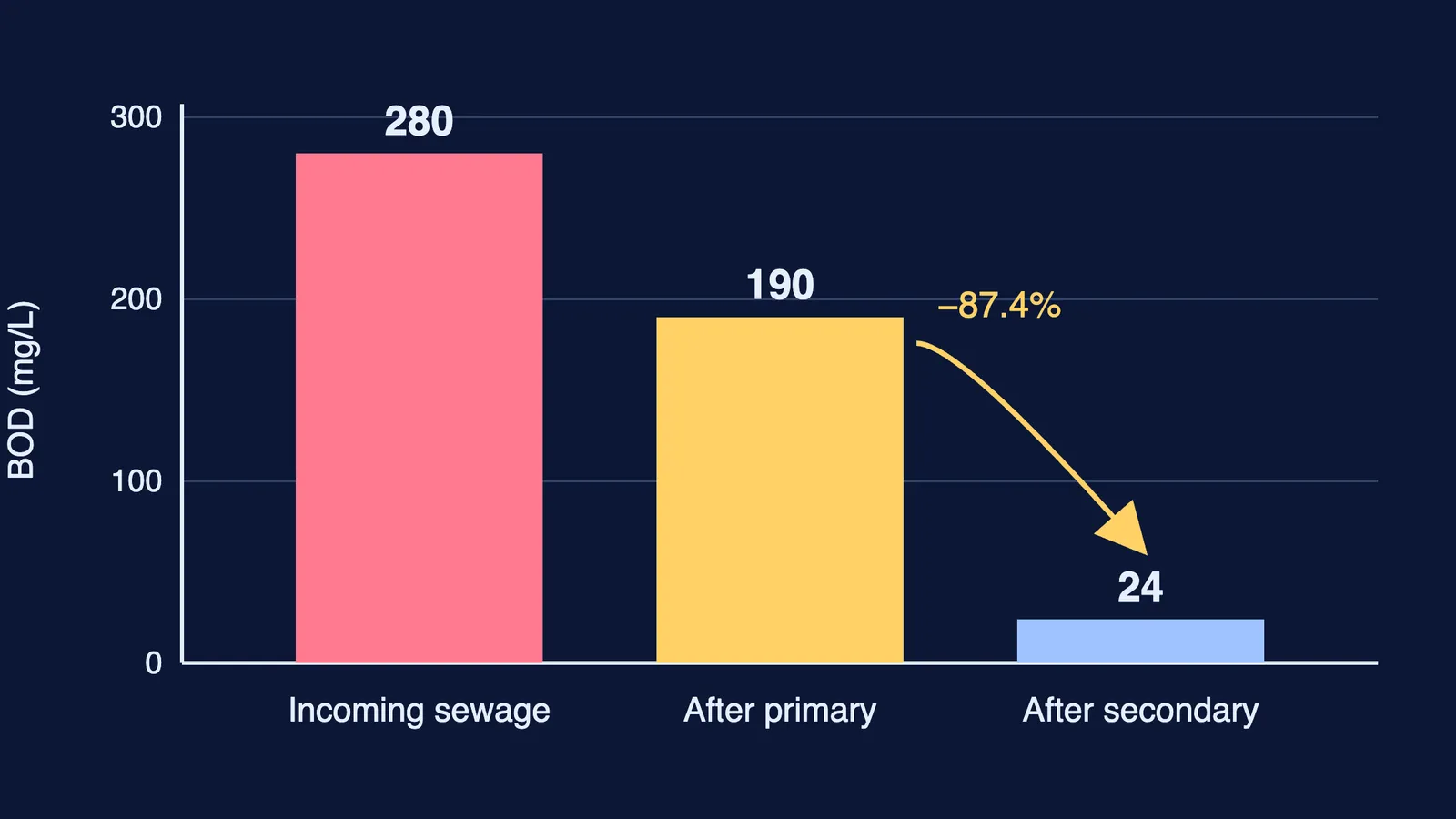
A town's sewage treatment plant beside a river logs the BOD of its water at three points one morning: incoming sewage 280 mg/L, after the primary settling tank 190 mg/L, and after the aeration tank and final settling 24 mg/L. Engineers then pump part of the settled sediment back into the aeration tank and send the rest to closed digesters. That week a blower fails, and for two days no air is pumped into the aeration tank.
(i) Primary treatment removes particles mainly by: (a) aeration (b) filtration and sedimentation (c) anaerobic digestion (d) adding antibiotics.
(ii) What are flocs?
(iii) Calculate the percentage fall in BOD during secondary treatment, and over the whole plant.
(iv) Predict what happens to the BOD of the outgoing water while the blower is off, and explain why part of the sediment is sent back to the aeration tank.
Answers.
(i) (b) Floating debris is filtered out and grit settles; the settled solids form primary sludge.
(ii) Masses of bacteria associated with fungal filaments, forming mesh-like structures in the aeration tank.
(iii) Secondary: (190 − 24) ÷ 190 × 100 = 87.4%. Whole plant: (280 − 24) ÷ 280 × 100 = 91.4%.
(iv) The BOD of the outgoing water would rise well above 24 mg/L, because the useful aerobic microbes need air to grow into flocs and consume the organic matter. The returned sediment is activated sludge, which serves as the inoculum for fresh effluent.
Case 3: A gobar gas plant that runs short
A dairy family near Anand feeds 150 kg of cattle dung a day, as slurry, into a concrete biogas tank. The plant yields 6.0 m³ of gas a day, and the floating cover rises as gas collects. Two neighbours now want to join, raising the daily demand to 9.0 m³. One neighbour suggests fitting an air pump to "stir the tank and speed things up", as the sewage plant does with its aeration tanks.
(i) The bacteria producing methane in this tank are: (a) *Methanobacterium* (b) *Rhizobium* (c) *Acetobacter aceti* (d) *Azotobacter*.
(ii) Why is cattle dung rich in these bacteria?
(iii) Find the gas yield per kilogram of dung and the daily dung needed for 9.0 m³, assuming the same yield.
(iv) Should the family fit the air pump? Justify, and say what the family can do with the spent slurry.
Answers.
(i) (a) *Methanobacterium*, one of the methanogens.
(ii) Methanogens live in the cattle rumen, where they help break down cellulose in the cattle's food, so they pass out in the dung.
(iii) 6.0 ÷ 150 = 0.04 m³ per kg. Dung needed: 9.0 ÷ 0.04 = 225 kg a day.
(iv) No. Methanogens grow anaerobically on cellulosic material; pumping in air removes the conditions they need, so methane output would fall. The spent slurry can go to the fields as fertiliser.
How should you attack case-study questions on this chapter?
Make a two-column list of every organism and its product (*Aspergillus niger* and citric acid, *Trichoderma polysporum* and cyclosporin A, *Monascus purpureus* and statins). Learn these pairs well for the MCQ parts.
Before reading the questions, label the passage with the process: household fermentation, industrial product, sewage, biogas, biocontrol or biofertiliser.
Ask whether the microbe needs air. Aerobic flocs work in aeration tanks; methanogens and sludge digesters work without oxygen. Many "predict" parts turn on this.
For numbers, write the formula first, then the substitution, then the answer with its unit.
Practise the logic of each section with our assertion-reason questions on microbes in human welfare. If one process still feels hazy, the Fermi Concept Library has a lesson on every biology concept, with its place in the map.