On this page
Ecosystem is Chapter 12 of the CBSE Class 12 Biology curriculum for 2026-27, covering components, productivity, decomposition, energy flow and pyramids. The CBSE 2026-27 sample paper has 2 case-based questions of 4 marks each in Section D. Below are three original cases, easy to hard, checked against the NCERT Ecosystem chapter (Reprint 2026-27); the scenarios and numbers are invented for practice. For notes on the whole chapter, see our Ecosystem Class 12 board exam guide.
Case 1: What feeds on what in a Bhopal school pond?
An eco-club samples the pond behind their school one February morning. A drop of water shows phytoplankton and tiny Daphnia. Hydrilla grows submerged, and lotus lines the edges. Snails graze on algae on the stones, small fish dart after the Daphnia, and a kingfisher dives for the fish twice in an hour. The black bottom ooze, their teacher says, teems with bacteria and fungi. One student's report ends: "Energy and nutrients both go round and round in the pond."
(i) Which group forms the first trophic level of this pond? (a) Daphnia (b) phytoplankton and Hydrilla (c) bacteria in the ooze (d) snails
(ii) Give the trophic level of the small fish and name its consumer category.
(iii) Name two climatic factors that regulate the rate of function of the whole pond.
(iv) Correct the last line of the student's report.
Answers.
(i) (b). Phytoplankton and submerged plants are the autotrophs, the producers.
(ii) Third trophic level. The fish is a secondary consumer, more correctly a primary carnivore, since it eats Daphnia, a herbivore.
(iii) Any two of solar input, the cycle of temperature and day-length.
(iv) Energy moves one way, from the sun to producers to consumers, and is lost as heat at each step. Nutrients do go round: decomposers in the ooze mineralise dead matter and release nutrients for reuse by the autotrophs.
Case 2: Why do litter bags in Wayanad and Leh decay at different rates?
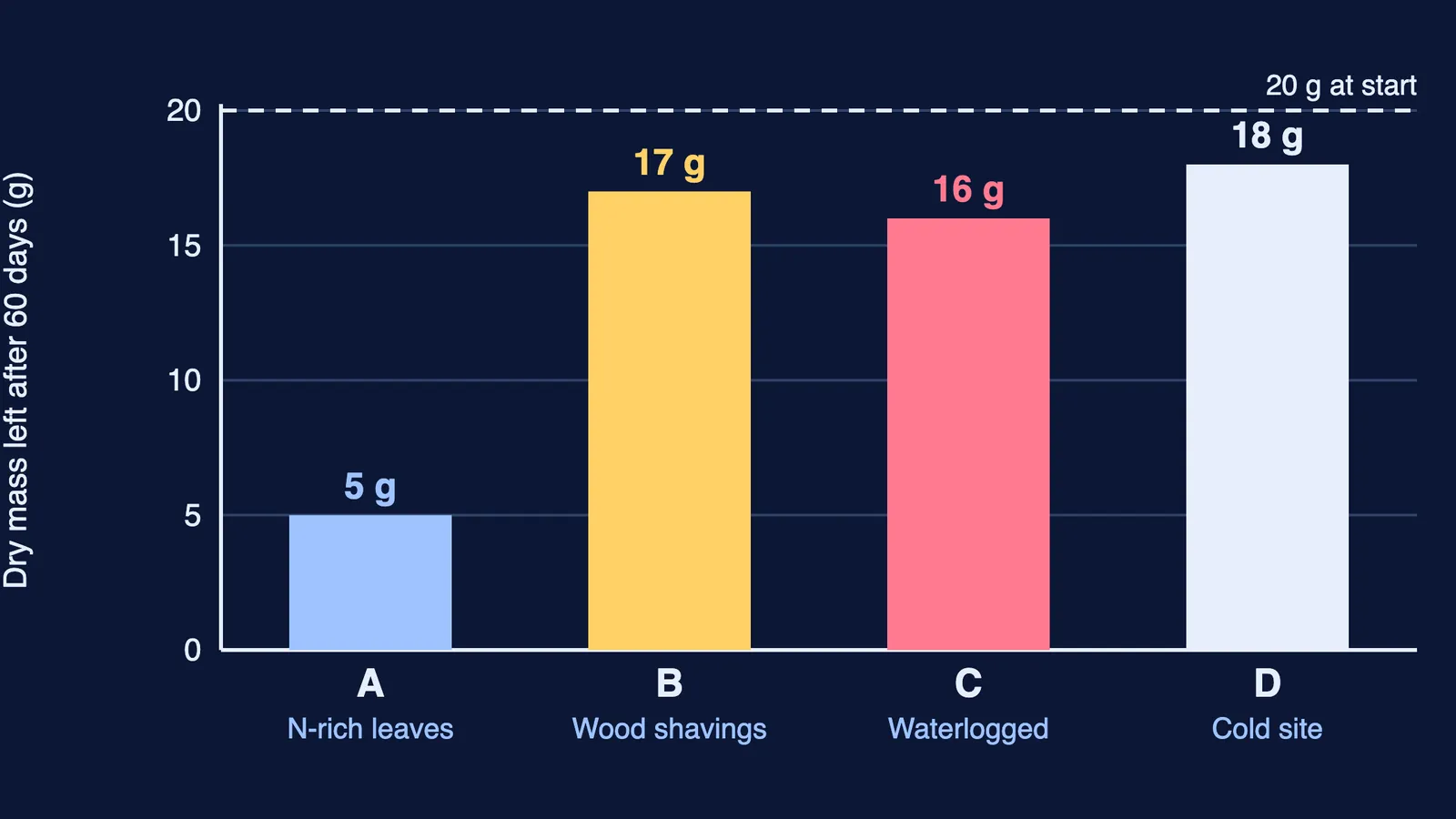
A student fills four mesh bags with 20.0 g of dry material each and leaves them for 60 days. Bags A and B lie on the warm, moist floor of a Wayanad estate: A holds soft leaves rich in nitrogen and sugars, B holds wood shavings rich in lignin. Bag C holds the same leaves as A but sits in waterlogged soil nearby. A partner school in Leh buries bag D, also with the same leaves, through winter. After drying, the bags weigh 5.0 g, 17.0 g, 16.0 g and 18.0 g. Earthworms had crawled into bag A.
(i) Earthworms breaking the leaves in bag A into smaller pieces carry out: (a) leaching (b) fragmentation (c) humification (d) mineralisation
(ii) Find the percentage of mass lost from bags A and B.
(iii) Bags A and B shared a climate. Why did B lose so little?
(iv) Explain the results for bags C and D, and say what will build up in the waterlogged soil over the years.
Answers.
(i) (b). Detritivores such as earthworms break detritus into smaller particles; this is fragmentation.
(ii) A: (20.0 - 5.0)/20.0 × 100 = 75 per cent. B: (20.0 - 17.0)/20.0 × 100 = 15 per cent.
(iii) In the same climate, the rate depends on the detritus's chemical composition. Lignin-rich material decomposes slowly; material rich in nitrogen and water-soluble sugars decomposes quickly.
(iv) Decomposition is largely an oxygen-requiring process, and soil microbes work best when it is warm and moist. Waterlogging (anaerobiosis, bag C: 20 per cent lost) and low temperature (bag D: 10 per cent lost) both inhibit decomposition, so organic matter builds up in the soil.
Case 3: How much energy reaches the top of a Kutch grassland food chain?
A class models a Kutch grassland plot with rounded, invented figures (real dry grasslands fix far less). Each square metre receives 1,000,000 kcal of photosynthetically active radiation (PAR) a year. The grasses fix 30,000 kcal m⁻² yr⁻¹ as gross primary productivity (GPP) and use 12,000 kcal m⁻² yr⁻¹ in respiration. Grasshoppers graze the grass, lizards eat the grasshoppers, and a few snakes eat the lizards. Nearby, a lone neem tree carries about 3,000 caterpillars, which feed 40 small birds.
(i) What percentage of the PAR did the grasses fix as GPP? (a) 0.3 (b) 3 (c) 30 (d) 50
(ii) Calculate the net primary productivity (NPP) of the plot.
(iii) Starting from the NPP and using the 10 per cent law, how much energy reaches the grasshoppers, the lizards and the snakes?
(iv) Describe the shape of the pyramid of numbers for the neem tree. A classmate argues its energy pyramid must have the same shape. Is she right?
Answers.
(i) (b). 30,000/1,000,000 × 100 = 3 per cent, inside NCERT's range of 2-10 per cent of PAR captured by plants.
(ii) NPP = GPP - R = 30,000 - 12,000 = 18,000 kcal m⁻² yr⁻¹.
(iii) Grasshoppers (second trophic level) get 10 per cent of 18,000 = 1,800; lizards (third trophic level) get 180; snakes (fourth) get 18 kcal m⁻² yr⁻¹. Only 0.1 per cent of the NPP reaches the snakes, so grazing food chains have few levels.
(iv) One tree supports 3,000 caterpillars, which support 40 birds, so the base is narrower than the middle: the pyramid of numbers is not upright but spindle-shaped (1, 3,000, 40). She is wrong: some energy is lost as heat at every transfer, so an energy pyramid is always upright.
How do you answer Ecosystem case study questions?
Underline every number with its unit: g m⁻² means biomass, kcal m⁻² yr⁻¹ means energy.
Write GPP - R = NPP before substituting. The formula line often carries part of the credit.
Apply the 10 per cent law from NPP, one level at a time, and label each level (herbivore, primary carnivore, secondary carnivore).
Match each observation to one NCERT factor: lignin and chitin slow decomposition; nitrogen and sugars speed it; cold and lack of oxygen inhibit it.
Never invert the energy pyramid. Numbers (a single tree) and biomass (the sea) can invert; energy cannot.
For a method that works across chapters, read how to answer case-based questions in board exams, then test the fine distinctions with our Ecosystem assertion-reason questions. If a term such as humification or standing crop is still hazy, the Fermi Concept Library has every concept in physics, chemistry, biology, mathematics and computing, each with its own lesson.