On this page
Reproductive Health is Chapter 3 of Unit VI, Reproduction, in the CBSE Class 12 Biology syllabus for 2026-27, which covers birth control, MTP, amniocentesis, STDs and ART. The CBSE 2026-27 Biology sample paper has two case-based questions of 4 marks each in Section D. Below are three original cases, easy to hard, built only on the NCERT chapter on Reproductive Health (Reprint 2026-27).
The people and records here are invented. In real life, choosing a contraceptive or a fertility treatment belongs with a qualified doctor. For the full chapter, read our Reproductive Health Class 12 board guide.
Case 1: When is the fertile period in a cycle?
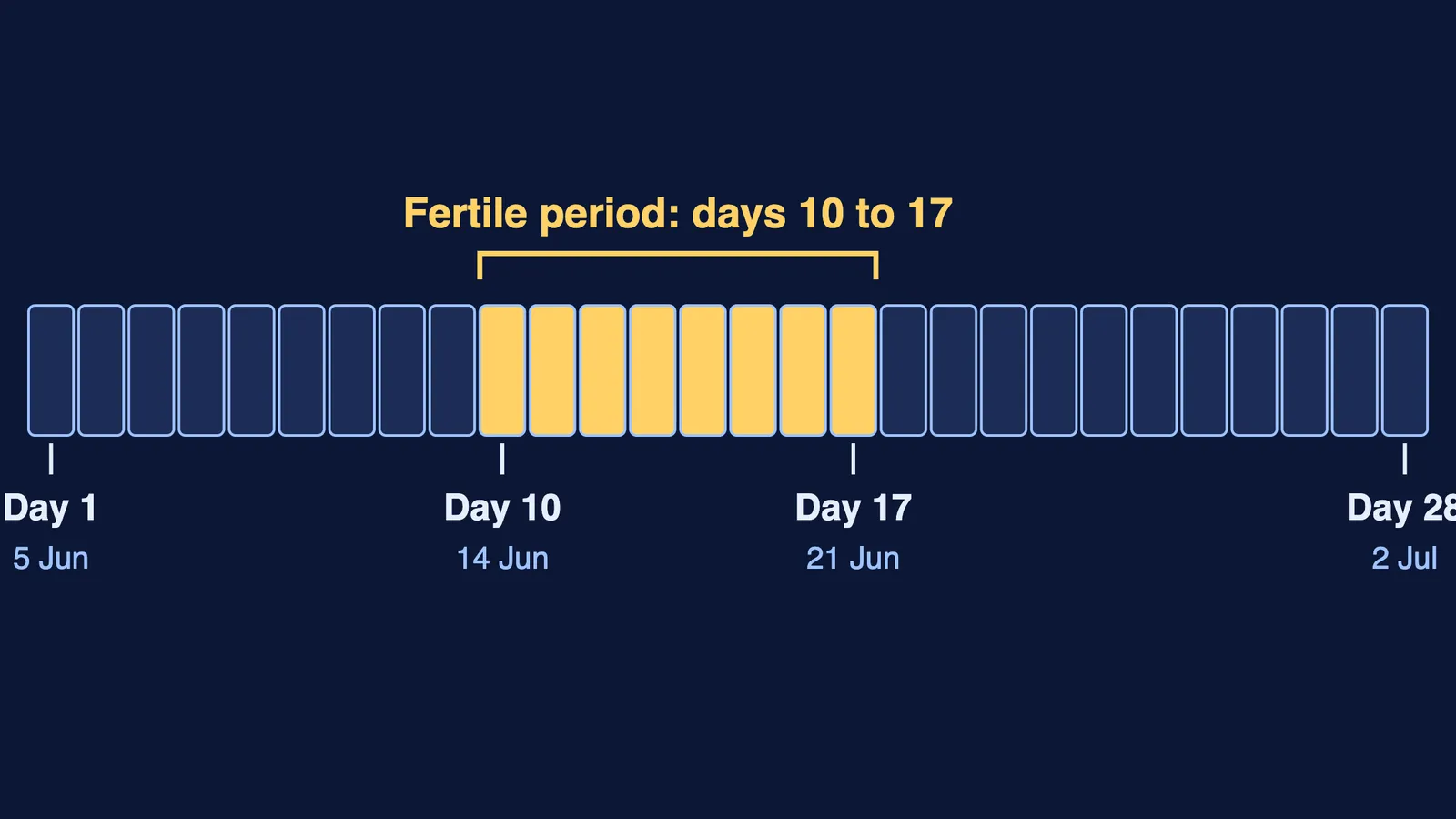
At a primary health centre near Cuttack, a health worker runs a session on natural methods of family planning. Sunita has a regular 28-day cycle, and her last menstruation began on 5 June 2026. Sunita and her husband want to use periodic abstinence. Rekha, Sunita's neighbour, had a baby on 20 January 2026 and breastfeeds him fully. On 15 August she asks whether breastfeeding alone still protects her from conceiving. The health worker reminds them that these methods have high chances of failure.
(i) Which of these is a natural method of contraception? (a) Copper T (b) Lactational amenorrhoea (c) Implant (d) Vasectomy
(ii) Why are days 10 to 17 of the cycle called the fertile period?
(iii) Between which dates should Sunita and her husband abstain from coitus in this cycle?
(iv) Can Rekha rely on lactational amenorrhoea on 15 August? Justify with a calculation.
Answers.
(i) (b) Lactational amenorrhoea. No medicine or device is used, so side effects are almost nil.
(ii) Ovulation can be expected in this window, so the chances of fertilisation are very high, as the NCERT chapter explains.
(iii) Day 1 is 5 June, so day 10 is 14 June and day 17 is 21 June: abstain from 14 June to 21 June, 8 days in all.
(iv) No. NCERT says the method has been reported to be effective only up to a maximum of six months after parturition, which ends on 20 July. 15 August is 207 days after the birth, 26 days past that limit.
Case 2: How do IUDs and emergency pills work?
Meera, a staff nurse at a district hospital in Nashik, is preparing a short talk for trainee nurses from a hypothetical register for one month. Of 160 clients, 56 chose a copper IUD, 40 oral pills, 16 injectables, 12 implants, 14 vasectomy and 22 tubectomy. The hospital store also holds Lippes loops, Multiload 375, Cu7 and LNG-20 devices, and the trainees must explain how each one works. Near month-end, a woman arrives 58 hours after unprotected intercourse and asks the nurse whether anything can still prevent a pregnancy.
(i) Which device in the store is a hormone-releasing IUD? (a) Lippes loop (b) Multiload 375 (c) LNG-20 (d) Cu7
(ii) How does a copper-releasing IUD prevent conception?
(iii) What percentage of clients chose a terminal method, and why is it called terminal?
(iv) Is emergency contraception still possible for the woman? State the time left and two options NCERT names.
Answers.
(i) (c) LNG-20. Lippes loop is non-medicated.
(ii) IUDs increase phagocytosis of sperms in the uterus, and the Cu ions released suppress sperm motility and fertilising capacity, per the NCERT chapter.
(iii) Vasectomy + tubectomy = 14 + 22 = 36; 36 ÷ 160 × 100 = 22.5%. Sterilisation blocks gamete transport and its reversibility is very poor, so it is for people who want no more pregnancies.
(iv) Yes. NCERT allows emergency use within 72 hours of coitus, so 72 − 58 = 14 hours remain. Options: progestogens or progestogen-estrogen combinations, or an IUD; a doctor chooses which.
Case 3: Which ART technique suits which couple?
An infertility clinic in Hyderabad holds three hypothetical files. Couple P: the wife cannot produce ova, but her fallopian tubes and uterus are normal. Couple Q: after IVF, the lab log shows one embryo at 6 blastomeres and another at 12 blastomeres. Couple R: married 16 months, trying to conceive without contraception since the wedding; relatives say the wife must be the cause. A trainee counsellor must explain each file in plain words, using only what the textbook says about infertility and assisted reproductive technologies.
(i) In which technique is a sperm injected directly into the ovum? (a) GIFT (b) ICSI (c) IUI (d) ZIFT
(ii) Which technique suits Couple P, and why?
(iii) Where should each of Couple Q's embryos be transferred? Name the technique for each.
(iv) Is Couple R infertile by the NCERT definition? How should the counsellor answer the relatives?
Answers.
(i) (b) ICSI, intra cytoplasmic sperm injection, forms the embryo in the laboratory.
(ii) GIFT. A donor ovum is transferred into the fallopian tube of a female who cannot produce one but can provide a suitable environment for fertilisation and development.
(iii) The 6-blastomere embryo goes into the fallopian tube by ZIFT (zygotes and embryos with up to 8 blastomeres). The 12-blastomere embryo goes into the uterus by IUT (more than 8 blastomeres).
(iv) Not yet. The NCERT chapter defines infertility as inability to conceive after 2 years of unprotected cohabitation: 24 − 16 = 8 months short. It also says that in India the female is often blamed, but more often than not the problem lies in the male partner, so both partners should be examined.
How to attack case-study questions on Reproductive Health?
Put the chapter's fixed numbers on one card: days 10 to 17, pills for 21 days with a 7-day gap, six months for LAM, 72 hours, MTP limits of 12 and 24 weeks, 8 blastomeres, 2 years.
Name the mechanism, not just the method: "Cu ions suppress sperm motility", not "Copper T stops pregnancy".
Sort each method into its NCERT group (natural, barrier, IUD, oral, injectable, implant, surgical) first; MCQs often test the grouping.
For ART parts, write where the gamete or embryo goes (fallopian tube or uterus) and what the patient lacks.
For the method, our guide to case-based questions in board exams helps, and the Reproductive Health assertion-reason set drills the same facts another way.
If terms like ZIFT and IUT still blur together, the Fermi Concept Library has a lesson for every biology concept, each with its place in the map of ideas around it.