On this page
Sexual Reproduction in Flowering Plants is Chapter 1 of Unit VI, Reproduction, in the CBSE Class 12 Biology syllabus for 2026-27. The CBSE 2026-27 Biology sample paper has two case-based questions of 4 marks each in Section D. Below are three original cases, easy to hard, built only on the NCERT chapter on sexual reproduction in flowering plants (Reprint 2026-27). Try each case before you read the answers.
For the full chapter, with diagrams and definitions, read our Sexual Reproduction in Flowering Plants Class 12 board guide.
Case 1: Counting pollen tubes in a school lab
In a Class 12 practical in Pune, Kavya dusts pollen from Vinca flowers onto a drop of 10 per cent sugar solution on a glass slide. After 25 minutes she looks under the low-power lens. In three fields she counts 64, 71 and 65 pollen grains, of which 45, 49 and 44 show pollen tubes. Her lab partner Arjun tries the same thing with rice pollen he collected from a farm plot 45 minutes before class, but sees no tubes at all, even after 30 minutes.
(i) Through which part of the pollen grain wall does the pollen tube come out? (a) Intine (b) Germ pore (c) Tapetum (d) Generative cell
(ii) Name the substance that makes the exine so hard to destroy.
(iii) What percentage of the pollen grains Kavya counted had germinated?
(iv) Explain Arjun's result, and say how a breeder could keep pollen usable for a cross months or years later.
Answers.
(i) (b) Germ pore. The germ pores are apertures in the exine where sporopollenin is absent.
(ii) Sporopollenin, which withstands high temperatures and strong acids and alkali; no enzyme that degrades it is known.
(iii) Grains counted: 64 + 71 + 65 = 200. Germinated: 45 + 49 + 44 = 138. Germination = 138 ÷ 200 × 100 = 69%.
(iv) The NCERT chapter says rice and wheat pollen lose viability within 30 minutes of release, so Arjun's 45-minute-old pollen was dead. Pollen of many species can be stored for years in liquid nitrogen at -196 °C, in pollen banks.
Case 2: Crossing tomatoes at a seed farm
A seed company near Hyderabad wants hybrid tomato seed. Tomato flowers are bisexual. On one morning a worker opens 480 flower buds of the female-parent line and removes the anthers with forceps. She finds that the anthers of 36 buds had already burst, so she discards those buds. The remaining buds are covered with butter-paper bags. When their stigmas become receptive, she dusts them with pollen from the male-parent line and bags them again. Three-quarters of the pollinated flowers set fruit.
(i) What is the removal of anthers from a bud called? (a) Bagging (b) Emasculation (c) Dehiscence (d) Rebagging
(ii) Why are the buds bagged straight after the anthers are removed?
(iii) How many hybrid fruits does this morning's work give?
(iv) Why were the 36 buds discarded, and what would the company change if the female parent bore only unisexual (female) flowers?
Answers.
(i) (b) Emasculation.
(ii) Bagging protects the stigma from contamination by unwanted pollen, so only the chosen male parent's pollen reaches it.
(iii) Buds kept: 480 − 36 = 444. Fruits: 0.75 × 444 = 333 hybrid fruits.
(iv) Anthers must be removed before they dehisce. In the 36 buds, the plant's own pollen may already have reached the stigma, so the seed would not be reliably hybrid. With unisexual female flowers, emasculation is not needed; the female buds are bagged before the flowers open, then pollinated and rebagged.
Case 3: Why is wheat seed dried before storage?
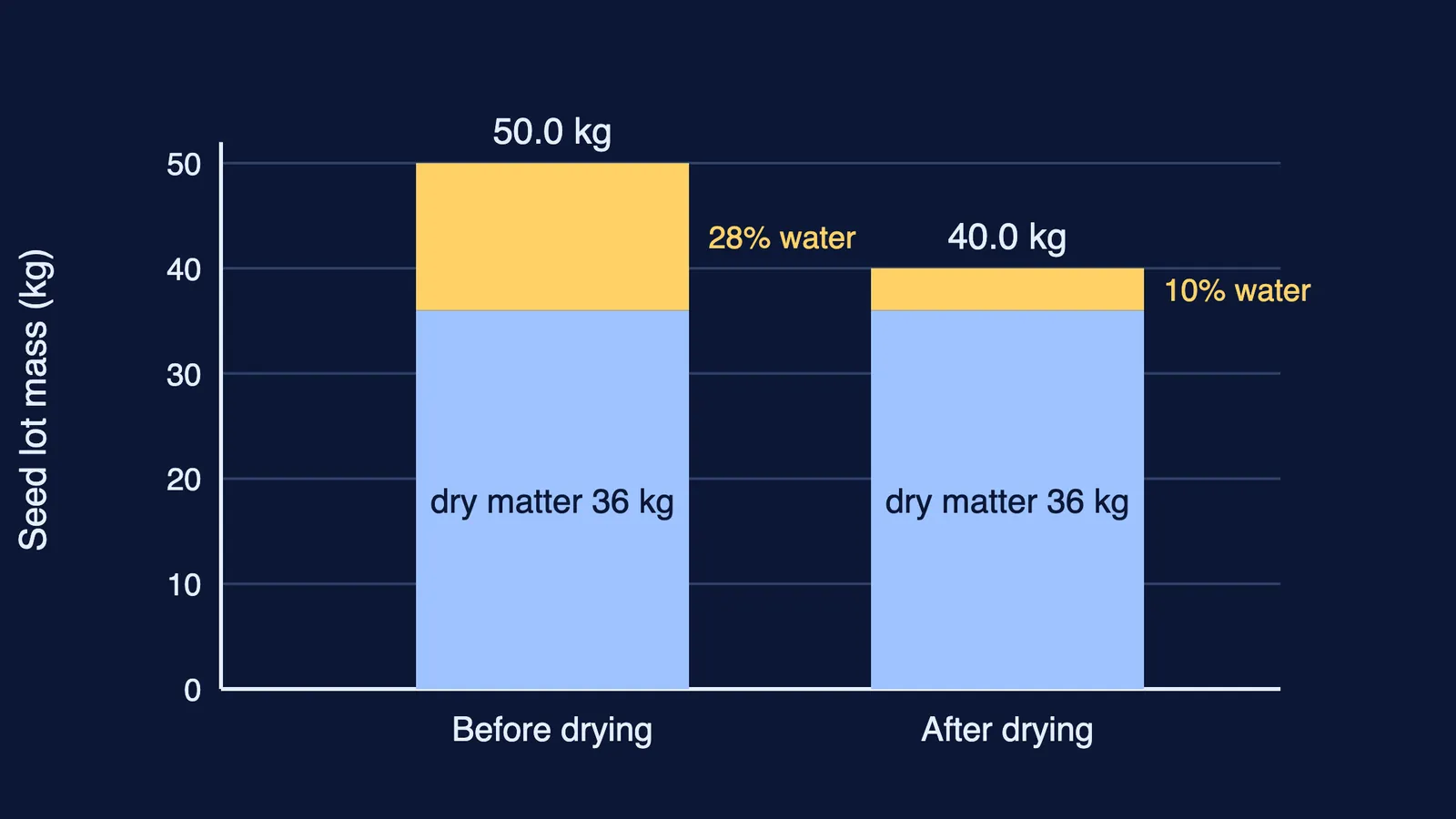
At a seed-processing unit in Punjab, a farmer brings 50 kg of wheat seed harvested early, while still moist. A moisture meter shows that 28% of its mass is water. The unit dries seed until the water is 10% of the mass, within the 10-15 per cent moisture by mass that the NCERT chapter gives for mature seeds. Only water is lost in drying. The farmer asks why the seed must be dried at all, and how the dry seed will take up water again when it is sown next season.
(i) Wheat seed keeps part of its endosperm. Such seeds are called (a) non-albuminous (b) albuminous (c) parthenocarpic (d) perispermic
(ii) Why do dehydration and dormancy matter for storing seed?
(iii) What is the mass of the seed lot after drying, and how much water is removed?
(iv) At sowing, through which opening in the seed coat does water enter, where does that opening come from, and what conditions must the seed have to germinate?
Answers.
(i) (b) Albuminous. NCERT lists wheat, maize, barley and castor as albuminous seeds.
(ii) As seeds dry, the embryo's metabolic activity slows and it may enter dormancy. That lets seed be stored as food through the year and kept to raise the next season's crop.
(iii) Dry matter = 72% of 50 kg = 36 kg, and it does not change. After drying it is 90% of the mass, so the new mass = 36 ÷ 0.90 = 40 kg. Water removed = 50 − 40 = 10 kg.
(iv) Water and oxygen enter through the ovule's micropyle, which remains as a small pore in the seed coat; the seed coat itself forms from the hardened integuments of the ovule. The seed germinates when it has adequate moisture, oxygen and a suitable temperature.
How do you attack case-study questions on this chapter?
Underline every number in the passage and match it to an NCERT line: 10 per cent sugar, 30 minutes for rice pollen, 10-15 per cent seed moisture.
Name the exact structure: germ pore, not "hole in the pollen"; micropyle, not "an opening".
For a procedure case, write the steps in order in the margin first: emasculation, bagging, dusting pollen, rebagging.
In a numerical part, show the sum, the formula and the unit on separate lines.
For method and more practice, see our guide to case-based questions in board exams and the assertion-reason set on sexual reproduction in flowering plants.
If double fertilisation or the embryo sac still feels like a list of names, the Fermi Concept Library has every concept in physics, chemistry, biology, mathematics and computing, each with its own lesson.