On this page
For definitions and the branch table, see our inverse trigonometric functions Class 12 board exam guide.
What do case-study questions on inverse trigonometric functions look like?
The CBSE 2026-27 Mathematics sample paper puts three case study-based questions of 4 marks each in Section E, and calculators are not allowed. Its cases have two or three sub-parts; ours have four, for extra practice. The CBSE 2026-27 Mathematics curriculum lists this chapter as definition, range, domain, principal value branch and graphs. Every idea below is in the NCERT chapter Inverse Trigonometric Functions (Reprint 2026-27).
Case 1: The loading plank
A kirana wholesaler in Nagpur rolls sacks into a delivery van along a wooden plank 1.3 m long. One end rests on the ground and the other on the van floor, which is 0.5 m high, so the plank covers 1.2 m of ground. Let θ be the angle the plank makes with the ground.
(i) θ equals: (a) tan⁻¹(12/5) (b) cos⁻¹(5/13) (c) tan⁻¹(5/12) (d) sin⁻¹(12/13)
(ii) Find the exact value of cos(tan⁻¹(5/12)).
(iii) A helper types sin⁻¹(1.3/0.5) to find θ and gets an error. Why?
(iv) A second plank on the other side of the van has gradient −5/12 when read from left to right. Find tan⁻¹(−5/12) and cot⁻¹(−5/12) in terms of θ.
Answers.
(i) (c). tan θ = 0.5/1.2 = 5/12, and θ lies in (0, π/2), inside the branch of tan⁻¹.
(ii) 12/13. In a right triangle with sides 5 and 12 the hypotenuse is 13, so cos θ = 12/13.
(iii) 1.3/0.5 = 2.6 lies outside [−1, 1], the domain of sin⁻¹. The correct ratio is 0.5/1.3.
(iv) tan(−θ) = −5/12 and −θ lies in (−π/2, π/2), so tan⁻¹(−5/12) = −θ. For cot⁻¹ the answer must lie in (0, π): cot(π/2 + θ) = −tan θ = −5/12, and π/2 + θ lies in (π/2, π), so cot⁻¹(−5/12) = π/2 + θ.
Case 2: The Persian wheel on a Punjab farm
On a farm near Bathinda, a bucket is fixed to the rim of a wheel of radius 2 m whose centre is 1 m above the water. The wheel turns once every 24 seconds, and the bucket starts at its lowest point, under water. After the wheel has turned through angle φ, the bucket's height above the water is h = 1 − 2 cos φ metres. A student rewrites this as φ = cos⁻¹((1 − h)/2).
(i) The largest set of h for which the student's formula is defined is: (a) −1 ≤ h ≤ 1 (b) −1 ≤ h ≤ 3 (c) 0 ≤ h ≤ 3 (d) 1 ≤ h ≤ 3
(ii) At what angle, and after how many seconds, does the bucket first come out of the water?
(iii) When is the bucket at height 1 + √2 m (about 2.41 m) on the way up, and when on the way down?
(iv) For how many seconds of each turn is the bucket above the water? Write a formula for φ during the descending half and state its range.
Answers.
(i) (b). cos⁻¹ needs −1 ≤ (1 − h)/2 ≤ 1, so −1 ≤ h ≤ 3.
(ii) h = 0 gives φ = cos⁻¹(1/2) = π/3. The wheel turns 2π/24 = π/12 radians a second, so t = (π/3) ÷ (π/12) = 4 s.
(iii) Way up: φ = cos⁻¹(−√2/2) = 3π/4, so t = 9 s. The formula can only give angles in [0, π], so the way-down time comes from 2π − 3π/4 = 5π/4, so t = 15 s.
(iv) The bucket goes back under at φ = 2π − π/3 = 5π/3, that is t = 20 s, so it is above water from 4 s to 20 s: 16 seconds. Descending half: φ = 2π − cos⁻¹((1 − h)/2), with range [π, 2π].
Case 3: The CCTV camera at a bus depot
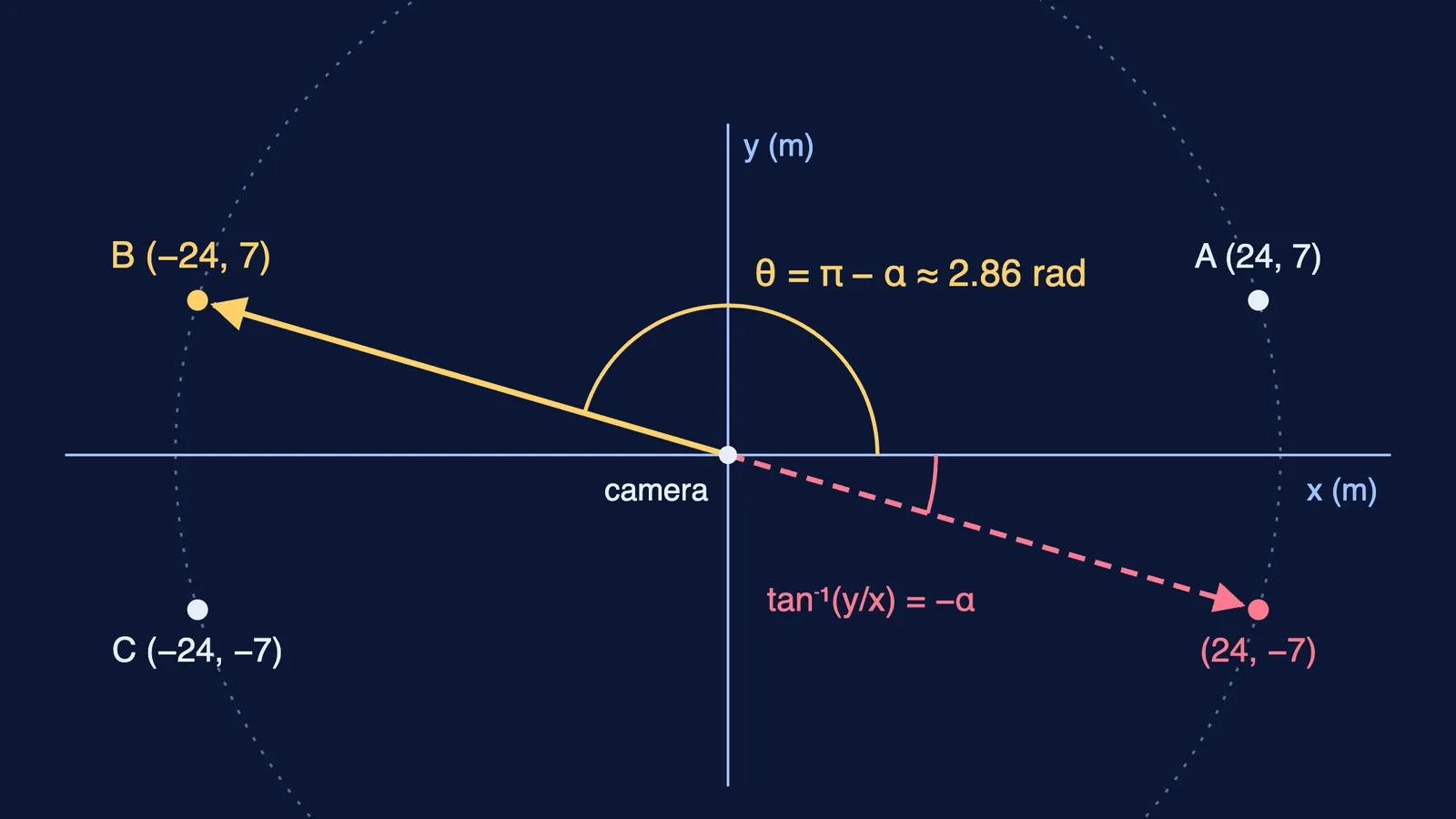
A pan camera stands at the centre of a bus depot yard in Chennai. Take the camera as the origin, x metres east and y metres north. Its software points the camera at a bus parked at (x, y) by turning it through θ = tan⁻¹(y/x) from due east. Three buses are parked at A (24, 7), B (−24, 7) and C (−24, −7). Let α = tan⁻¹(7/24).
(i) The values the software's formula can produce lie in: (a) [0, π] (b) (−π/2, π/2) (c) (0, π) (d) [−π/2, π/2]
(ii) Find the distance of bus A from the camera, and sin α and cos α.
(iii) For bus B the camera points the wrong way. Where does it point, what is the correct angle, and how can cos⁻¹ give it?
(iv) Write one rule using cos⁻¹ that gives the correct angle in (−π, π] for any bus, and use it for bus C.
Answers.
(i) (b). That is the principal branch of tan⁻¹; the ends ±π/2 are never reached, and the formula fails when x = 0.
(ii) √(24² + 7²) = 25 m, so sin α = 7/25 and cos α = 24/25.
(iii) tan⁻¹(7/(−24)) = −α, which points towards (24, −7). The correct angle is π − α ≈ 2.86 rad. Since π − α lies in [0, π] and cos(π − α) = −24/25, it equals cos⁻¹(−24/25), that is cos⁻¹(x/25).
(iv) With r = √(x² + y²): θ = cos⁻¹(x/r) if y ≥ 0, and θ = −cos⁻¹(x/r) if y < 0. For C, θ = −cos⁻¹(−24/25) = −(π − α) = α − π ≈ −2.86 rad.
How do you solve case-study questions on inverse trigonometric functions?
Write the branch next to every inverse function before you calculate: [−π/2, π/2], [0, π] or (−π/2, π/2).
Check the input: sin⁻¹ and cos⁻¹ accept only numbers from −1 to 1.
Draw the right triangle for expressions like cos(tan⁻¹(5/12)).
If a quantity repeats or turns past the branch, find the other angle yourself, as in Cases 2 and 3.
Give answers in radians and check one value by substituting back.
Next, try the inverse trigonometric functions assertion-reason set and our guide to case-based questions in board exams. If a step keeps going wrong, the Fermi Problem Library has worked problems with a step-by-step solver that explains the reasoning rather than printing an answer.