On this page
Every statement below was checked against the NCERT Class 12 chapter Inverse Trigonometric Functions (Reprint 2026-27), and every value was recomputed in Python.
How do you answer assertion-reason questions in Class 12 Maths?
The CBSE Class 12 Maths sample question paper for 2026-27 has two assertion-reason questions, Q19 and Q20, in Section A at 1 mark each. Judge each statement on its own first, then ask one question: does R directly prove A? Keys for the six assertion-reason items:
(A) Both A and R are true and R is the correct explanation of A.
(B) Both A and R are true but R is NOT the correct explanation of A.
(C) A is true but R is false.
(D) A is false but R is true.
Keys for the four statement pairs:
(A) Both statements are correct.
(B) Both statements are incorrect.
(C) Statement I is correct, Statement II is incorrect.
(D) Statement I is incorrect, Statement II is correct.
All items stay inside Unit I of the CBSE 2026-27 Class 12 Maths syllabus: definition, domain, range, principal value branch and graphs. Every inverse function here means its principal value branch, as NCERT states.
Assertion-reason questions on inverse trigonometric functions
Q1 (easy). Assertion (A): cos⁻¹(−√3/2) = −π/6. Reason (R): The range of the principal value branch of cos⁻¹ is [0, π].
Answer: (D). R is the NCERT range. A is false: −π/6 lies outside [0, π]; the correct value is 5π/6, since cos(5π/6) = −√3/2.
Trap: copying the rule sin⁻¹(−x) = −sin⁻¹x onto cos⁻¹.
Q2 (easy). Assertion (A): tan⁻¹(1/√3) = π/6. Reason (R): π/6 lies in (−π/2, π/2) and tan(π/6) = 1/√3.
Answer: (A). Both are true, and R is exactly the definition of the principal value: the angle in (−π/2, π/2) whose tangent is 1/√3. So R explains A.
Trap: reading the −1 as a power; NCERT warns that tan⁻¹x is not (tan x)⁻¹, and 1/tan(1/√3) ≈ 1.54.
Q3 (medium). Assertion (A): The domain of f(x) = cos⁻¹(2x − 1) is [0, 1]. Reason (R): The range of the principal value branch of cos⁻¹ is [0, π].
Answer: (B). A is true: −1 ≤ 2x − 1 ≤ 1 gives 0 ≤ x ≤ 1. R is true, but A comes from the domain of cos⁻¹, which is [−1, 1], not from its range.
Trap: mixing up which interval belongs to the input.
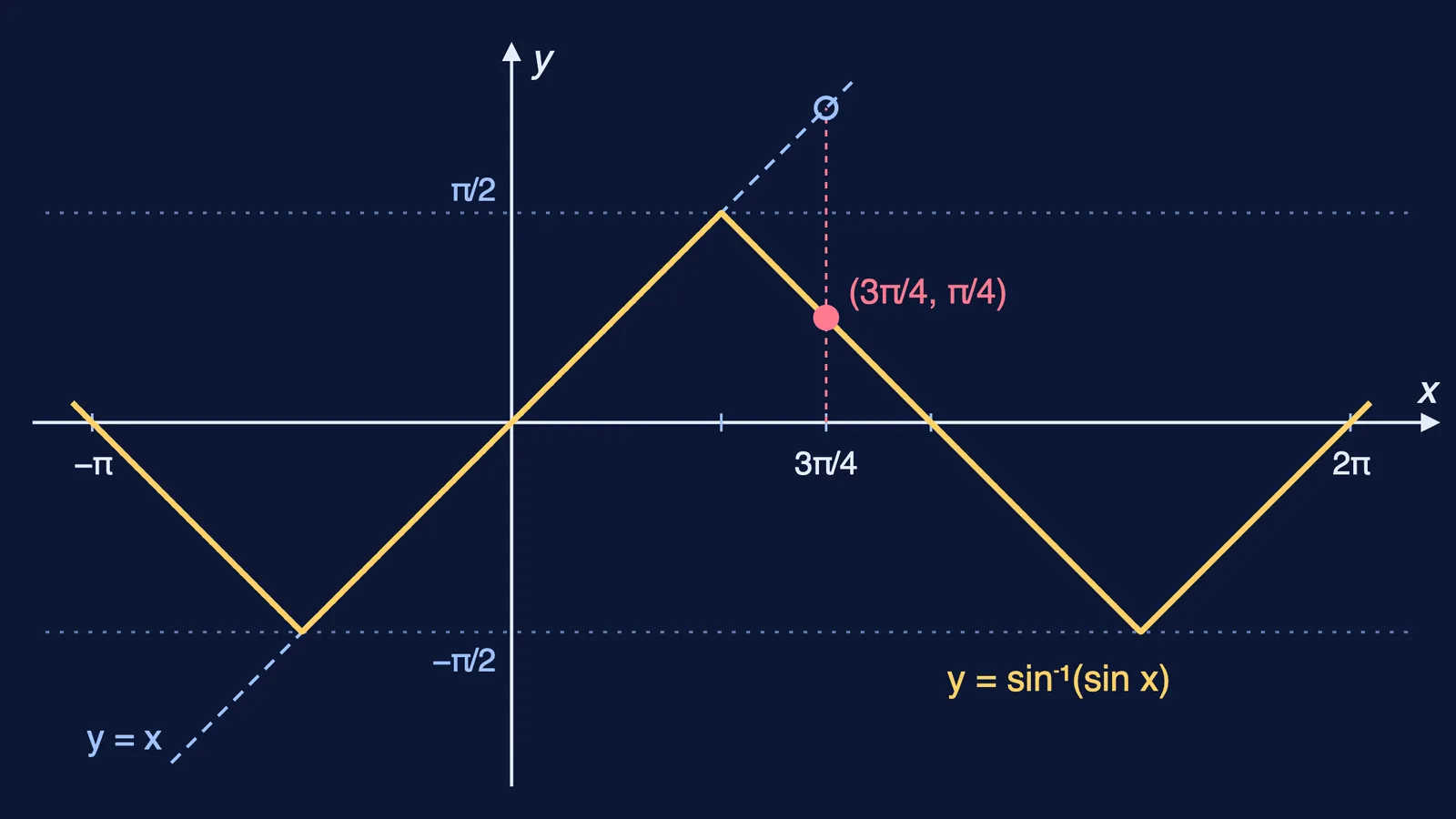
Q4 (medium). Assertion (A): sin⁻¹(sin(3π/4)) = π/4. Reason (R): sin⁻¹(sin x) = x for every real x.
Answer: (C). A is true: sin(3π/4) = √2/2, and the angle in [−π/2, π/2] with that sine is π/4. R is false: NCERT gives sin⁻¹(sin x) = x only for x in [−π/2, π/2], and A itself is a counterexample.
Trap: cancelling sin⁻¹ and sin without checking the interval.
Q5 (hard). Assertion (A): sec⁻¹(−√2) = 3π/4. Reason (R): The principal value branch of sec⁻¹ has range [0, π] − {π/2}.
Answer: (A). sec(3π/4) = −√2, and sec(−π/4) = √2, so the only candidate in the range is 3π/4. R is exactly why the answer is in the second quadrant, not the fourth.
Trap: writing −π/4 because secant is negative.
Q6 (hard). Assertion (A): The equation sin⁻¹x = 2π/3 has no real solution. Reason (R): sin(2π/3) = √3/2, which lies in [−1, 1].
Answer: (B). A is true: sin⁻¹x always lies in [−π/2, π/2], and 2π/3 is larger than π/2. R is true, but it points the other way; x = √3/2 gives sin⁻¹x = π/3, not 2π/3.
Trap: taking sine of both sides and forgetting to check the range.
Statement I and Statement II questions with answers
Q7 (easy). Statement I: The domain of tan⁻¹ is R and its principal value branch has range (−π/2, π/2). Statement II: The domain of sec⁻¹ is [−1, 1].
Answer: (C). I matches the NCERT table. II is false: the domain of sec⁻¹ is R − (−1, 1), since sec x never lies strictly between −1 and 1.
Trap: giving sec⁻¹ the domain of cos⁻¹.
Q8 (medium). Statement I: cos⁻¹(cos(4π/3)) = 4π/3. Statement II: tan⁻¹(tan(5π/4)) = π/4.
Answer: (D). I is false: cos(4π/3) = −1/2, so the value is 2π/3, inside [0, π]. II is true: tan(5π/4) = 1, and the angle in (−π/2, π/2) with tangent 1 is π/4.
Trap: cancelling in I, then distrusting the correct answer in II.
Q9 (hard). Statement I: cosec⁻¹(−2) = −π/6. Statement II: cot⁻¹(−1) = 3π/4.
Answer: (A). I: cosec(−π/6) = −2, and −π/6 lies in [−π/2, π/2] − {0}. II: cot(3π/4) = −1, and 3π/4 lies in (0, π).
Trap: writing −π/4 for II, as if cot⁻¹ had the same range as tan⁻¹.
Q10 (hard). Statement I: The domain of f(x) = cos⁻¹(x² − 1) is [0, √2]. Statement II: cos⁻¹(−x) = −cos⁻¹x for every x in [−1, 1].
Answer: (B). I is false: −1 ≤ x² − 1 ≤ 1 gives x² ≤ 2, so the domain is [−√2, √2]. II is false: at x = 0 the left side is π/2 and the right side is −π/2, which is not even in the range of cos⁻¹.
Trap: dropping the negative root, and treating cos⁻¹ as an odd function.
How should you use this set?
Attempt all ten in 12 minutes, marking T or F beside each statement first.
For each miss, note what you misjudged: A, R, or the link between them.
Redo Q4, Q6 and Q8 by sketching the principal branch and marking the answer on it.
Turn one value you got wrong into a new pair of your own.
The hero graph shows Q4: y = sin⁻¹(sin x) follows y = x only between −π/2 and π/2, then turns back, so x = 3π/4 gives π/4.
If principal branches still blur together, the Fermi Concept Library gives every concept in mathematics its own lesson and its place in the map.
For long answers and step marks, read our guide to inverse trigonometric functions for the Class 12 board exam. For the method behind this format, see our assertion-reason strategy guide.