On this page
Three original cases, easy to hard. New to zeroes? Read our Class 10 Polynomials chapter guide first.
What do case-study questions on polynomials look like?
The CBSE Class 10 Mathematics Standard sample paper for 2026-27 has three case study-based questions of 4 marks each in Section E, each with three sub-parts of 1, 1 and 2 marks, and calculators are not allowed. Everything stays inside the CBSE 2026-27 Class X Mathematics curriculum (zeroes of a polynomial, and the relationship between zeroes and coefficients of quadratic polynomials) and the rationalised NCERT Chapter 2, Polynomials (Reprint 2026-27).
Two NCERT facts carry most of the marks. The zeroes of ax² + bx + c are the x-coordinates of the points where its graph meets the x-axis. If α and β are those zeroes, then α + β = −b/a and αβ = c/a.
Case 1: Two fountain jets in a society park
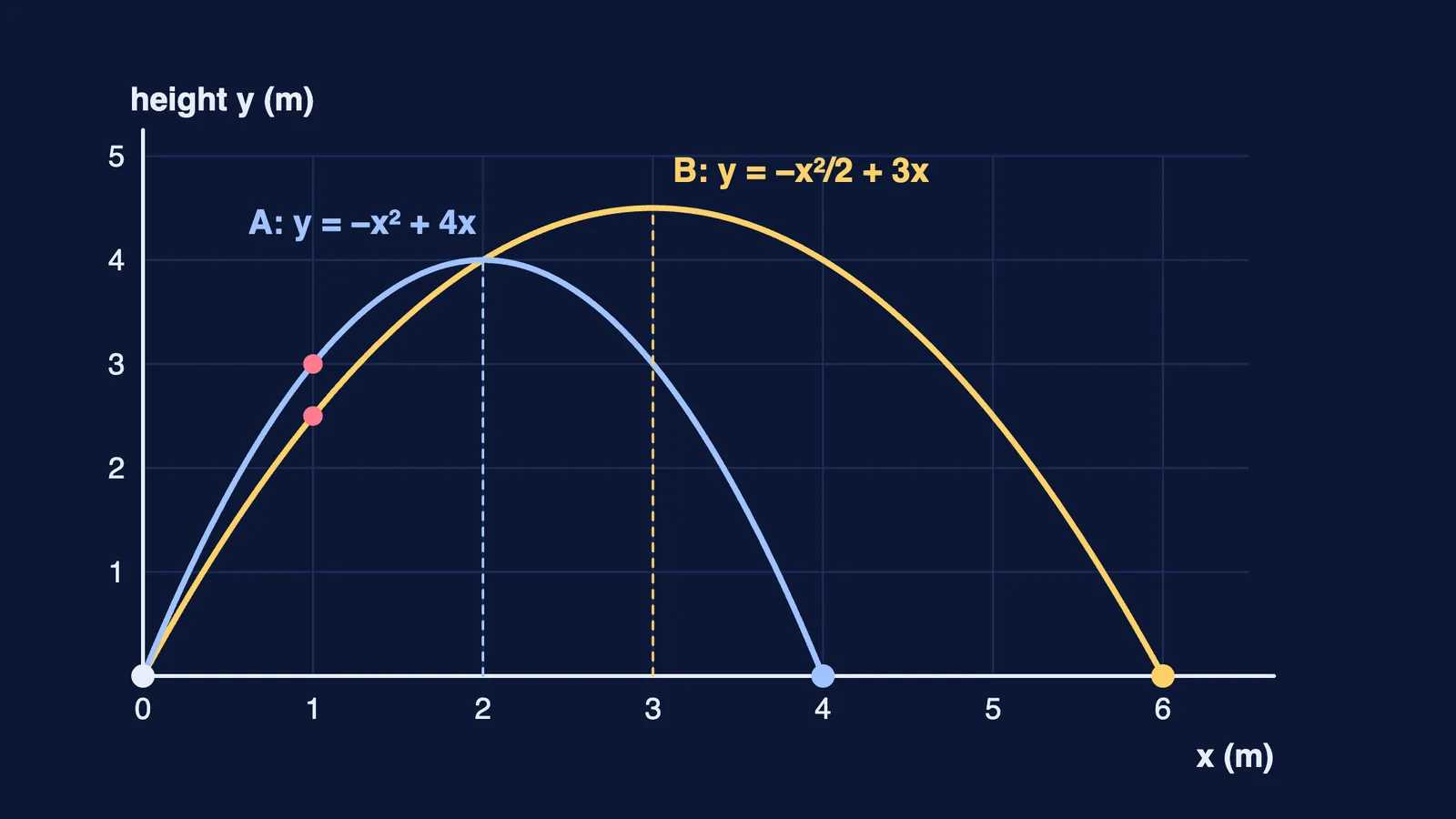
A housing society in Lucknow is fitting two fountain nozzles at ground level in its park, both pointing the same way. Take the nozzle as the origin, with x the horizontal distance and y the height of the water, both in metres. The stream from nozzle A follows y = −x² + 4x. Nozzle B is set to throw farther: its stream also starts at the nozzle, lands 6 m away, and is 2.5 m high at a horizontal distance of 1 m. The gardener needs to know where each stream lands.
(i) The polynomial −x² + 4x is: (a) linear, with a straight-line graph (b) quadratic, with a graph opening upwards (c) quadratic, with a graph opening downwards (d) cubic
(ii) How high is stream A at a horizontal distance of 1 m?
(iii) Find the zeroes of −x² + 4x and say what each one means for stream A.
(iv) Find the quadratic polynomial that describes stream B.
Answers.
(i) (c). The degree is 2 and a = −1 < 0, so the parabola opens downwards.
(ii) p(1) = −1 + 4 = 3, so 3 m.
(iii) −x² + 4x = −x(x − 4), so the zeroes are 0 and 4. The water leaves the nozzle at x = 0 and lands 4 m away.
(iv) Its zeroes are 0 and 6, so it has the form k(x − 0)(x − 6) = k(x² − 6x). At x = 1 the height is 2.5: k(1 − 6) = 2.5 gives k = −1/2. So y = −x²/2 + 3x.
Case 2: The annual day stage mat
A school in Kochi orders a rectangular rubber mat to cover the whole stage floor for its annual day function. The supplier's bill does not list the length and breadth; it only says the mat has a perimeter of 34 m and an area of 60 m². Ananya, in Class 10, knows their sum and product, so she treats them as the zeroes of a quadratic polynomial. She also wants the length of a tape strip running corner to corner.
(i) If the length is l m and the breadth is b m, then l + b equals: (a) 34 (b) 17 (c) 60 (d) 30
(ii) Write a quadratic polynomial whose zeroes are l and b.
(iii) Find the length and breadth of the mat.
(iv) Using only the sum and product, find the length of the diagonal.
Answers.
(i) (b). 2(l + b) = 34, so l + b = 17.
(ii) x² − (sum)x + (product) = x² − 17x + 60, or any k(x² − 17x + 60) with k ≠ 0.
(iii) x² − 17x + 60 = (x − 12)(x − 5), so the mat is 12 m by 5 m.
(iv) l² + b² = (l + b)² − 2lb = 289 − 120 = 169, so the diagonal is √169 = 13 m. Check: 12² + 5² = 144 + 25 = 169.
Case 3: Break-even points at a pump factory
A small factory in Coimbatore makes domestic water pumps. Its accountant models the monthly profit as P(x) = −2x² + 40x − 150, in thousands of rupees, where x is the number of pumps made in hundreds. A negative value is a loss. The owner wants the production levels with neither profit nor loss. Next year the fixed costs will rise, changing the constant term to −k, and the accountant predicts that the two no-profit, no-loss levels will then be only 600 pumps apart.
(i) What is the profit when 1,000 pumps are made? (a) ₹1,50,000 (b) ₹50,000 (c) a loss of ₹50,000 (d) ₹2,50,000
(ii) What does a zero of P(x) mean for the factory?
(iii) Find the zeroes of P(x) and verify the relationship between the zeroes and the coefficients.
(iv) Find k and the new no-profit, no-loss production levels.
Answers.
(i) (b). P(10) = −200 + 400 − 150 = 50, that is ₹50,000.
(ii) A production level at which the factory makes neither profit nor loss.
(iii) P(x) = −2(x² − 20x + 75) = −2(x − 5)(x − 15), so the zeroes are 5 and 15 (500 and 1,500 pumps). Sum 20 = −40/−2 = −b/a; product 75 = −150/−2 = c/a.
(iv) The sum stays 20 and the product is k/2. (α − β)² = (α + β)² − 4αβ gives 36 = 400 − 2k, so k = 182. Then α + β = 20 and α − β = 6 give 13 and 7: 700 and 1,300 pumps.
How should you attack case-study questions on polynomials?
Write what x and y stand for, with units, first.
Put the polynomial in the form ax² + bx + c and note a, b and c with their signs; a sign slip in −b/a costs the most marks.
Read every zero back into the story: a landing point, a side, a production level.
Given the sum and product, use k(x² − Sx + P); for α² + β² or α − β, start from (α + β)².
Check one answer by substitution: p(zero) must come out as 0.
Read our guide to case-based questions in board exams and try the Polynomials assertion-reason set. If one step keeps slipping, the Fermi Problem Library has a step-by-step solver that explains the reasoning rather than printing an answer.