

On this page
Most lost marks in Polynomials come from a sign slip in −b/a or a true fact picked as the reason. These 10 original questions target both.
What do these questions cover?
The CBSE Class 10 Mathematics Standard sample paper for 2026-27 has two assertion-reason questions, Q19 and Q20, of 1 mark each. Every item here stays inside the CBSE 2026-27 Class 10 Mathematics syllabus: zeroes of a polynomial and the relationship between zeroes and coefficients of quadratic polynomials. Each was checked against the NCERT Class 10 Polynomials chapter, Reprint 2026-27. For the theory first, see our Class 10 Polynomials chapter guide.
How do you answer assertion-reason questions?
Judge each statement alone first. If both are true, read "A, because R" and ask whether R is the actual reason, as our assertion-reason strategy guide explains.
Keys for Q1 to Q6:
(A) Both A and R are true and R is the correct explanation of A.
(B) Both A and R are true but R is NOT the correct explanation of A.
(C) A is true but R is false.
(D) A is false but R is true.
Keys for Q7 to Q10:
(A) Both statements are correct.
(B) Both statements are incorrect.
(C) Statement I is correct, Statement II is incorrect.
(D) Statement I is incorrect, Statement II is correct.
Assertion-reason questions on Polynomials with answers
Q1 (easy). Assertion (A): The zero of the polynomial 3x − 6 is 2. Reason (R): The zero of the linear polynomial ax + b, a ≠ 0, is −b/a.
Answer: (A). R gives −(−6)/3 = 2 directly.
Trap: writing b/a and getting −2.
Q2 (easy). Assertion (A): The graph of y = x² − 6x + 9 meets the x-axis at exactly one point. Reason (R): Every quadratic polynomial has two distinct zeroes.
Answer: (C). A is true: x² − 6x + 9 = (x − 3)², touching the x-axis only at x = 3. R is false: a quadratic can have two distinct zeroes, two equal zeroes, or none.
Trap: assuming "degree 2" means "two crossing points".
Q3 (medium). Assertion (A): The polynomial x² + 4 has no zero. Reason (R): A quadratic polynomial has at most two zeroes.
Answer: (B). Both are true: x² + 4 ≥ 4 for every real x. "At most two" is a ceiling; it cannot tell you the count is zero.
Trap: choosing (A) because both lines count zeroes.
Q4 (medium). Assertion (A): If the graph of y = p(x) cuts the x-axis at exactly three points, then p(x) must be a cubic polynomial. Reason (R): A polynomial of degree n has at most n zeroes.
Answer: (D). R is NCERT's own remark. A is false: x⁵ − x = x(x − 1)(x + 1)(x² + 1) has degree 5 but only three zeroes, −1, 0 and 1.
Trap: reading "at most n" as "exactly n".
Q5 (medium). Assertion (A): The product of the zeroes of 3 − 8x + 4x² is 3/4. Reason (R): For ax² + bx + c, a ≠ 0, the product of the zeroes is c/a.
Answer: (A). In standard form it is 4x² − 8x + 3, so c/a = 3/4; the zeroes 1/2 and 3/2 confirm it.
Trap: taking the first number written, 3, as a and getting 4/3.
Q6 (hard). Assertion (A): Both zeroes of x² + 5x + 6 are negative. Reason (R): The product of the zeroes of x² + 5x + 6 is positive.
Answer: (B). Both are true: the zeroes are −2 and −3, and their product is 6. A positive product only says the zeroes share a sign (2 and 3 would also give 6); it is the negative sum, −5, that makes them both negative.
Trap: treating "positive product" as "both negative".
Statement I and II questions on Polynomials with answers
Q7 (easy). Statement I: The degree of 5 − 2x³ + x is 3. Statement II: x + 1/x is a quadratic polynomial.
Answer: (C). I is correct: the highest power is x³. In II, 1/x is x to the power −1, so x + 1/x is not a polynomial.
Trap: mentally clearing the fraction.
Q8 (medium). Statement I: A quadratic polynomial with zeroes 2 and −3 is x² − x − 6. Statement II: Every quadratic polynomial with zeroes 2 and −3 has the form k(x² + x − 6), where k is a non-zero real number.
Answer: (D). The sum of the zeroes is −1, so the x term is +x: (x − 2)(x + 3) = x² + x − 6, and I is incorrect. II is correct: any non-zero multiple keeps the same zeroes.
Trap: copying the sum, −1, as the x coefficient.
Q9 (hard). Statement I: If α and β are the zeroes of x² − 9x + 14, then 1/α + 1/β = 9/14. Statement II: If the two zeroes of x² + kx + 9 are equal, then k = 6 or k = −6.
Answer: (A). For I, 1/α + 1/β = (α + β)/αβ = 9/14 (the zeroes are 2 and 7). For II, equal zeroes give α² = 9, so α = 3 or −3, and k = −2α is −6 or 6.
Trap: keeping only k = 6 and losing the negative case.
Q10 (hard). Statement I: If the graph of y = ax² + bx + c opens downwards and cuts the x-axis at one point on each side of the origin, then c < 0. Statement II: If −2 is a zero of x² + kx − 8, then the other zero is −4.
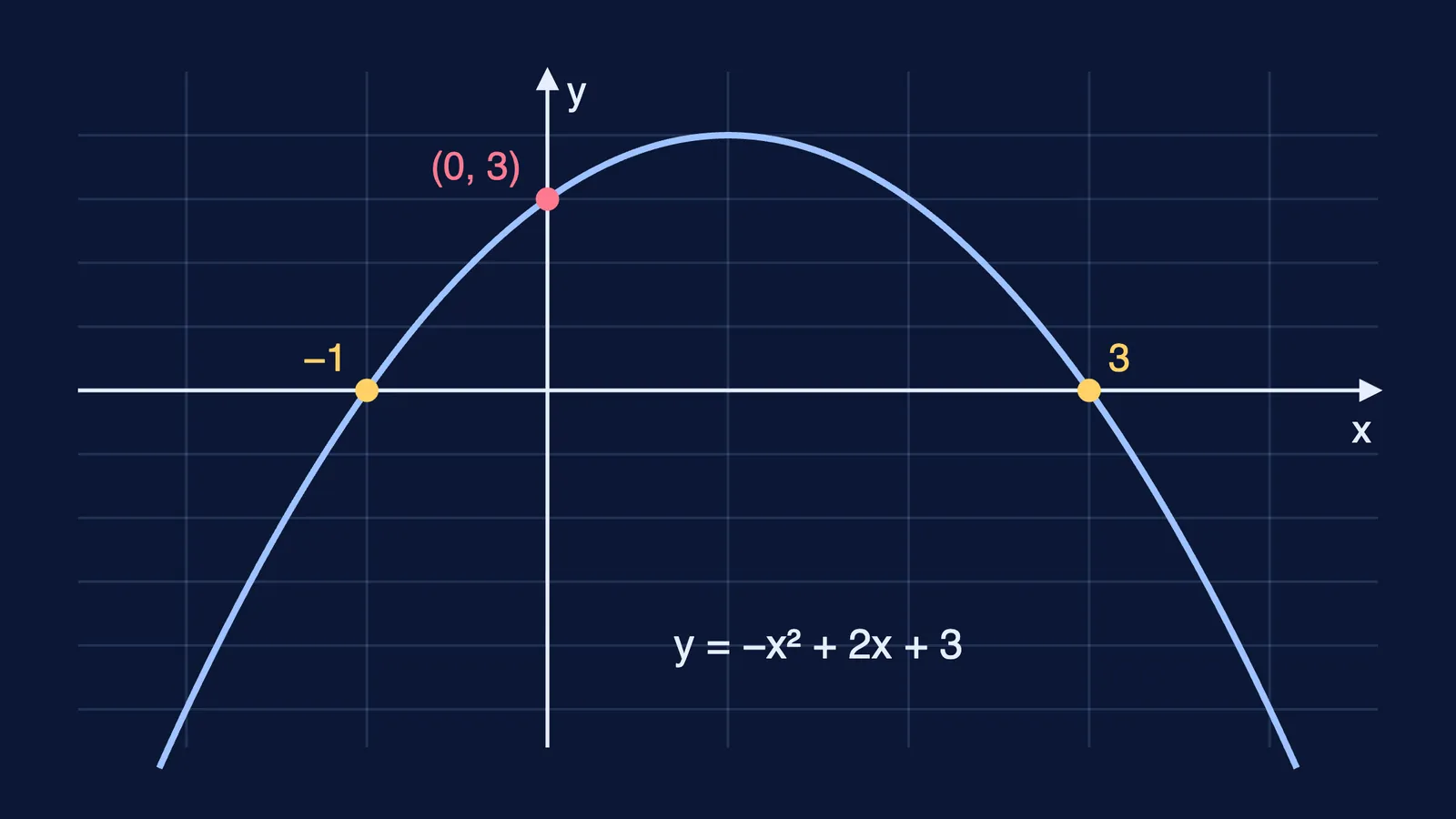
Answer: (B). In I, a < 0 and the zeroes have opposite signs, so c/a < 0, which forces c > 0, as the graph above shows. In II, the product of the zeroes is −8, so the other zero is 4 (and k = −2).
Trap: forgetting that a is negative.
How should you use this set?
Attempt all ten in 12 minutes without looking back.
Label each miss: wrong fact, sign slip, or wrong link.
Redo the misses two days later.
If an idea still feels shaky, the Fermi Concept Library covers every concept in mathematics, each with its own lesson. For a step beyond the board syllabus, see our guide to the remainder when a polynomial is divided by a quadratic or cubic.


