On this page
Three original cases on Chapter 7 of NCERT Class 11 Biology (Reprint 2026-27), each checked against that chapter. The CBSE 2026-27 Biology curriculum lists this chapter as the morphology, anatomy and functions of the frog's digestive, circulatory, respiratory, nervous and reproductive systems, so every case is about the frog. Treat them as practice in the case-based style.
For the chapter itself, start with the Structural Organisation in Animals Class 11 guide. New to the format? Read how to answer case-based questions.
Case 1: Where did the frogs go in May?
In a Pune housing society, Dhruv hears loud croaking after the first heavy rain in June. With a torch he finds one frog whose throat balloons out with every call. A second frog sits on wet grass and looks greener than a third one on bare mud. On a 22 °C night and a 34 °C afternoon he notes that both frogs feel cool and slippery. His sister puts a bowl of water out "so they can drink". Dhruv wonders why he never saw a single frog in May.
(i) Which feature tells Dhruv that the calling frog is a male? (a) Webbed hind feet (b) Vocal sacs (c) Nictitating membrane (d) Tympanum
(ii) Will the frogs drink from the bowl? How does a frog take in water?
(iii) Between 22 °C and 34 °C, does a frog keep its body temperature constant? Name the term for such animals.
(iv) Where were the frogs in May, what is this called, and how did they breathe then?
Answers.
(i) (b) Vocal sacs. Males also have a copulatory pad on the first digit of the fore limbs.
(ii) No. The frog never drinks water; it absorbs it through the skin.
(iii) No. Across the 34 − 22 = 12 °C swing, its body temperature follows the surroundings: it is a poikilotherm (cold-blooded).
(iv) They sheltered in deep burrows to escape the peak summer heat, which is summer sleep or aestivation. During aestivation gaseous exchange takes place through the skin.
Case 2: Counting eggs in a paddy field
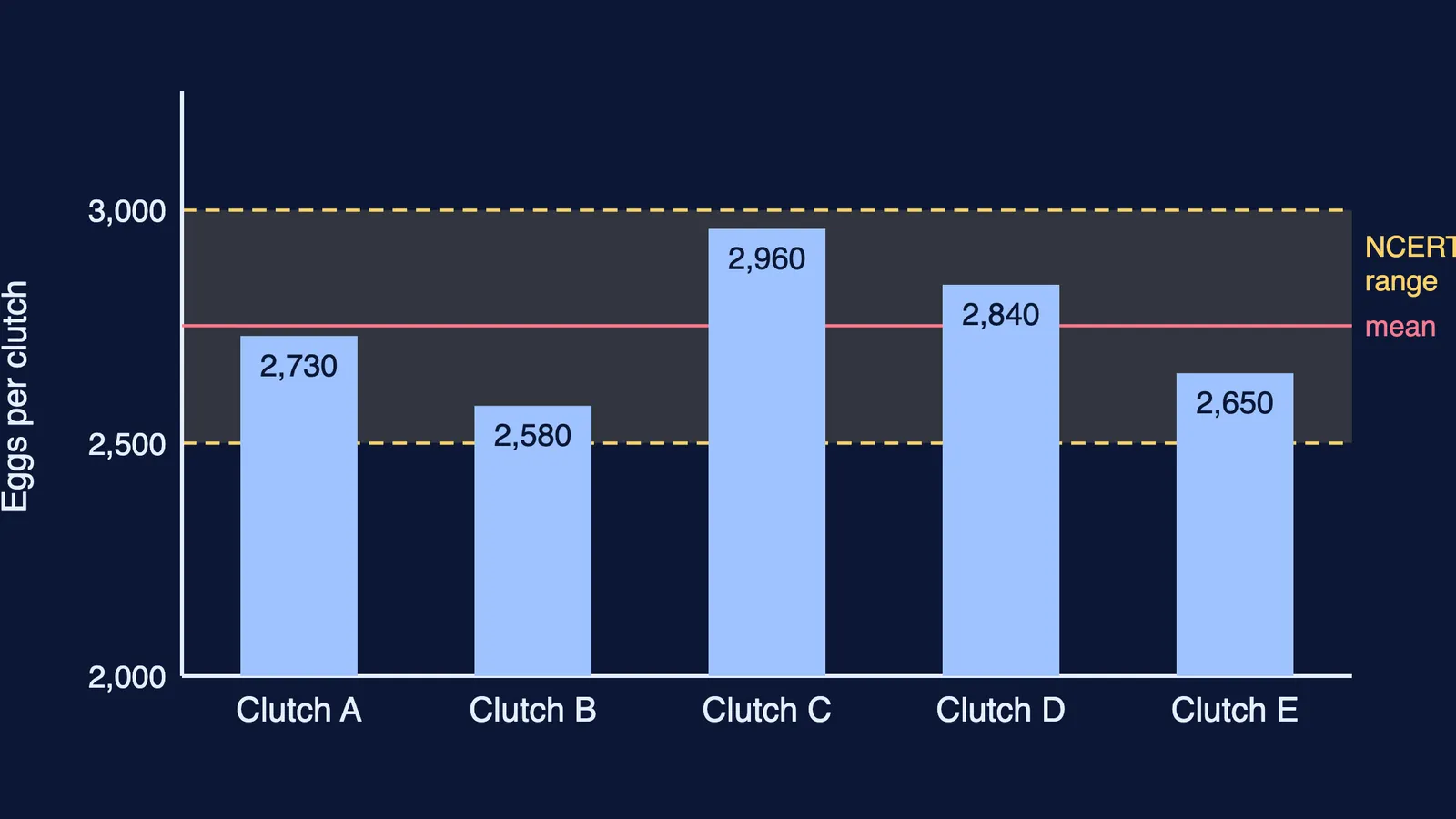
Farmers near Thrissur, Kerala, protect the bullfrogs in their paddy fields because the frogs eat insects that damage the crop. After a July shower, a college nature club photographs five fresh egg clutches in a shallow channel and counts the eggs on a laptop: 2,730, 2,580, 2,960, 2,840 and 2,650. One member says the frogs mated inside the body and the eggs will hatch straight into tiny frogs. Their mentor then brings out models of the male and female urinogenital systems.
(i) Where does fertilisation take place in the frog? (a) Inside the oviduct (b) Inside the cloaca (c) In water, outside the body (d) Inside the ovary
(ii) Find the mean number of eggs per clutch. Does every clutch fall in the range NCERT gives?
(iii) Correct the member's claim about what hatches from the eggs.
(iv) Trace the path of sperms from the testis to the outside, and state how the female's ducts differ.
Answers.
(i) (c) Fertilisation is external and takes place in water.
(ii) Total = 2,730 + 2,580 + 2,960 + 2,840 + 2,650 = 13,760. Mean = 13,760 ÷ 5 = 2,752. Yes: the smallest (2,580) and largest (2,960) lie within the 2,500 to 3,000 ova a mature female lays at a time.
(iii) The eggs hatch into a larval stage, the tadpole, which undergoes metamorphosis to form the adult frog.
(iv) Testis → 10 to 12 vasa efferentia → kidney → Bidder's canal → urinogenital duct → cloaca → cloacal aperture. In the female, the ovaries have no functional connection with the kidneys, and the oviducts and ureters open separately into the cloaca.
Case 3: Following an insect meal
A zoology department in Bhopal teaches frog anatomy on a 3D digital model, not by dissection. Students tag a "virtual insect" and follow it. A tongue flicks it into the mouth, and the model then highlights the gut organ by organ, the glands that pour juices into it, and the blood vessels leaving the intestine. Riya notices the alimentary canal looks short for the frog's size. She concludes, "A short gut must mean the frog digests poorly, and the food it absorbs goes straight to the heart."
(i) Through which route do bile and pancreatic juice reach the gut? (a) Into the stomach through the oesophagus (b) Into the duodenum through a common bile duct (c) Into the rectum through the cloaca (d) Into the buccal cavity through the pharynx
(ii) Name the venous connection that carries blood from the intestine to the liver.
(iii) The model's heart has three chambers. Name them, and the structure that receives blood from the vena cava.
(iv) Evaluate Riya's conclusion, tracing the meal from capture to absorption.
Answers.
(i) (b) The duodenum receives bile from the gall bladder and pancreatic juice from the pancreas through a common bile duct.
(ii) The hepatic portal system.
(iii) Two atria and one ventricle. The sinus venosus, joined to the right atrium, receives blood through the vena cava.
(iv) Both parts are wrong. The canal is short because the frog is a carnivore. The bilobed tongue captures the insect; it passes via buccal cavity, pharynx and oesophagus to the stomach (HCl and gastric juices), then as chyme to the duodenum, where bile emulsifies fat and pancreatic juice digests carbohydrates and proteins. Final digestion happens in the intestine, and villi and microvilli absorb the food. Blood from the intestine goes first to the liver through the hepatic portal system.
How do you attack case-study questions on the frog?
Underline clue words first (calling, burrow, eggs, duct, juice, chamber); each points to one section of the chapter.
Learn paired terms together: aestivation and hibernation, cutaneous and pulmonary respiration, hepatic and renal portal systems.
Judge each part of a character's claim separately; Case 3 hides two errors in one sentence.
For path questions, write arrows and name every organ; skipping Bidder's canal leaves the path incomplete.
In data parts, write the total, the division, then the comparison with NCERT's figure.
For another format on this chapter, try our Structural Organisation in Animals assertion-reason questions. If the portal systems still blur together, the Fermi Concept Library covers every concept in biology, each with its own lesson and its place in the map.