On this page
Fill rows of boxes with 1, 2, ..., n so that every row and column increases: how many ways are there? The hook length formula answers in one line, and the best-known proof of it is short enough to follow by hand.
What is the hook length formula?
Start with a partition of n, such as 5 = 3 + 2, and draw it as a Young diagram: left-justified rows of boxes, here 3 on top and 2 below. If partitions are new to you, start with our guide to integer partitions and how to count them.
A standard Young tableau is a filling of the n boxes with 1 to n, each used once, so that rows increase left to right and columns increase top to bottom (Hook length formula, Wikipedia).
The hook of a box is the box itself plus every box to its right and every box below it; the hook length is the number of boxes in the hook (Wikipedia).
The hook length formula states that the number of standard Young tableaux of a shape equals n! divided by the product of the hook lengths of all its boxes. J. S. Frame, G. de B. Robinson and R. M. Thrall published it in 1954 in the Canadian Journal of Mathematics (DOI 10.4153/CJM-1954-030-1).
How do you use the hook length formula on the shape (3,2)?
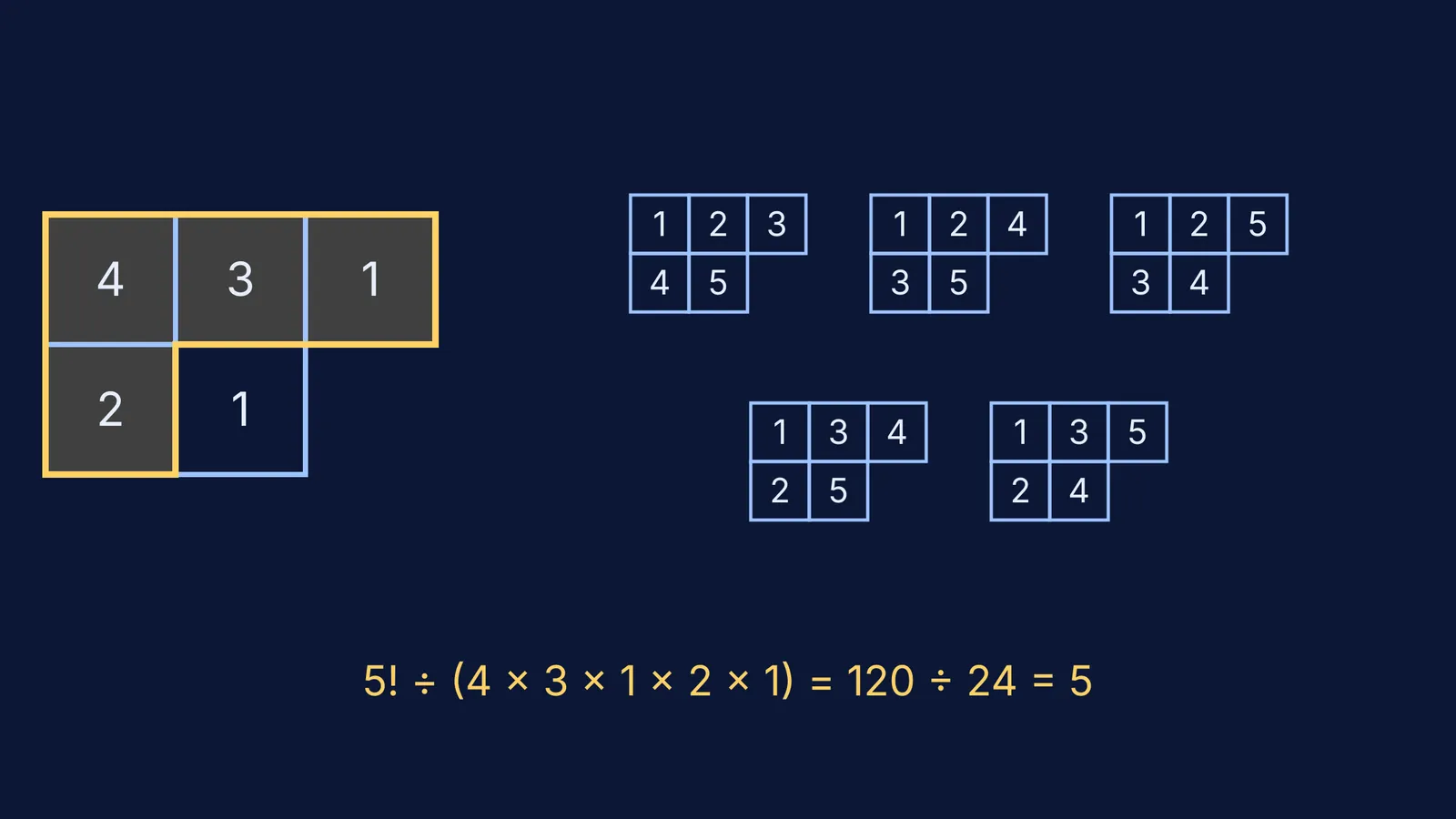
Write each hook length inside its box.
Top-left: itself, 2 to the right, 1 below. Hook 4.
Top-middle: itself, 1 right, 1 below. Hook 3.
Top-right: just itself. Hook 1.
Bottom-left: itself and 1 right. Hook 2.
Bottom-right: just itself. Hook 1.
The product is 4 × 3 × 1 × 2 × 1 = 24, and 5! = 120, so the formula gives 120 ÷ 24 = 5.
Now check it by listing. The top-left box must hold 1, and the five fillings are:
1 2 3 over 4 5
1 2 4 over 3 5
1 2 5 over 3 4
1 3 4 over 2 5
1 3 5 over 2 4
Any other choice breaks a column: 1 4 5 over 2 3 puts 4 above 3. Avoiding the listing is the same trade our post on counting with a bijection makes in other problems.
Why do 2×n shapes give the Catalan numbers?
For two rows of n boxes, the top row's hooks are n+1, n, ..., 2 and the bottom row's are n, n−1, ..., 1, so the product is (n+1)! × n!. The formula then gives (2n)! ÷ ((n+1)! n!), which is the Catalan number C(n). The OEIS entry for the Catalan numbers records that C(n) is the number of standard Young tableaux of shape (n,n); the sequence begins 1, 1, 2, 5, 14, 42, 132 (OEIS A000108).
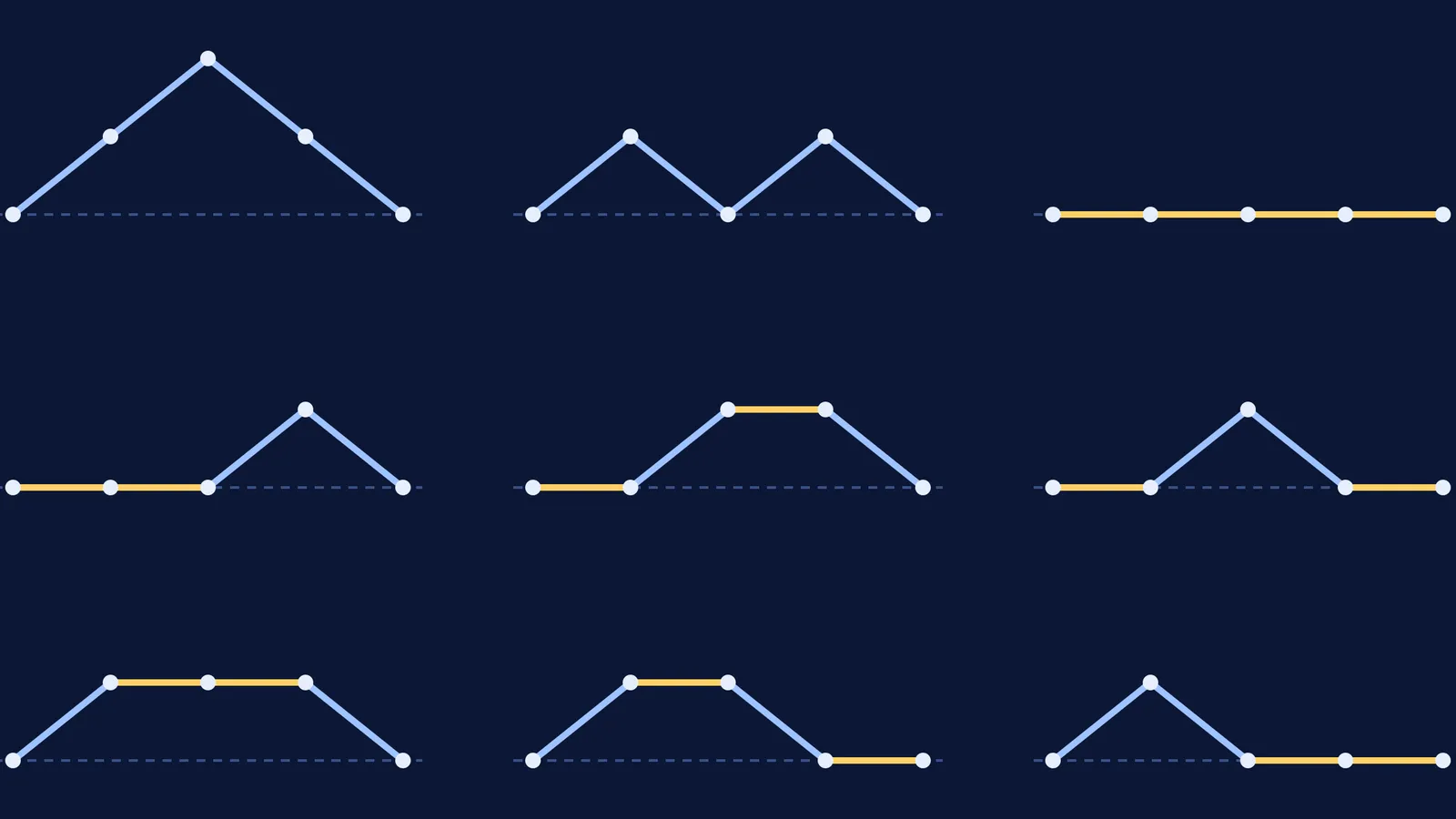
The ballot picture explains why. Read 1 to 2n in order, writing U when a number sits in the top row and D when it sits in the bottom row. The column rule means you always have at least as many U's as D's so far: a ballot sequence, or Dyck path. The rows 1 2 5 over 3 4 6 give UUDDUD (Wikipedia). Check n = 3: 6! ÷ (4·3·2 × 3·2·1) = 720 ÷ 144 = 5, which is C(3). If you have read our post on the ballot problem and the reflection principle, this is the tie case, where the top row never falls behind.
Why does the hook length formula work?
A probabilistic proof, in which the hook lengths appear naturally, came from Curtis Greene, Albert Nijenhuis and Herbert S. Wilf in Advances in Mathematics in 1979 (DOI 10.1016/0001-8708(79)90023-990023-9)). Their idea is the hook walk (Wikipedia's account of the proof):
Pick a box uniformly at random.
Jump to a uniformly random other box in its hook.
Repeat until you land on a corner, a box with hook length 1.
The largest number n always sits in a corner, so the true count for a shape is the sum of the counts for the shapes left after deleting one corner. The paper shows the walk ends at each corner with probability equal to the formula for the smaller shape divided by the formula for the whole shape. Those probabilities add to 1, so the formula obeys the same recurrence as the true count, and induction finishes the proof.
Test it on (3,2). Deleting its corners leaves (2,2), with 2 tableaux, and (3,1), with 3, so the walk should end bottom-right with probability 3/5. From bottom-left it must go right: probability 1. Top-middle gives 1/2; top-left, 1/3 × 1/2 + 1/3 × 1 = 1/2; the corners give 0 and 1. The average of 1/2, 1/2, 0, 1 and 1 is 3/5.
How should you practise the hook length formula?
Count (2,2), (3,1) and (2,1,1) by formula, then list them to check. You should get 2, 3 and 3.
Try (4,3,1,1); the answer is 216 (Wikipedia).
Run the hook walk on (2,1) by hand: each corner should come out at 1/2.
Explain to a friend why 1 2 5 over 3 4 6 reads UUDDUD.
If factorials or recurrences feel shaky, the Fermi Concept Library has a lesson for every concept in mathematics, each with its place in the map, so you can step back before going on.