

On this page
When you think of predators, you might picture a lion chasing a zebra across the savanna or a shark hunting seals in the open ocean. It is easy to see them simply as nature's killers, constantly on the attack to survive. But their role goes far beyond merely passing energy along the food chain. Predators act as keystone species that shape their entire environment from the top down. By keeping prey in check, they prevent overgrazing, ensure natural resources remain available for other animals, and allow a much wider variety of species to thrive.
What is the 10% rule in ecology?
To truly understand a predator's place in the world, you first have to trace the energy that sustains them. In 1942, ecologist Raymond Lindeman studied Cedar Bog Lake in Minnesota and quantified how energy moves through an ecosystem (Wikipedia: Ecological efficiency). He found that, on average, only about 10% of the energy stored as biomass in one trophic level is passed on to the next.
This 10% rule explains why energy pyramids are always upright. When a herbivore eats a plant, 90% of the energy is lost to heat, respiration and waste. When a predator then eats that herbivore, another 90% of that remaining energy is lost. Because energy runs out so quickly, food chains rarely exceed four or five levels. It simply takes too much plant life to support a top predator, which is why predators will always be far fewer in number than the producers at the bottom.
If you are stuck on energy transfer calculations for a homework assignment or exam, Fermi's AI tutor can work out what you already know and build a plan for the session to help you master the trophic levels step by step.
What makes a keystone species?
While all predators transfer energy, some have an outsized impact on their home, acting as a "keystone" that holds the entire ecological structure together. The term was coined after a famous 1966 experiment in Washington's Makah Bay by biologist Robert Paine (Wikipedia: Keystone species).
Paine removed the top predator—the ochre starfish—from a stretch of the rocky shoreline to see what would happen. Without the starfish to eat them, the local mussel population exploded. The mussels quickly crowded out the algae, barnacles and snails that also lived on the rocks. Within a short time, local biodiversity plummeted from 15 species down to just eight. The starfish was a keystone species: its presence alone prevented the mussels from monopolizing the rock space, allowing the misfits of five-kingdom biology and other organisms to coexist peacefully.
To explore more examples of keystone species and their intricate food webs, the Fermi Concept Library maps every concept in biology, each with its own lesson.
Why are predators important in nature?
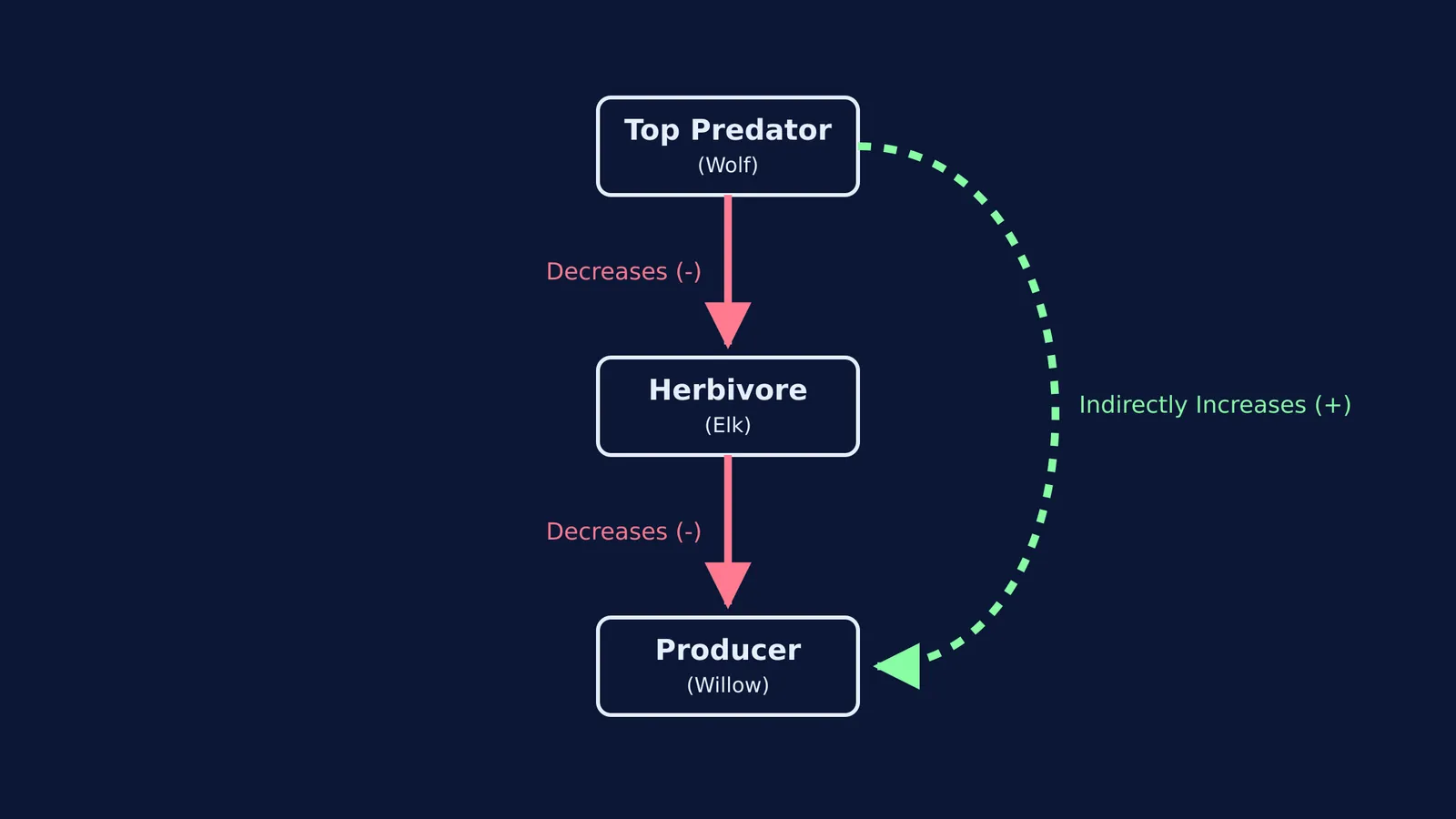
When a keystone predator is removed, the entire landscape changes in a chain reaction. The most famous real-world example of this "trophic cascade" happened in Yellowstone National Park over the course of the 20th century.
After wolves were eradicated from the park in the 1920s to protect livestock, the elk population grew unchecked. Without the threat of predation, the northern elk herd surged, reaching approximately 17,000 animals when wolf reintroduction began in 1995, according to the National Park Service. The massive herd heavily browsed young willow, aspen and cottonwood along the riverbanks.
As the wolf population grew after 1995, they initiated a trophic cascade that helped restore the landscape. By early 2013, the elk count had dropped to 3,915. With fewer elk, the proportion of browsed tree leaders decreased in some areas, allowing cottonwood and willow to grow taller. The wolves did not just reduce the elk numbers; their presence allowed the vegetation to recover.
Whether you are looking at stabilising, directional and disruptive selection in a population or calculating energy transfer between levels, biology is full of these interconnected systems. Understanding predators is the key to seeing how nature stays in balance.


