On this page
A matrix is symmetric when it equals its own transpose, Aᵀ = A. The spectral theorem says every real symmetric matrix can be diagonalised by an orthogonal matrix: A = QΛQᵀ, where the columns of Q are perpendicular unit eigenvectors and Λ is the diagonal matrix of eigenvalues.
What does the spectral theorem for symmetric matrices say?
For any real n×n matrix with Aᵀ = A, you get three promises:
Every eigenvalue is a real number.
Eigenvectors for different eigenvalues are perpendicular.
There are always enough eigenvectors to make a full orthonormal basis of n vectors, even when an eigenvalue repeats.
The Wikipedia article on the spectral theorem sketches the proof. Real eigenvalues: if Ax = λx, the number x̄ᵀAx equals its own complex conjugate when A is real and symmetric, and it also equals λ|x|², so λ is real. Perpendicular eigenvectors: if Ax = λ₁x and Ay = λ₂y, then λ₁(x·y) = (Ax)·y = x·(Ay) = λ₂(x·y), so with λ₁ ≠ λ₂, x·y = 0.
The symmetric case is credited to Augustin-Louis Cauchy; the historian Thomas Hawkins tells that story in Cauchy and the spectral theory of matrices90032-4) (Historia Mathematica, 1975). If eigenvalues are new to you, start with what eigenvalues of a 2×2 matrix mean and how to find them.
How do you diagonalise a 2×2 symmetric matrix as QΛQᵀ?
Take A = [5 2; 2 2].
Characteristic equation: λ² − (trace)λ + det = 0, which is λ² − 7λ + 6 = 0, so λ = 6 and λ = 1.
For λ = 6: (5 − 6)x + 2y = 0 gives y = x/2, so v₁ = (2, 1).
For λ = 1: 4x + 2y = 0 gives y = −2x, so v₂ = (1, −2).
Check: v₁·v₂ = 2 − 2 = 0.
Divide each by its length √5 and use them as columns: Q = (1/√5)[2 1; 1 −2] and Λ = diag(6, 1).
Multiply out and QΛQᵀ = (1/5)[25 10; 10 10] = [5 2; 2 2]. Since Qᵀ = Q⁻¹, you skip the inverse needed by the general PDP⁻¹ route for finding large powers of a matrix by diagonalisation.
How does it find the principal axes of a tilted ellipse?
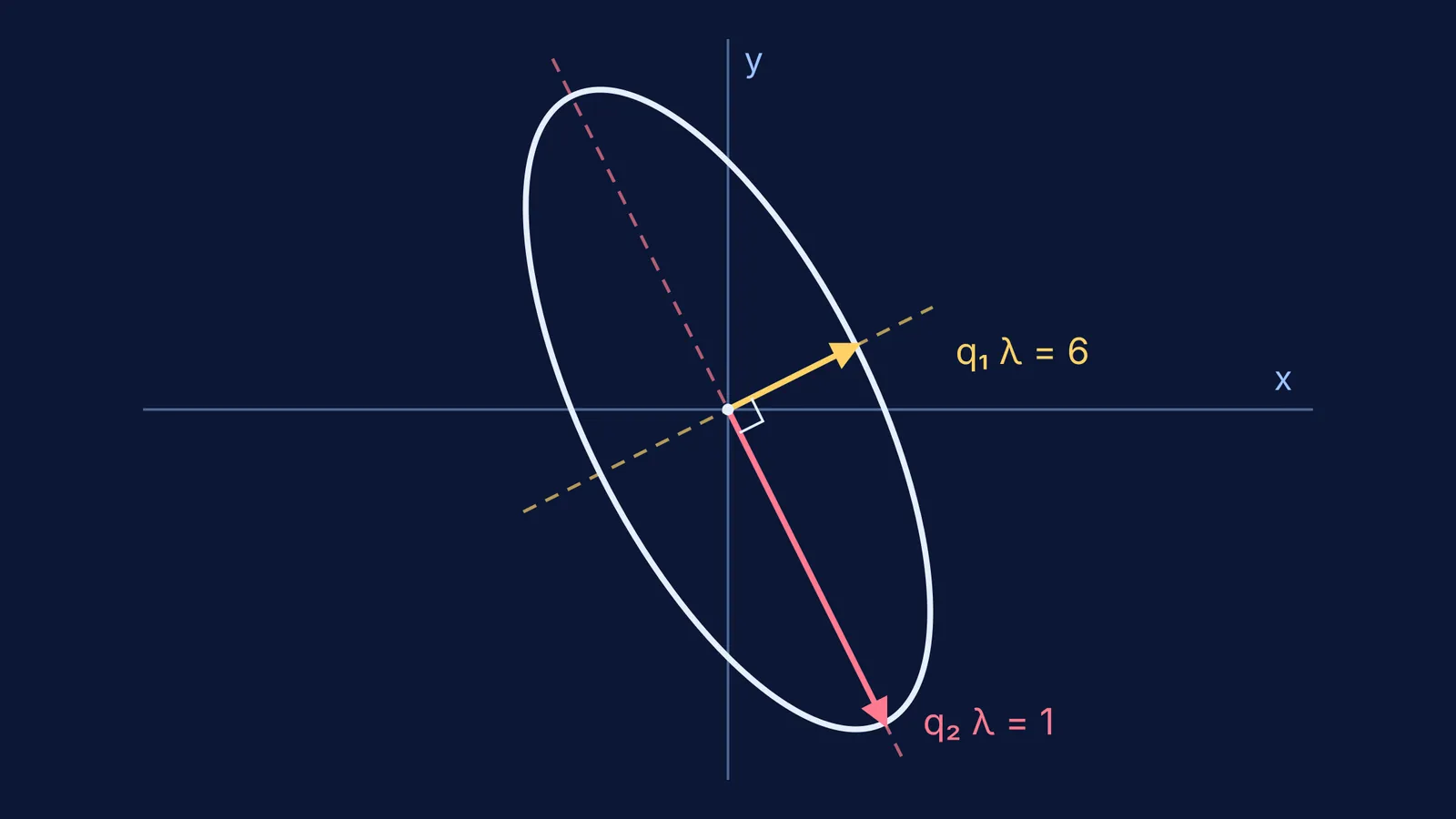
Every quadratic form can be written as xᵀAx with a symmetric A (symmetric matrix article). The curve 5x² + 4xy + 2y² = 6 is xᵀAx = 6 with the same A: the 4xy splits as 2 above the diagonal and 2 below. That xy term tilts the ellipse.
In coordinates u and v along q₁ and q₂ the cross term disappears: 6u² + v² = 6, or u² + v²/6 = 1. So:
The ellipse's axes point along the eigenvectors (2, 1) and (1, −2).
The semi-axis along each eigenvector is √(c/λ): √(6/6) = 1 along (2, 1), and √(6/1) = √6 ≈ 2.45 along (1, −2).
Small eigenvalue, long axis.
How do you diagonalise a 3×3 symmetric matrix with a repeated eigenvalue?
Take A = [2 1 1; 1 2 1; 1 1 2].
Put t = 2 − λ. Then det(A − λI) = t³ − 3t + 2 = (t − 1)²(t + 2), so t = 1 twice and t = −2, giving λ = 1, 1, 4.
For λ = 4: the rows of A − 4I force x = y = z, so q₁ = (1, 1, 1)/√3.
For λ = 1: every row of A − I is (1, 1, 1), so the eigenvectors fill the plane x + y + z = 0, already perpendicular to q₁.
Pick two perpendicular vectors in that plane: q₂ = (1, −1, 0)/√2 and q₃ = (1, 1, −2)/√6. Their dot product is 1 − 1 + 0 = 0.
Q has columns q₁, q₂, q₃, and Λ = diag(4, 1, 1).
Step 4 is where marks are lost. Any two independent vectors in the plane are eigenvectors, but Q needs perpendicular ones. If your first picks are not, Gram–Schmidt orthogonalisation fixes them in one step.
Why can non-symmetric matrices fail?
Drop symmetry and each promise can break. A real symmetric matrix is never defective, meaning short of eigenvectors; other matrices can be.
Complex eigenvalues: the rotation [0 −1; 1 0] gives λ² + 1 = 0, so λ = ±i. No real direction stays put.
Too few eigenvectors: [1 1; 0 1] has λ = 1 twice but only one eigenvector direction, (1, 0), so it cannot be diagonalised.
Skewed eigenvectors: [1 2; 0 3] has eigenvectors (1, 0) and (1, 1), at 45° to each other. It diagonalises as PDP⁻¹, but P is not orthogonal.
For eigenvectors, orthogonal matrices and quadratic forms, the Fermi Concept Library gives each concept its own lesson. When your matrix will not diagonalise, the Fermi Problem Library has a step-by-step solver that explains the reasoning.