

On this page
Colour the numbers 1, 2, 3 and so on with a few colours, and try to keep every colour free of a sum: no x and y of one colour whose total z has that colour too. Issai Schur showed in 1916 that you always lose once the list is long enough (MathWorld, Schur's problem).
What is Schur's theorem in Ramsey theory?
The theorem: for any number of colours r, there is an M such that every r-colouring of 1 to M has x, y, z of one colour with x + y = z (Jungić, Introduction to Ramsey Theory, section 4.2).
A triple with x + y = z is called a Schur triple, and x may equal y, so 1 + 1 = 2 counts (same source).
A colour with no Schur triple inside it is called sum-free. The Schur number S(k) is the largest N for which 1 to N can be split into k sum-free colours (OEIS A045652).
Why is S(2) = 4? A check you can do in one minute
Use red and blue; swapping them changes nothing.
Put 1 in red.
1 + 1 = 2, so 2 cannot be red. It is blue.
2 + 2 = 4, so 4 cannot be blue. It is red.
1 + 3 = 4, and 1 and 4 are both red, so 3 cannot be red. It is blue.
Check the result. Red is {1, 4}: its sums are 2, 5 and 8, none red. Blue is {2, 3}: its sums are 4, 5 and 6, none blue. So 1 to 4 can be coloured, and S(2) is at least 4.
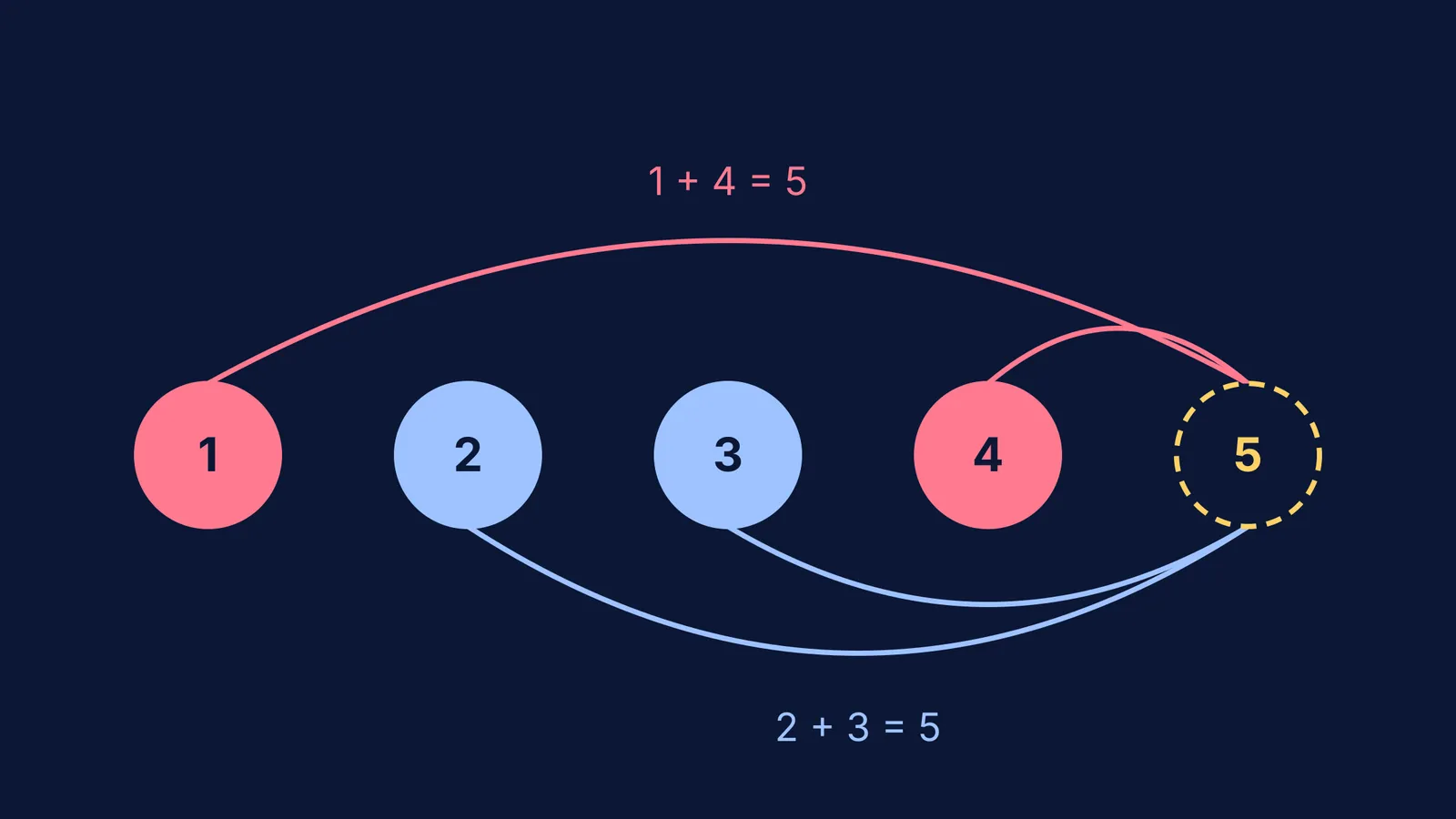
Now add 5. If 5 is red, 1 + 4 = 5 is a red triple. If 5 is blue, 2 + 3 = 5 is a blue triple. Every step above was forced, so no colouring of 1 to 5 survives, and S(2) = 4. The lesson: look for forced moves before you list cases.
Why must a triple appear for any number of colours?
The proof borrows Ramsey's theorem for triangles. Draw the numbers 1 to M as dots and join every pair. Colour the line between a and b with the colour of the difference, b minus a. If M is a big enough Ramsey number, some triangle i, j, k (with i < j < k) has three lines of one colour (Jungić, section 4.2).
Then x = j minus i, y = k minus j and z = k minus i share that colour, and x + y = z. Our post on why six people always contain three friends or three strangers explains the triangle step.
What are the known Schur numbers?
Only five are known: S(1) to S(5) are 1, 4, 13, 44 and 160 (OEIS A045652).
S(5) = 160 was settled in 2017 by Marijn Heule, who encoded the problem in propositional logic and used massively parallel SAT solving; the checked proof is two petabytes in size (Heule, arXiv:1711.08076). S(6) is still open.
How does Schur's theorem connect to Fermat's last theorem?
Fermat's last theorem says x^n + y^n = z^n has no solution in positive whole numbers when n > 2, and Andrew Wiles proved it in 1995 (Jungić, section 4.2).
Schur's 1916 result: for n > 1, every prime p above the forcing number for n colours has a solution of x^n + y^n ≡ z^n (mod p) with p not dividing xyz (same source).
The idea: every nonzero remainder mod p is a power of one primitive root q. Colour each remainder by its exponent mod n, which gives n colours. A same-colour triple a + b = c, divided by the shared power of q, becomes a sum of two nth powers equal to a third. Our guide to primitive roots modulo a prime covers that first step.
Try it with cubes. Mod 13 the nonzero cubes are 1, 5, 8 and 12, and no two of them add to a third, so there is no solution. Mod 19 the cubes are 1, 7, 8, 11, 12 and 18, and 1 + 7 = 8 gives 1³ + 4³ ≡ 2³, since 65 = 57 + 8. For three colours the forcing number is 14, so Schur's theorem promises a solution for 17, 19 and every prime after them.
So Fermat's theorem cannot be proved by working modulo one large prime: those congruences always have solutions.
How to practise this
Colour 1 to 12 with the three cube classes mod 13: {1, 5, 8, 12}, {2, 3, 10, 11} and {4, 6, 7, 9}. Check each is sum-free.
Show this colouring cannot take 13, then find one that does.
Find a solution of x³ + y³ ≡ z³ (mod 31).
If a step stalls, the Fermi Problem Library has a step-by-step solver that explains the reasoning, and the Fermi Concept Library covers every concept in mathematics, each with its own lesson. For another colouring argument, read about Sperner's lemma and triangle colouring.


