On this page
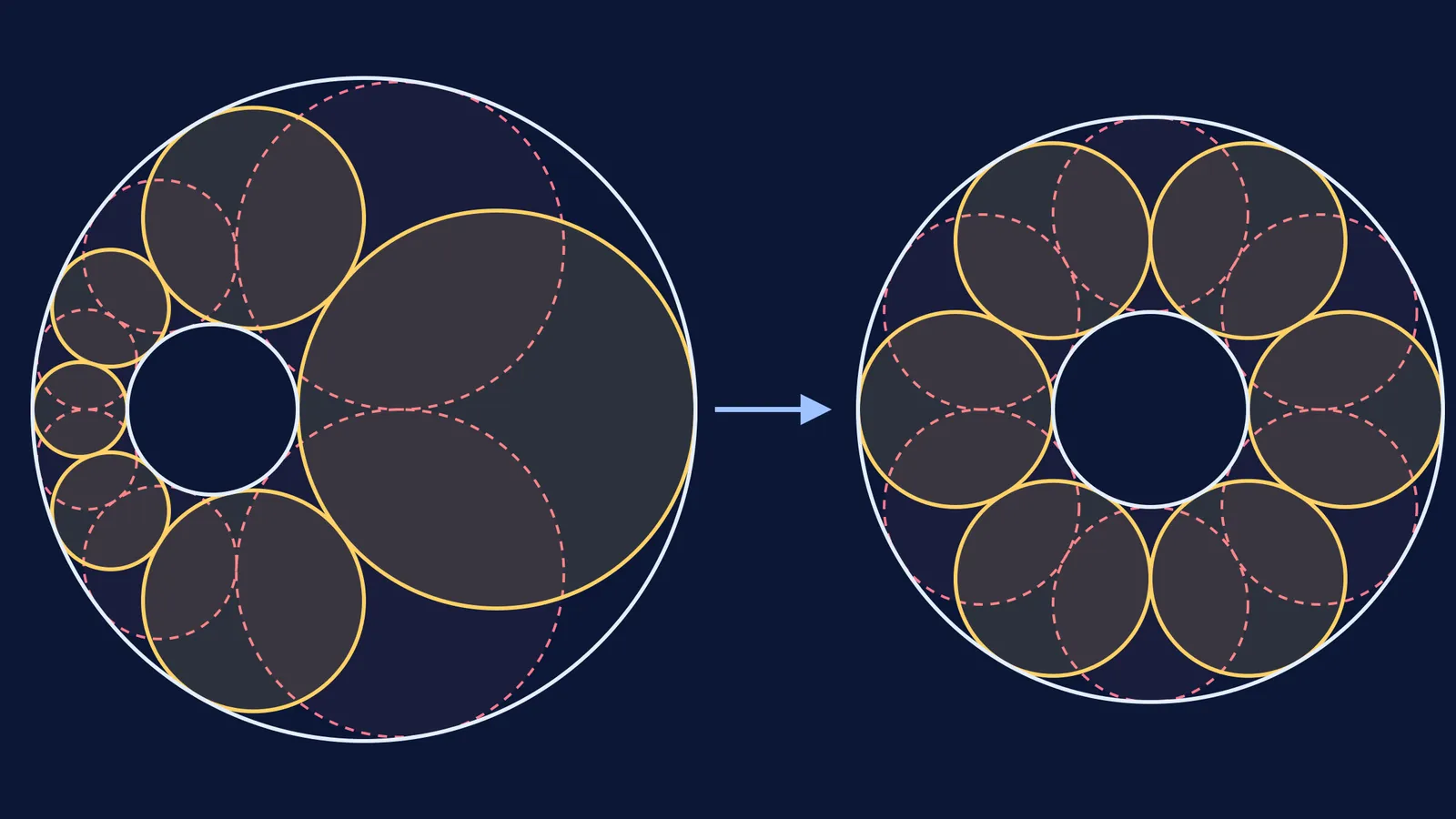
Take two circles, one inside the other. From a point on the outer circle, draw a tangent to the inner circle until it meets the outer circle again, then draw the next tangent, and keep going. Usually the zigzag never closes. When it does, something surprising follows.
What is Poncelet's porism?
Poncelet's porism says that if an n-sided polygon inscribed in one conic and circumscribed about another closes for one starting point, it closes for every starting point (MathWorld, Poncelet's porism). Jean-Victor Poncelet wrote about it in 1822 in his treatise on the projective properties of figures (Wikipedia, Poncelet's closure theorem). If one such polygon exists there are infinitely many, and every point of the outer conic is a vertex of one of them.
"Inscribed" means the vertices sit on the outer conic; "circumscribed about" means every side touches the inner one. So you never get exactly one closed triangle between two circles: either none, or a whole family that turns round the gap.
Why does the polygon close from every starting point?
Carl Jacobi applied elliptic functions to the problem in an 1828 paper listed by MathWorld. The modern proof on Wikipedia pairs each point on the outer conic with a tangent point on the inner one. These pairs form an elliptic curve, and one step of the zigzag acts on that curve as a translation: it shifts every point by the same amount.
The intuition: walk round a circular track in steps of fixed length. If n steps bring you back once, they make a whole number of laps, so they bring you back from any start. On the circles the arcs between vertices are unequal; on the elliptic curve the steps are equal.
When does a triangle fit between two circles?
For triangles there is a clean test. If the outer circle has radius R, the inner one radius r, and their centres are d apart, triangles close exactly when d² = R² − 2Rr (MathWorld, Poncelet's porism). In every triangle the distance d between the circumcentre and the incentre satisfies d² = R(R − 2r), the same equation, which MathWorld's Euler triangle formula page calls the simplest case of Poncelet's porism.
William Chapple published this result in 1746 and Leonhard Euler in 1765 (Wikipedia, Euler's theorem in geometry). Since d² cannot be negative, it gives Euler's inequality R ≥ 2r, with equality only for the equilateral triangle.
So the circumcircle and incircle of any triangle carry infinitely many other triangles with the same two circles.
How can you check the porism by hand?
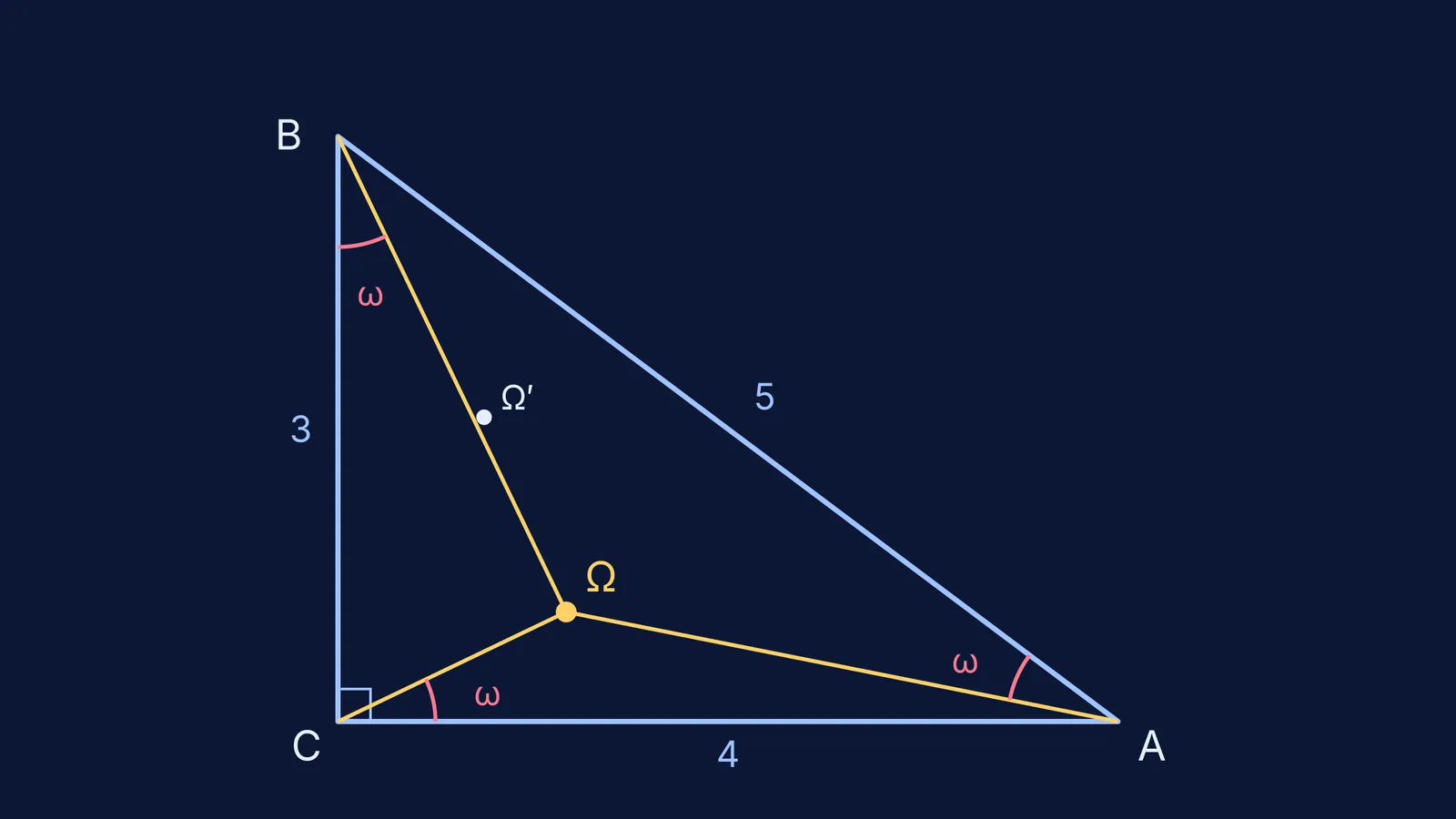
Start with a triangle you know. The 3-4-5 right triangle has R = 2.5 (half the hypotenuse) and r = 1 (area 6 over semi-perimeter 6). With vertices (0, 0), (4, 0) and (0, 3), the circumcentre is (2, 1.5), the midpoint of the hypotenuse, and the incentre is (1, 1). So d² = 1² + 0.5² = 1.25, and R² − 2Rr = 6.25 − 5 = 1.25. They match.
Now test "every starting point" on circles you choose. Take R = 5 and r = 2, so d² = 25 − 20 = 5. Put the outer centre at the origin and the inner centre I at (√5, 0).
Start at P = (−5, 0). Its distance to I is 5 + √5, so each tangent from P makes an angle b with the x-axis where sin b = 2/(5 + √5).
A chord from P at angle b to the diameter has length 10 cos b, so it ends at x = −5 + 10 cos² b = 5 − 40/(30 + 10√5).
Simplify: 40/(30 + 10√5) = 4/(3 + √5) = 3 − √5, so x = 2 + √5. By symmetry the other two vertices are (2 + √5, ±√(16 − 4√5)).
The third side is the vertical line x = 2 + √5. Its distance from I is (2 + √5) − √5 = 2, exactly r. The triangle closes.
From the top point (0, 5), a calculator gives vertices near (5.00, 0.09) and (0.47, −4.98), and the third side again lies 2.00 from I. Move the inner circle to d = 2.5 and no start closes.
What should you take away for exam geometry?
You won't need to prove Poncelet's theorem, but d² = R(R − 2r) is a fast check whenever a problem gives a triangle's circumradius and inradius, and R ≥ 2r catches impossible data at once. The habit worth keeping is step 4: when a claim says "always", test one case exactly, then one case that breaks the condition.
If circumcentres, incentres or tangents from an external point still feel shaky, the Fermi Concept Library covers every concept in mathematics, and the Fermi Problem Library has a step-by-step solver that explains the reasoning.
For more triangle and circle geometry, read what barycentric coordinates say about points in a triangle, the condition for two circles to touch and conic sections key terms for Class 11.