On this page
Suppose a class of 7 students forms committees of 3, with one rule: any two committees must share at least one member. How many committees can there be? The Erdős–Ko–Rado theorem answers this, and one proof of it fits in a few lines.
What does the Erdős–Ko–Rado theorem say?
A family of sets is intersecting if every two sets in it have at least one element in common.
The theorem: if n ≥ 2k, an intersecting family of k-element subsets of {1, …, n} has at most C(n − 1, k − 1) sets, as stated in the Wikipedia summary of the theorem.
Paul Erdős, Chao Ko and Richard Rado proved it in 1938 but published it only in 1961, in the paper Intersection theorems for systems of finite sets in the Quarterly Journal of Mathematics.
For the committee question, n = 7 and k = 3, so the answer is C(6, 2) = 15 committees.
What is the star family, and why does it have C(n − 1, k − 1) sets?
The simplest intersecting family is a star: fix one element, say 1, and take every k-set that contains it. Any two meet at 1. Each set picks its other k − 1 elements from the remaining n − 1, giving C(n − 1, k − 1) sets, exactly the bound.
Worked example with n = 5, k = 2: the star at 1 is {1,2}, {1,3}, {1,4}, {1,5}. That is 4 sets out of the C(5, 2) = 10 pairs, and the theorem says you cannot do better.
When n > 2k, stars are the only largest families, per the same article. When n = 2k there are others: for n = 4, k = 2, the family {2,3}, {2,4}, {3,4} matches the bound with no common element.
Why does the theorem need n ≥ 2k?
If n < 2k, two disjoint k-sets would need 2k different elements, and only n exist. So every k-set meets every other, and the largest intersecting family is all C(n, k) sets.
Try n = 5, k = 3: all 10 three-element subsets meet each other, more than the star's C(4, 2) = 6.
The boundary case n = 2k is a good check. Each k-set is disjoint from exactly one other k-set, its complement, so you can keep at most one from each complementary pair: C(2k, k)/2 sets. A line of algebra shows this equals C(2k − 1, k − 1), the star size again.
How does Katona's circle proof work?
Gyula Katona published a two-page proof in 1972, A simple proof of the Erdös–Chao Ko–Rado theorem90054-8) in the Journal of Combinatorial Theory, Series B. It is double counting, the same tool behind counting with a bijection.
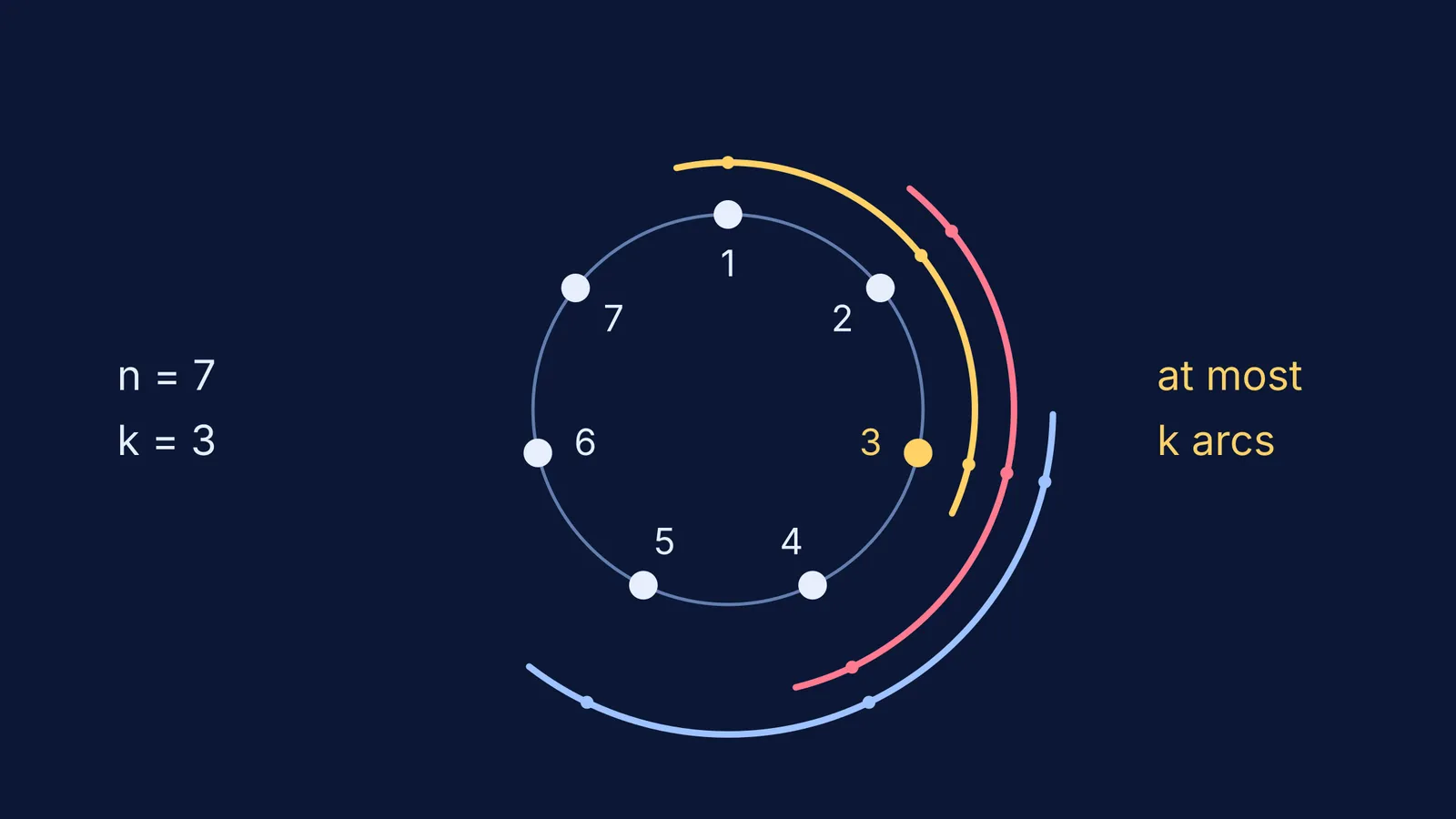
Arrange 1, …, n around a circle in some order. An arc is a block of k neighbours on that circle. There are n arcs.
Key lemma: if n ≥ 2k, an intersecting family contains at most k of these arcs.
Count pairs (circular order, set of the family that is an arc in that order) in two ways.
Why the lemma holds: suppose arc A = a₁, …, aₖ is in the family. Any other arc meeting A either ends at some aᵢ or starts at aᵢ₊₁, for i from 1 to k − 1. Pair those two arcs at each of the k − 1 gaps. Together they cover 2k neighbouring positions, so when n ≥ 2k they are disjoint and the family holds at most one of each pair. That gives at most 1 + (k − 1) = k arcs.
Now the count, with n = 7 and k = 3:
There are (n − 1)! = 720 circular orders of 7 elements.
Each order contributes at most k = 3 arcs, so the total is at most 2,160.
A fixed 3-set is an arc in k!(n − k)! = 6 × 24 = 144 of the orders (glue it into a block, arrange the block and the other 4 around the circle, order inside the block).
So 144 times the family size is at most 2,160, and the family has at most 15 sets.
In general the same steps give k(n − 1)!/(k!(n − k)!) = C(n − 1, k − 1).
How can you practise this idea?
Try these:
For n = 6, k = 2, the largest intersecting family has C(5, 1) = 5 pairs, a star. Find 3 pairs that pairwise meet but lie in no star.
Draw 7 points on a circle, pick one arc of length 3, and confirm at most 2 other arcs can join it.
Neighbouring results: Hall's marriage theorem on when matchings exist and Dilworth's theorem on chains and antichains.
If the binomial coefficients felt shaky, the Fermi Concept Library covers each mathematics concept, and the Fermi Problem Library has a step-by-step solver that explains the reasoning, so you can see where a count went wrong.