

On this page
Most triangle centres you meet in school come from symmetric rules: three medians, three bisectors, three altitudes. The Brocard points come from a rule that turns one way around the triangle, and the answer is still a single point.
What are the Brocard points of a triangle?
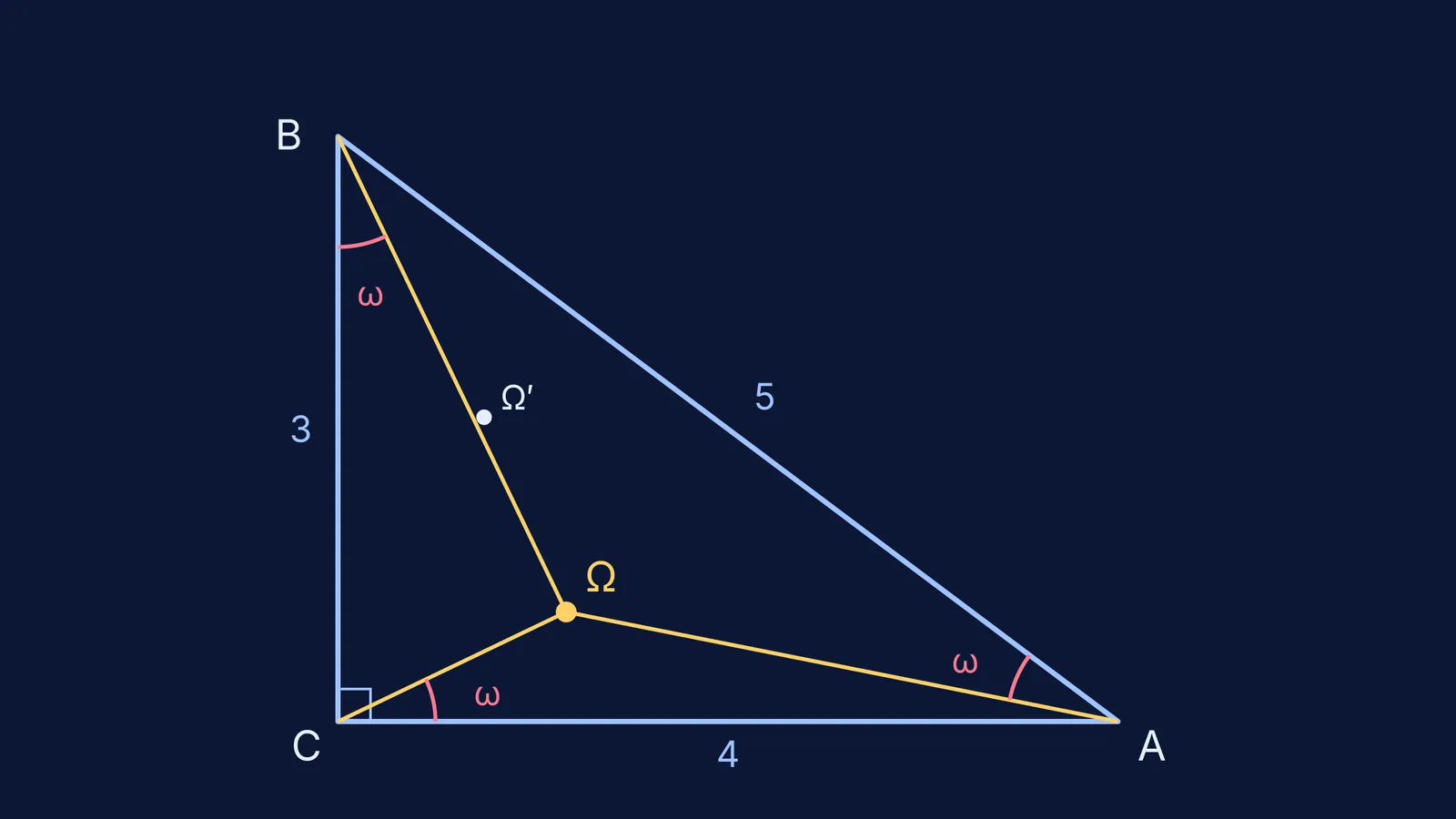
In every triangle ABC there is exactly one point Ω with ∠ΩAB = ∠ΩBC = ∠ΩCA, called the first Brocard point, and the common angle ω is the Brocard angle (Wikipedia: Brocard points).
To picture it, stand at A and turn the side AB inward by ω. Do the same at B with BC, and at C with CA. For exactly one value of ω, the three turned lines meet at one point, and that point is Ω.
Go round the other way, asking for ∠Ω′AC = ∠Ω′CB = ∠Ω′BA, and you get the second Brocard point Ω′, with the same angle ω (same source).
Wolfram MathWorld says the points were described by the French army officer Henri Brocard in 1875, although Jacobi and, in 1816, Crelle had investigated them earlier (MathWorld: Brocard points).
The two points are isogonal conjugates: reflect the lines AΩ, BΩ and CΩ in the angle bisectors at A, B and C, and the reflected lines meet at Ω′ (MathWorld: Brocard points). This is the same reflection that turns a median into a symmedian, explained in what a symmedian is and how isogonal conjugates work. Ω and Ω′ are also the same distance from the circumcentre (Wikipedia: Brocard points).
How do you find the Brocard angle?
The Brocard angle satisfies cot ω = cot A + cot B + cot C (MathWorld: Brocard angle).
The same page gives the version in terms of side lengths, cot ω = (a² + b² + c²)/(4Δ), where Δ is the area. The two versions match because each cotangent can be written with sides. The cosine rule gives cos A = (b² + c² − a²)/(2bc). The area formula gives sin A = 2Δ/(bc). Divide one by the other:
cot A = (b² + c² − a²)/(4Δ)
cot B = (c² + a² − b²)/(4Δ)
cot C = (a² + b² − c²)/(4Δ)
Add the three and every term with a minus sign cancels, leaving (a² + b² + c²)/(4Δ).
Why is the Brocard angle never more than 30°?
MathWorld states that the largest Brocard angle any triangle can have is 30° (MathWorld: Brocard angle). You can prove it in two lines.
Weitzenböck's inequality says a² + b² + c² ≥ 4√3·Δ for every triangle, with equality only when the triangle is equilateral (Wikipedia: Weitzenböck's inequality). Divide both sides by 4Δ to get cot ω ≥ √3 = cot 30°. Cot gets smaller as the angle grows from 0° to 90°, so ω ≤ 30°.
For an equilateral triangle, each angle is 60° and cot 60° = 1/√3, so cot ω = 3/√3 = √3 and ω is exactly 30°. Ω and Ω′ then both sit at the centre, because the line from a vertex to the centre bisects the 60° angle there.
Worked example: the Brocard point of a 3-4-5 triangle
Take the right triangle with BC = a = 3, CA = b = 4, AB = c = 5 and the right angle at C. Its area is 6, so it has integer sides and integer area, the kind covered in which triangles have integer sides and integer area.
Cotangents. Angle A faces the side of length 3, so cot A = 4/3. Angle B faces the side of length 4, so cot B = 3/4. The right angle gives cot C = 0.
Add: cot ω = 4/3 + 3/4 = 25/12.
Check with the sides: (9 + 16 + 25)/(4 × 6) = 50/24 = 25/12. The two answers match.
So tan ω = 12/25 = 0.48 and ω ≈ 25.64°, below the 30° limit.
Find Ω. Put C at (0, 0), A at (4, 0) and B at (0, 3). The first Brocard point has barycentric weights c²a² : a²b² : b²c² for A, B and C (Wikipedia: Brocard points), which here is 225 : 144 : 400, totalling 769. That gives Ω = (900/769, 432/769) ≈ (1.170, 0.562). If weighted averages of vertices are new to you, read how barycentric coordinates turn points into weighted averages.
Check one angle. At C the side CA lies along the x-axis, so tan ∠ΩCA = (432/769)/(900/769) = 432/900 = 12/25, which matches step 4.
How should you practise problems like this?
Write cot ω both ways from memory and derive the side version once yourself.
Prove ω ≤ 30° without notes, saying where equality holds.
Repeat the worked example on a 5-12-13 triangle and check one angle with coordinates.
Find Ω′ for the 3-4-5 triangle by swapping the weights to a²b² : b²c² : c²a².
If the cotangent identities or the cosine rule feel shaky, the Fermi Concept Library gives every concept in mathematics its own lesson and shows where it fits on the map. When your answer to a practice problem doesn't match, the Fermi Problem Library has a step-by-step solver that explains the reasoning rather than printing an answer, so you can find the step where you went wrong.


