

On this page
A Heronian triangle is a triangle whose three sides and area are all whole numbers, as defined in Wikipedia's article on Heronian triangles. The 3-4-5 right triangle, with area 6, is the simplest; many others, such as 5-5-6, have no right angle at all.
Which triangles have integer sides and integer area?
Start with Heron's formula. For sides a, b, c and semi-perimeter s = (a + b + c)/2, the area is √(s(s − a)(s − b)(s − c)), as MathWorld's entry on Heron's formula states. MathWorld places Heron's proof in his book Metrica, dated to about 100 BC to 100 AD.
So a triangle with whole-number sides has a whole-number area exactly when s(s − a)(s − b)(s − c) is a perfect square. MathWorld's Heronian triangle page lists the first ones that pass, ordered by longest side: 3-4-5, 5-5-6, 5-5-8, 6-8-10, 10-10-12, 5-12-13, 10-13-13, 9-12-15, 4-13-15 and 13-14-15. Their shortest sides, continued much further, form sequence A055594 in the OEIS.
The area of a Heronian triangle is always divisible by 6, according to the Wikipedia article. Check the first few: 6, 12, 12, 24, 48, 30.
How do you glue two Pythagorean triangles into a Heronian triangle?
Take two integer right triangles that share a leg and stand them back to back on it. The shared leg becomes the height, the other legs join into the base, and the area is half base times height.
The simplest case glues a 3-4-5 triangle to its mirror image. Joining along the 4 gives 5-5-6, and joining along the 3 gives 5-5-8. Both have area 12, as the Wikipedia article shows.
Two different triangles also work:
Take 6-8-10 and 8-15-17. They share the leg 8.
Put them side by side. The base is 6 + 15 = 21 and the slanted sides are 10 and 17, so the area is ½ × 21 × 8 = 84.
Now overlap them instead. The base is 15 − 6 = 9, giving the obtuse triangle 9-10-17 with area ½ × 9 × 8 = 36.
Heron's formula agrees. For 10-17-21, s = 24 and 24 × 14 × 7 × 3 = 7056 = 84². For 9-10-17, s = 18 and 18 × 9 × 8 × 1 = 1296 = 36².
Gluing does not reach every Heronian triangle. The Wikipedia article gives 5-29-30, with area 72, as one that cannot be split into two integer right triangles, though every Heronian triangle is similar to one that can.
Why is the 13-14-15 triangle famous?
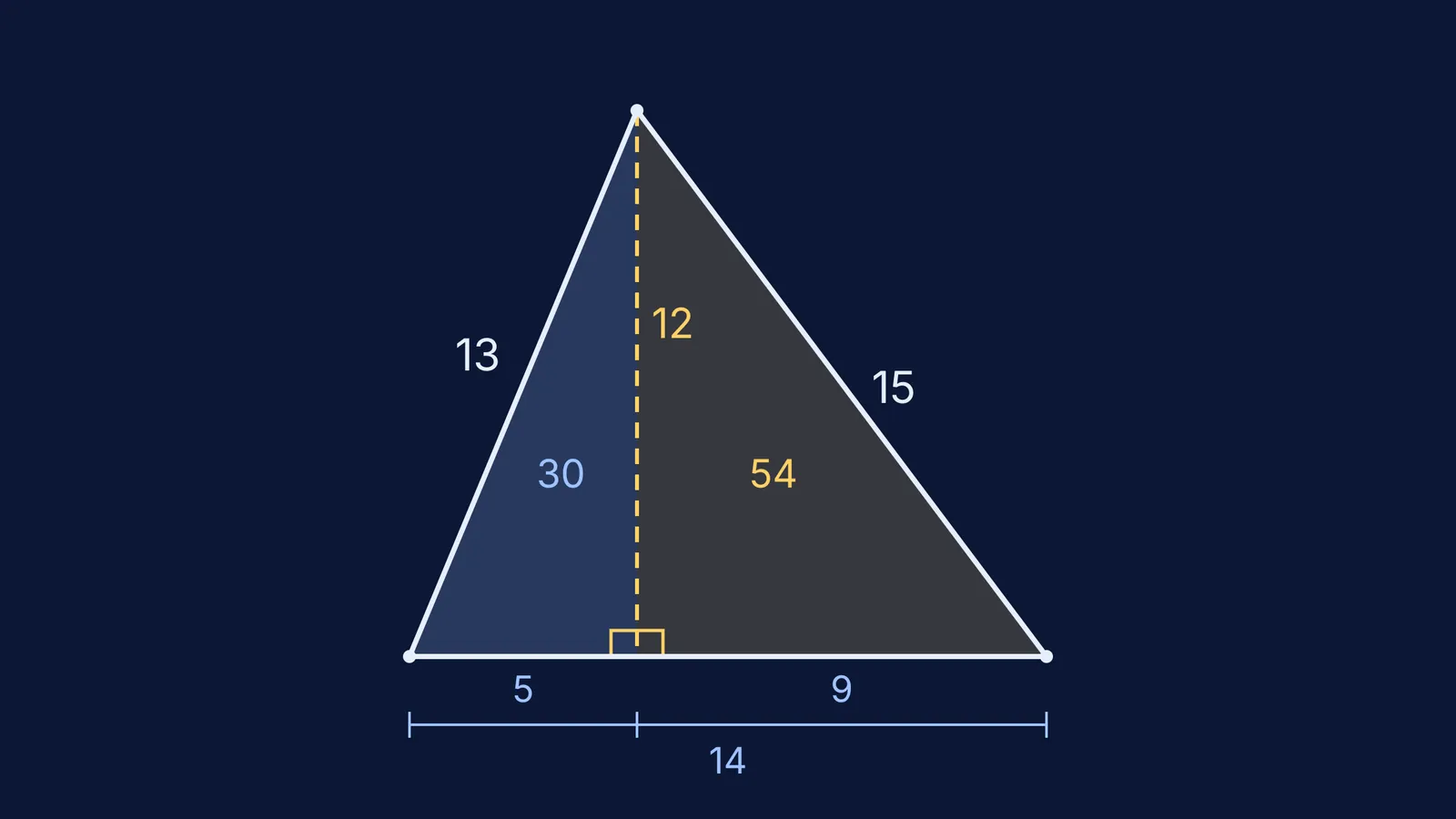
Heron used it to demonstrate his formula, with area 84, according to the Wikipedia article. The same article lists the "almost equilateral" Heronian triangles, whose sides are consecutive whole numbers; 13-14-15 is the next after 3-4-5.
Check it: s = 21, and 21 × 8 × 7 × 6 = 7056 = 84². Now see it as a gluing. The height onto the side 14 has length 12 and lands 5 from one end and 9 from the other, splitting the triangle into 5-12-13 and 9-12-15, as the picture at the top shows.
Why must the semi-perimeter s be an integer?
Square Heron's formula and multiply by 16:
16 × Area² = (a + b + c)(−a + b + c)(a − b + c)(a + b − c)
Each of the last three brackets is the perimeter minus twice one side, so all four brackets are even or all four are odd. If the perimeter were odd, the right side would be a product of four odd numbers, which is odd. The left side is 16 times a whole number, which is even. Both cannot be true, so the perimeter is even and s is a whole number.
How do you test a triangle for integer area?
Add the sides. If the perimeter is odd, it is not Heronian: 6-7-8 has perimeter 21.
Halve the perimeter to get s, then write down s − a, s − b and s − c.
Factorise the four numbers instead of multiplying them out.
If every prime appears an even number of times, the area is the square root. If not, the triangle is not Heronian.
Try 7-8-9: s = 12, and 12 × 5 × 4 × 3 = 2⁴ × 3² × 5. The lone 5 means the area, √720, is not a whole number.
Related reading: the area of a triangle as ½ab sin C, the Baudhayana-Pythagoras theorem and Pick's theorem on a dot grid.
When you practise, the Fermi Problem Library has worked problems with a step-by-step solver that explains the reasoning rather than printing an answer, so you can see which step went wrong.
Pick two Pythagorean triples that share a leg, glue them, and check your triangle with the four steps above.


