On this page
A slanted shape on dot paper is awkward to measure with base and height. Pick's theorem turns it into a counting job. Below, we move one corner at a time so you can predict each new area before checking it.
What is Pick's theorem?
For a simple polygon (one whose outline does not cross itself) with every vertex on a grid point, the area is A = I + B/2 − 1, where I is the number of grid points strictly inside and B is the number of grid points on the boundary (Wolfram MathWorld). Georg Pick first described the result in 1899, in the proceedings of the "Lotos" society in Prague (Wikipedia: Pick's theorem). The answer is in grid squares. His story: Georg Pick and the formula for lattice polygon area.
How do you count inside and boundary dots?
I (inside): dots fully inside. A dot touching an edge is not inside.
B (boundary): every dot the outline passes through, corners included.
Shortcut for slanted edges: a segment from the origin to the point (a, b) passes through exactly gcd(a, b) + 1 grid points, counting both ends (Breuer, arXiv, section 10).
So for each edge, take the gcd of its horizontal and vertical steps; B is the sum of those gcds around the shape (Math Club handout, PDF). The edge from (4, 0) to (6, 4) has steps 2 and 4, gcd 2, so it passes through (4, 0), (5, 2) and (6, 4).
Worked example: what happens when you move one vertex?
Put (0, 0) at the bottom left of your dot paper.
Start: the rectangle (0, 0), (4, 0), (4, 3), (0, 3). B = 4 + 3 + 4 + 3 = 14 and I = 6, so A = 6 + 7 − 1 = 12, the same as 4 × 3.
Move (4, 3) to (5, 3). The dots (4, 1) and (4, 2) leave the boundary and become inside, so I = 8. B = 4 + 1 + 5 + 3 = 13. A = 8 + 6.5 − 1 = 13.5, matching the trapezium formula (4 + 5) ÷ 2 × 3.
Move (5, 3) to (6, 4). Edge gcds are 4, 2, 1 and 3, so B = 10. Rows y = 1, 2, 3 hold 4, 4 and 5 inside dots, so I = 13 and A = 13 + 5 − 1 = 17.
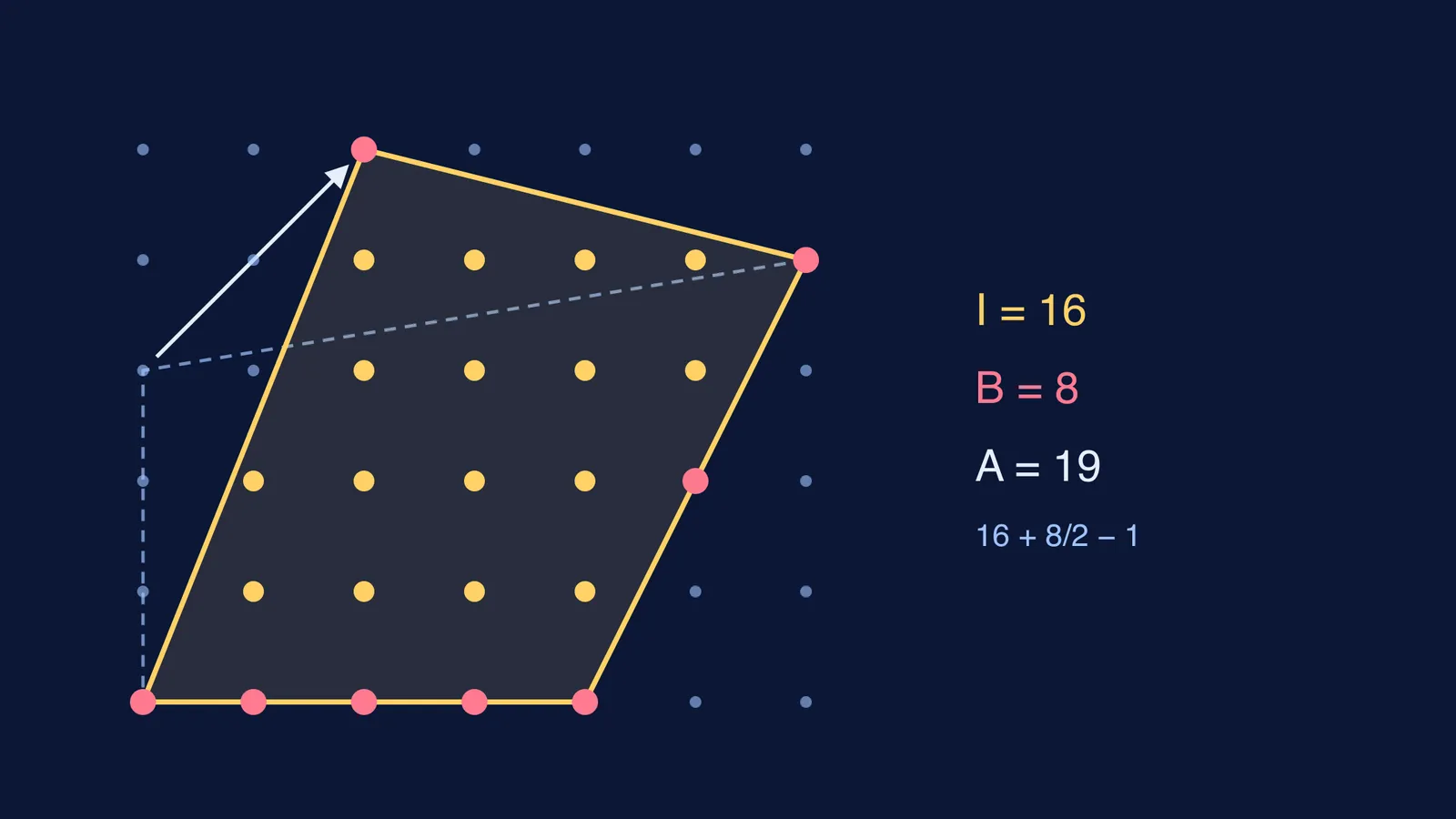
Move (0, 3) to (2, 5). Edge gcds are 4, 2, 1 and 1, so B = 8. Rows y = 1 to 4 hold 4 inside dots each, so I = 16 and A = 16 + 4 − 1 = 19, which the shoelace method for polygon area from coordinates confirms.
In step 2, I rose by 2 and B fell by 1, so the area grew by 2 − 0.5 = 1.5: exactly the thin triangle the move added. Each inside dot is worth 1; each boundary dot, a half.
A triangle with three grid-point corners and no other grid points on or inside it has area exactly 1/2 (Wikipedia: Pick's theorem).
When does Pick's theorem not work?
A corner is off the dots, such as (1.5, 2).
The shape has holes. For a polygon with h holes, each bounded by its own grid polygon and not touching the others or the outer edge, the area is A = I + B/2 + h − 1 (Wikipedia: Pick's theorem).
The outline crosses itself, like a bow tie. Split it into simple pieces first.
For curved shapes, go back to estimating area by counting squares.
Practice grids
Draw each shape, count I and B, then predict the area. Shapes 1, 2 and 4 come from a Math Club handout on Pick's theorem (Math Club handout, PDF).
Triangle (0, 0), (6, 0), (0, 2).
Quadrilateral (0, 0), (4, 0), (5, 2), (1, 3).
Shape 2 with (1, 3) moved to (1, 4). Does the area grow by more or less than 3?
The L-shape (0, 0), (5, 0), (5, 3), (3, 3), (3, 1), (0, 1).
Answers (checked by the shoelace method):
B = 10, I = 2, A = 6.
B = 7, I = 8, A = 10.5.
B = 8, I = 10, A = 13, so the area grows by 2.5.
B = 16, I = 2, A = 9.
The Fermi Simulation Lab has interactive simulations for ideas that are easier to see than to read. If you keep getting a different answer from the book, the Fermi Problem Library has worked problems with a step-by-step solver that explains the reasoning.
Tonight, draw one shape, move one corner three times, and predict each area before you count.