

On this page
A lattice polygon has all its vertices on the points of an integer grid. Standard coordinate methods require dividing the shape into triangles or computing matrices, as seen in finding the area of a triangle using determinants.
In 1899, Austrian mathematician Georg Alexander Pick published "Geometrisches zur Zahlenlehre" in *Sitzungsberichte des deutschen naturwissenschaftlich-medicinischen Vereines für Böhmen "Lotos" in Prag* (vol. 19, pp. 311–319). He proved that the exact area requires only counting grid points:
Interior points strictly inside the perimeter (I)
Boundary points lying on edges and vertices (B)
Pick's theorem states that the area A of any simple lattice polygon equals interior points plus half the boundary points minus one: A = I + B/2 − 1
The theorem holds for any simple polygon with non-intersecting edges and no holes, turning continuous area into discrete counting.
How did Georg Pick discover the formula in 1899?
Georg Alexander Pick entered the University of Vienna at 16, published his first paper at 17, and earned his doctorate in 1880 under Leo Königsberger, as detailed in his MacTutor biography. After assisting physicist Ernst Mach, he became professor of mathematics at the German University in Prague in 1892.
In 1911, Pick chaired the committee that brought Albert Einstein to Prague as professor of theoretical physics. The two became close friends and played violin duets together. Pick introduced Einstein to the absolute differential calculus of Gregorio Ricci-Curbastro and Tullio Levi-Civita, providing the mathematical framework Einstein used for general relativity.
Pick published 67 papers across complex analysis and differential geometry, including the Schwarz-Pick lemma. Yet his 1899 grid paper lay obscure for 51 years until Hugo Steinhaus featured it in his 1950 book *Mathematical Snapshots* (Oxford University Press, pp. 76–77). Pick's life ended in tragedy: deported in July 1942 after the Nazi annexation, he died two weeks later at age 82 in Theresienstadt concentration camp.
Why does counting grid points give the exact area?
Pick's theorem relies on primitive triangles: grid-vertex triangles with no other boundary points (B = 3) and no interior points (I = 0). Every primitive triangle has an area of exactly 1/2. Any simple lattice polygon can be triangulated into T such triangles. In "Pick's Theorem Revisited", Dale E. Varberg showed that the formula's additivity ensures that combining adjacent lattice polygons preserves the relationship.
Summing the angles across all T triangles explains the formula:
Every triangle's angles sum to 180° (π radians), giving a total of T × π.
Around each of the I interior points, angles meet in full 360° circles, contributing 2π × I.
At the B − n boundary points along edges, angles sum to 180°, contributing π × (B − n), where n is vertex count.
The polygon's n interior vertex angles sum to (n − 2) × π.
Equating these gives T × π = 2π × I + π × (B − n) + π × (n − 2), which simplifies to T = 2I + B − 2. Since each primitive triangle has area 1/2, the total area is A = T / 2 = I + B/2 − 1.
This angle sum proves why an equilateral triangle can never exist on a square grid. Its area is (√3 / 4) × s², which is irrational because s² is an integer by Pythagoras' theorem. But Pick's theorem requires lattice polygon area to be a rational multiple of 1/2. Like cellular patterns on a discrete grid, discrete lattices enforce strict structural rules.
How do you apply Pick's theorem to complex shapes?
To find boundary points along any line segment between integer points (x₁, y₁) and (x₂, y₂), take the greatest common divisor gcd(|x₂ − x₁|, |y₂ − y₁|).
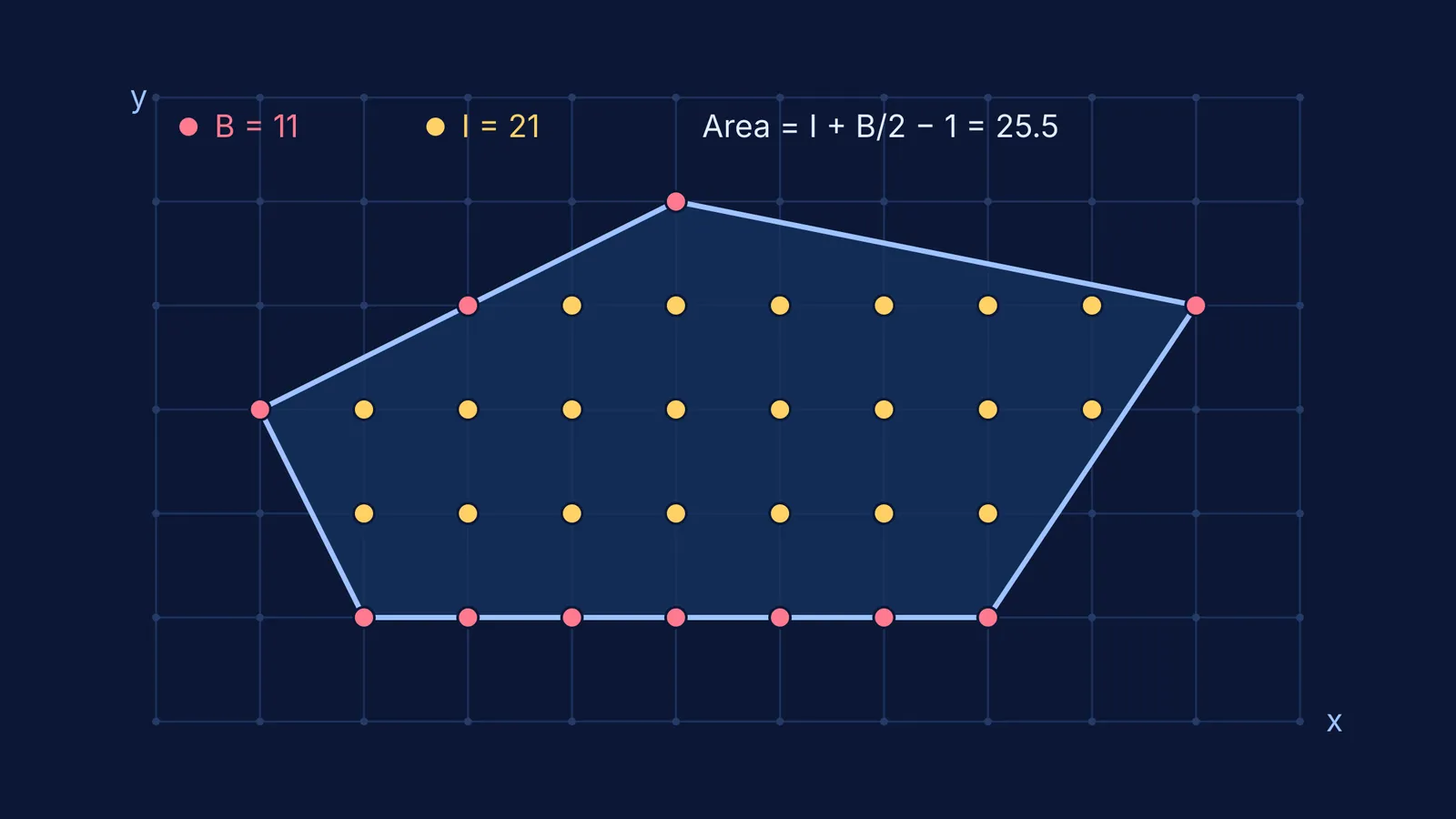
Consider a lattice pentagon with vertices (2, 1), (8, 1), (10, 4), (5, 5), and (1, 3):
Find boundary points (B): The five edges give gcd(6, 0) = 6, gcd(2, 3) = 1, gcd(5, 1) = 1, gcd(4, 2) = 2, and gcd(1, 2) = 1, giving B = 11.
Find interior points (I): Scanning rows reveals 7 points at y = 2, 8 at y = 3, and 6 at y = 4, giving I = 21.
Calculate area: A = 21 + 11/2 − 1 = 25.5.
If a polygon contains h internal holes, Pick's formula generalizes to A = I + B/2 + h − 1. You can confirm edge alignments first by checking collinear points with vectors.
When students tackle coordinate geometry or verify calculations under exam pressure, the Fermi Problem Library offers worked problems with a step-by-step solver that explains the reasoning rather than printing an answer. For concepts easier to see than to read, the Fermi Simulation Lab provides interactive simulations for learning, helping students explore coordinate grids directly.
Why does Pick's theorem fail in three dimensions?
In 1957, mathematician John E. Reeve published "On the Volume of Lattice Polyhedra" in the *Proceedings of the London Mathematical Society*, proving that Pick's theorem has no direct 3D analogue. Reeve constructed tetrahedra with vertices at (0, 0, 0), (1, 0, 0), (0, 1, 0), and (1, 1, r) for any positive integer r.
For every integer r ≥ 1:
The tetrahedron has zero interior points (I = 0).
Its only boundary points are its 4 vertices (B = 4).
Its volume is r / 6.
Because the volume increases with r while point counts remain identical, volume cannot depend solely on lattice points. This counterexample inspired Eugène Ehrhart's theory of Ehrhart polynomials in the 1960s. On a flat grid, however, Pick's 1899 theorem remains an elegant, reliable shortcut.


