

On this page
When you need the area of a rectangle, you multiply its length by its breadth. For a triangle, you use half the base times the height. But how do you find the area of a leaf, a puddle, or a handprint?
For irregular shapes, standard formulas fail. Instead, we use a grid. By placing the shape on squared paper and counting the squares it covers, you can estimate its area with surprising accuracy. It is a practical method introduced in Class 6 that builds the foundation for more advanced calculus, such as finding the area under curves.
If you are working through these geometry problems and need a hand, the Fermi Concept Library is a great place to start. Fermi's AI tutor teaches through the problem, drawing the figure so you can see exactly which squares to count and which to ignore.
How do you find the area of a shape by counting squares?
To use this method, you need to draw or trace your shape onto a grid where each square represents one square unit (for example, 1 cm²). Because the boundary of an irregular shape will cut through many squares, you cannot simply count every square it touches.
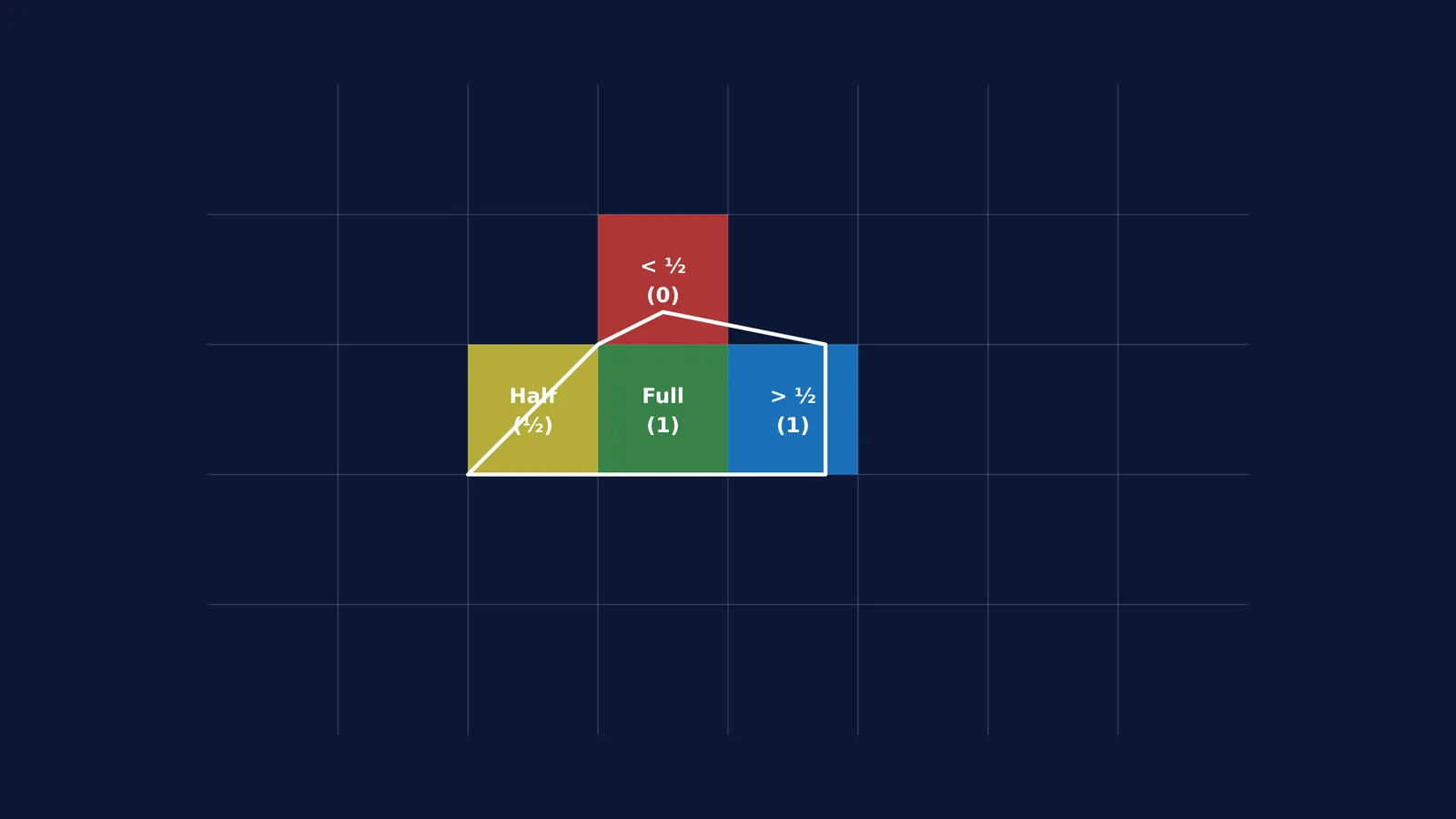
The CBSE Class 6 mathematics syllabus dedicates Chapter 10 to Mensuration, where these standard rules for counting are taught (NCERT). The four conventions are:
Full squares: Count every fully covered square as 1 square unit.
More-than-half squares: If a square is more than half-filled by the shape, count it as 1 full square unit.
Half squares: If a square is exactly half-filled, count it as ½ square unit.
Less-than-half squares: If a square is less than half-filled, ignore it (count as 0).
Why ignore the small slivers? By counting the more-than-half squares as full ones and dropping the less-than-half ones, the overestimates and underestimates roughly cancel each other out, leaving you with a highly accurate total.
How do you calculate the final area from your counted squares?
Imagine you trace a leaf onto a 1 cm grid and count the squares it covers. You might find:
14 fully-filled squares
6 more-than-half squares
2 exactly half-filled squares
5 less-than-half squares
Here is how you apply the rules to find the total area:
Full squares: 14 × 1 = 14
More-than-half: 6 × 1 = 6
Half-filled: 2 × ½ = 1
Less-than-half: 5 × 0 = 0
The total area is 14 + 6 + 1 + 0 = 21 square units.
What is Pick's theorem and how does it find grid area?
Counting squares is an estimation tool for curves, but if your shape is a polygon whose corners all land perfectly on grid intersections (a lattice polygon), you can calculate its exact area without estimating.
This is done using Pick's theorem. The theorem was first described by the Austrian mathematician Georg Alexander Pick in 1899 (Wikipedia). Instead of judging whether squares are half-full, Pick's theorem counts the intersections (points) on the grid:
Area = I + (B / 2) − 1
Here, *I* is the number of grid points strictly inside the shape, and *B* is the number of grid points on the boundary. If you draw a polygon with 5 points inside and 4 points on its boundary, its area is 5 + (4 / 2) − 1 = 6 square units.
Why is counting squares taught before area formulas?
The counting method is often a student's first real encounter with measuring 2D space. Before moving on to formulas like perimeter and area in Class 6 or the more complex rules for area in Class 8, counting squares builds an intuitive sense of what area actually means. It teaches that area is simply the amount of flat space enclosed by a boundary.
The next time you are faced with a strange shape, grab some graph paper. You don't always need a formula to find the answer.


