

On this page
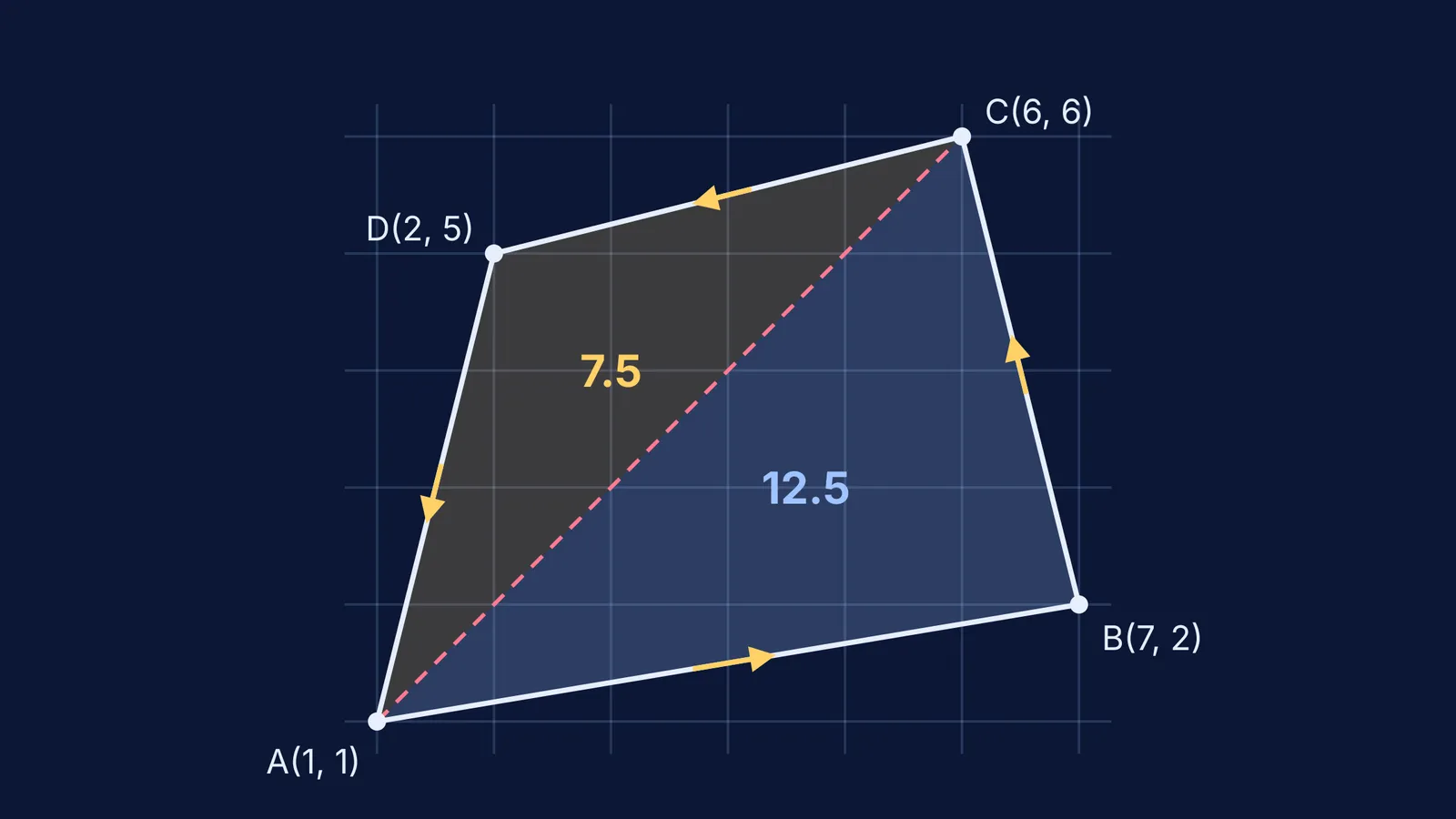
You have four points, say A(1, 1), B(7, 2), C(6, 6) and D(2, 5), and a question asking for the area of quadrilateral ABCD. The shoelace formula handles this in a few lines, and works for any polygon. The one thing it needs from you is the vertices in the right order.
What is the shoelace formula?
The shoelace formula gives the area of a polygon from the coordinates of its vertices. Wolfram MathWorld's Polygon Area page writes it as A = ½ Σ (x_i y_(i+1) − x_(i+1) y_i), where the last vertex wraps round to the first, for a "planar non-self-intersecting polygon", meaning a flat shape whose sides do not cross. That version is a signed area; its absolute value is the area, whichever way round you went.
The name comes from how the working looks. Write the coordinates in a column, repeat the first point at the bottom, and the cross-multiplications zigzag down the list like laces through a shoe. Wikipedia's article on the shoelace formula says it was described by Albrecht Ludwig Friedrich Meister in 1769.
How do you find the area of a quadrilateral given coordinates of its vertices?
Here is the full working for A(1, 1), B(7, 2), C(6, 6), D(2, 5), taken counterclockwise.
List the points in order and repeat the first at the end: (1, 1), (7, 2), (6, 6), (2, 5), (1, 1).
For each neighbouring pair, work out x of the first times y of the second, minus x of the second times y of the first.
A to B: 1×2 − 7×1 = −5.
B to C: 7×6 − 6×2 = 30.
C to D: 6×5 − 2×6 = 18.
D to A: 2×1 − 1×5 = −3.
Add them: −5 + 30 + 18 − 3 = 40. Halve it and take the absolute value: the area is 20 square units.
Individual terms are often negative. Only the final total gets the absolute value.
Why does the order of the vertices matter?
The formula walks round the boundary in the order you give it. Go round the shape, clockwise or counterclockwise, and you get the true area, with a plus or minus sign depending on direction (Wikipedia). Jump across the shape and the path crosses itself, so you are no longer describing the shape you meant.
Try the same four points in the order A, C, B, D. The terms are 0, −30, 31 and −3, the total is −2, and the "area" comes out as 1 square unit instead of 20. The path A to C to B to D is a bow tie, and the formula has measured the bow tie, not your quadrilateral.
To get a safe order:
Sketch the points first, even roughly, and read them off going round the outside.
If the question names the shape ABCD, it usually means the vertices go in that order, but check with the sketch.
For a convex shape, sorting the points by angle around their average point always gives a correct order.
How can you check the answer by splitting into triangles?
Cut the quadrilateral along a diagonal and use the triangle version of the same formula: area = ½ |x1(y2 − y3) + x2(y3 − y1) + x3(y1 − y2)|. This is just the shoelace formula with three vertices.
Along diagonal AC:
Triangle ABC: 1(2 − 6) + 7(6 − 1) + 6(1 − 2) = 25, so the area is 12.5.
Triangle ACD: 1(6 − 5) + 6(5 − 1) + 2(1 − 6) = 15, so the area is 7.5.
Total: 12.5 + 7.5 = 20. It matches.
Along the other diagonal, BD, you get 11.5 for triangle ABD and 8.5 for triangle BCD, which again adds to 20. For a convex quadrilateral both diagonals lie inside, so either split works. If the shape is concave (one corner pushed inward), only one diagonal lies inside. Use that one. The other gives two overlapping triangles, and their sum is too big.
The idea of splitting a shape into pieces you already trust is the same one behind the diagonal-and-offsets method for quadrilaterals. If you want to know why each triangle piece works in the first place, see why the area of a triangle is half base times height.
Where else does this show up?
The method works the same way for pentagons, hexagons or any polygon whose sides do not cross: more rows in the list, same zigzag. For polygons whose corners all sit on grid points, there is a counting shortcut too, covered in our piece on Georg Pick and the formula for lattice polygon area. It makes a handy third check.
If you want more coordinate-area questions to practise on, the Fermi Problem Library has worked problems with a step-by-step solver that explains the reasoning rather than printing an answer, so you can see where a wrong vertex order throws the sum off. If the triangle formula or absolute values still feel shaky, the matching lessons are in the Fermi Concept Library.


